Nuku'alofa — Capital of Tonga
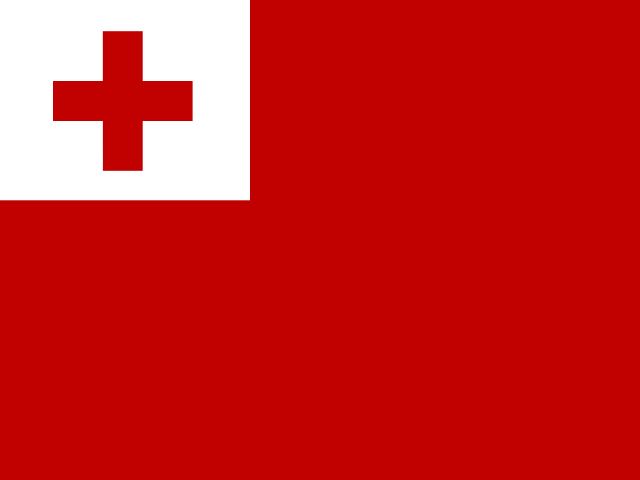
Nuku'alofa sits on the north coast of Tongatapu, Tonga's main island, and became the kingdom's capital as part of King George Tupou I's 19th-century unification and modernization of Tonga, formalized alongside the 1875 constitution that also fixed the national flag permanently — the same reform period that turned a collection of competing chiefdoms into a single centralized constitutional kingdom.
The name translates roughly to 'abode of love' in Tongan, and the town grew up around the royal palace complex, a wooden Victorian-style building constructed in 1867 that remains the official residence of the Tongan monarch and one of the most recognizable landmarks in the capital, standing prominently on the waterfront.
As the seat of the only remaining monarchy in the Pacific Islands, Nuku'alofa carries a level of royal ceremonial life unmatched by most Pacific capitals — coronations, royal funerals, and state occasions are centered on the Royal Palace and the nearby royal tombs (Mala'e Kula), and the city's civic rhythm is still shaped by the royal calendar in a way distinct from the more purely administrative capitals found elsewhere in the region.
Nuku'alofa experienced serious civil unrest in November 2006, when riots destroyed a significant portion of the central business district amid frustration over the slow pace of democratic reform and the concentration of economic power among a small elite; the riots led to a state of emergency and accelerated political reforms that expanded the elected component of Tonga's legislature in the years that followed.
The city and much of low-lying Tongatapu remain vulnerable to Pacific cyclones and, more unusually, to volcanic hazard from the Hunga Tonga–Hunga Haʻapai eruption of January 2022, an underwater volcanic explosion roughly 65 kilometers from Nuku'alofa that generated a tsunami reaching the capital's shoreline and coated the city in volcanic ash, in what was recorded as one of the most powerful volcanic eruptions anywhere in the world in decades.
Nuku'alofa is also a center of Tongan religious life, dominated by the large Free Wesleyan Church of Tonga's Centenary Church, whose congregation includes the royal family, and Methodism's outsized role in Tonga — a legacy of 19th-century missionary work that predates and helped shape the constitutional monarchy itself — is visible across the capital in the near-total shutdown of commerce and public activity that Tongan law still mandates every Sunday.
The Talamahu Market in the center of the capital remains the main hub for fresh produce, root crops, and woven pandanus handicrafts brought in from across Tongatapu and the outer island groups, and it functions as one of the clearest windows into everyday Tongan commercial life alongside the more formal government and diplomatic quarter surrounding the palace.
Tonga's location just west of the International Date Line has given Nuku'alofa an informal claim to being among the first capitals in the world to greet each new day, a point of local pride reflected in the national tourism slogan 'where time begins,' even though several other Pacific nations further east along the date line make similar claims of their own.
Quick facts
- Nuku'alofa's population is roughly 25,000 within the city proper, with a wider urban area of about 35,000 as of recent estimates.
- Tonga is the only Pacific Island nation never colonized by a foreign power, a status its rulers guarded partly through the 1875 constitution and partly through an agreement that kept the kingdom a British-protected state, not a colony, from 1900 to 1970.
- The 2006 unrest pushed Tonga toward its first general election with a fully elected majority of legislative seats in 2010, part of a broader reform that cut back the seats reserved for hereditary nobles.
- Ashfall from the 2022 eruption fouled Nuku'alofa's water supply and damaged crops across Tongatapu, and early relief flights were delayed because the ash forced a temporary shutdown of the capital's only international runway.
- Nuku'alofa sits on a narrow coastal strip barely above sea level along Tongatapu's northern shore, leaving the capital with minimal natural elevation and heavy exposure to storm surge during cyclone season.
- Tonga's constitution itself enshrines Sunday as a day of rest, one of relatively few national constitutions anywhere to give a religious observance this level of formal legal protection.
- Vava'u and Ha'apai, Tonga's other main island groups, depend on inter-island ferries and small aircraft routed through Nuku'alofa, making the capital the logistical hub for an archipelago whose outer islands remain sparsely populated.