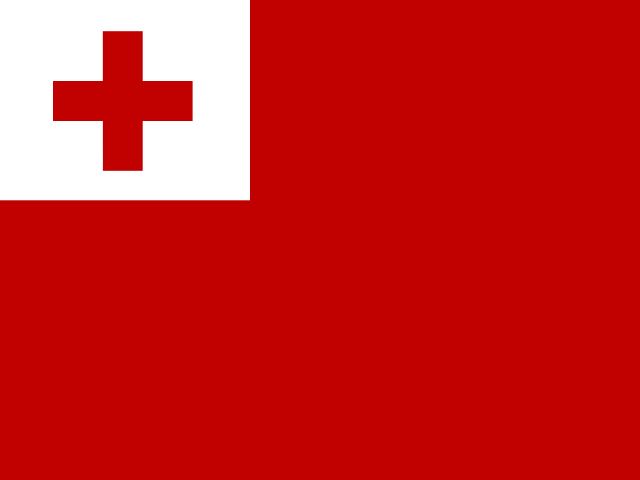
The Flag of Tonga
Oceania · Adopted 4 November 1875
Tonga's flag is the oldest continuously used national flag in the Pacific, adopted on 4 November 1875 as part of the constitution proclaimed that year by King George Tupou I, the monarch who unified Tonga's competing chiefdoms into a single kingdom and steered it toward a Western-style constitutional government while deliberately avoiding the direct colonization that swallowed nearly every other Pacific island group during the same period.
The design is straightforward: a red field with a white canton in the upper hoist corner, bearing a red couped Greek cross. Red is explained in Tongan tradition as representing the blood of Christ, and white as representing purity — a directly Christian symbolism reflecting Tonga's rapid adoption of Christianity in the 19th century under Wesleyan missionary influence, which King George Tupou I himself embraced and helped institutionalize as part of the new kingdom's identity.
What makes Tonga's flag genuinely unusual among the world's national flags is that changing it is constitutionally prohibited. Clause 47 of Tonga's 1875 constitution states explicitly that the flag can never be altered, a level of legal permanence almost no other country's flag carries — most national flags can be changed by ordinary legislation or, at most, an amendable constitutional provision, but Tonga's founding document treats the flag's design as effectively permanent.
An earlier flag briefly used before 1875, all-red with a white cross covering the whole field, was reportedly abandoned specifically because it too closely resembled the flag of the International Red Cross, an organization founded just over a decade earlier in 1863 — the 1875 redesign, moving the cross into a canton rather than covering the full field, was intended in part to create clearer visual separation from the Red Cross symbol, even though the two still share the same basic red-and-white cross vocabulary.
Tonga is unique among Pacific nations for having never been formally colonized by a European power, though it did accept a British protectorate relationship from 1900 to 1970 covering foreign affairs while retaining internal self-government throughout — a status distinct from full colonization and one Tongan history and civic education draw a clear line around, treating 1970 as a restoration of full sovereign independence rather than a grant of independence from direct colonial rule.
The Tupou dynasty that adopted the flag in 1875 remains Tonga's ruling royal house today, giving the flag an unbroken 150-year connection to the same royal line that first proclaimed it, a continuity almost no other Pacific nation's national symbols can claim.
Tonga's monarchy has genuinely ancient roots that predate the 1875 constitution by centuries: the Tu'i Tonga dynasty, established around the 10th century, once presided over a maritime sphere of influence extending across parts of Fiji, Samoa, and other nearby island groups, long before European contact and long before the modern kingdom's 1875 constitutional framework was written — a depth of unbroken political history the flag's relatively recent 1875 adoption date does not by itself convey.
Political power in Tonga shifted meaningfully in 2010, when constitutional reforms driven by years of pro-democracy pressure — including riots in the capital in 2006 — expanded the elected component of the Legislative Assembly and reduced the number of seats reserved for nobles and royal appointees, a change that left the flag and the monarchy's ceremonial role untouched even as the country's actual governing structure moved substantially toward a more conventional constitutional democracy.
Tonga's flag reached a wider global audience than its small population would normally command at the 2016 Rio Olympics opening ceremony, when taekwondo athlete Pita Taufatofua carried it while marching shirtless and oiled in traditional dress, an image that went viral internationally and briefly made Tonga's red-and-white cross one of the most recognized small-nation flags in the world, a level of visibility Taufatofua repeated at the 2018 Winter Olympics and 2020 Summer Olympics.
Constitution Day, 4 November, remains a public holiday marking the flag's original adoption, alongside Tonga's separate observance of the 1970 restoration of full sovereignty — both occasions distinct from each other, reflecting Tonga's unusual two-stage relationship with formal independence.
Tonga's flag also flew over the country's response to the January 2022 Hunga Tonga-Hunga Ha'apai eruption and tsunami, one of the largest volcanic explosions recorded anywhere on Earth in decades, which cut Tonga's single undersea internet cable and left the kingdom almost entirely isolated from outside communication for weeks; the same red-and-white cross that Tongans had carried at Olympic ceremonies became a visible rallying symbol during the international aid effort and the kingdom's own recovery, with the flag flown at reconstructed churches and community halls across the worst-hit outer islands in the eruption's aftermath.
Beyond the national flag itself, Tonga maintains a separate royal standard for the reigning monarch and a distinct naval ensign for the small Tonga Defence Services' maritime wing, both of which incorporate the same red-and-white cross vocabulary but add additional royal or military insignia not present on the plain civil flag — a layered system of flags for different official functions that is more elaborate than in most other Pacific island states, reflecting Tonga's status as the region's only continuously functioning monarchy with a full set of traditional court and military symbols still in active use.
Beyond the color scheme, the constitution's protection extends to the flag's exact geometry — a 1:2 length-to-width shape, with the white rectangle required to occupy precisely the upper-left quarter of the field, with the red couped cross centered and sized within it — a specification unchanged since 1875 and that Tongan officials point to whenever the question of modernizing the design is raised, since clause 47 forecloses even minor proportional tweaks that other monarchies' flags have quietly absorbed over the same century and a half.
A canton of exactly one quarter
- Geometry-accurate flag — The white rectangle is required to fill precisely the upper hoist quarter of the flag, which is a proportion you can check by folding the flag in half twice.
As an Amazon Associate we earn from qualifying purchases made through these links, at no extra cost to you.
Often confused with
- Switzerland — is the flag the Red Cross emblem itself was built from — the 1863 Geneva founders simply inverted Switzerland's white-on-red cross to red-on-white, the very resemblance Tonga's own 1875 designers were trying to steer clear of. Compare side by side →
Tonga at a glance
- Capital
- Nuku'alofa
- Population
- 104,000 (2024)
- Currency
- Tongan Paʻanga (TOP)
- Language(s)
- Tongan and English (both official)
Population figure as of 2024, source: UN World Population Prospects (2024 revision). See methodology for how facts are sourced and kept current.