Port of Spain — Capital of Trinidad and Tobago
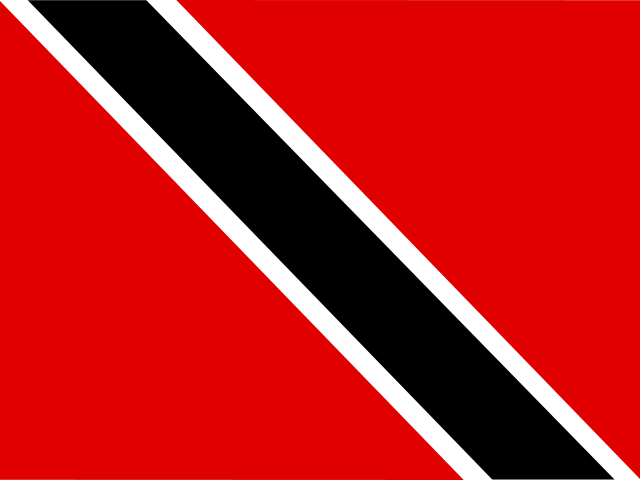
See the flag of Trinidad and Tobago →
Port of Spain traces its origins to a small Spanish settlement founded on Trinidad's northwest coast in the 16th century, but the city's real growth began after Spain's 1783 Cedula of Population, an edict that actively encouraged Catholic settlers of any nationality — French planters fleeing unrest in nearby colonies especially — to relocate to Trinidad with land grants, an unusually open immigration policy for a Spanish colonial territory that quickly transformed the town's demographic and economic character.
Trinidad passed from Spanish to British control in 1797, when a British naval force captured the island with little resistance, and Port of Spain continued as the colonial capital under British rule; Tobago, administered separately for much of its colonial history under a succession of French, British, and briefly Dutch and Courlander control, was only formally unified with Trinidad as a single colony in 1889 — meaning the "twin-island" pairing in the country's name reflects a relatively late administrative merger rather than a much longer shared political history.
The city's population grew substantially in the 19th century with the arrival of indentured laborers from India, brought to work the sugar plantations after the 1834–1838 abolition of slavery across the British Empire, a migration that fundamentally reshaped Trinidad's ethnic composition and is directly referenced in the black band of the national flag's official symbolism of a population "drawn together from many lands."
Port of Spain is internationally famous as the historic heart of Trinidad Carnival, an annual pre-Lenten festival with roots in both French colonial masquerade balls and the resistance and celebration traditions of the enslaved and formerly enslaved population, which by the 19th century had transformed the imported European carnival tradition into a distinctly Afro-Trinidadian street festival — a lineage widely credited as the origin point for the steelpan instrument and calypso and soca music traditions that later spread across the wider Caribbean and its diaspora.
As the seat of government since the colonial period, Port of Spain remained the capital through Trinidad and Tobago's 1962 independence and its 1976 transition to a republic, and it functions today as the country's political and financial center, home to its parliament (the Red House, rebuilt after a 1990 attempted coup badly damaged the original 1906 building) and the bulk of its national institutions.
The 1990 coup attempt, led by the Muslimeen group under Yasin Abu Bakr, held the prime minister and several cabinet members hostage inside the Red House for six days and remains the only successful storming of a Caribbean parliament building in the region's post-independence history, an episode still taught in Trinidadian schools as a formative test of the young republic's institutions barely fourteen years after it had become a republic at all.
The city's Queen's Park Savannah, a roughly 260-acre former sugar estate converted to public parkland in the 19th century, is ringed by a cluster of ornate early-20th-century mansions collectively nicknamed "the Magnificent Seven," built by wealthy cocoa and sugar merchants in a mix of European architectural styles, and the Savannah remains the traditional finish line for Port of Spain's Carnival parade competitions each year.
Quick facts
- Port of Spain has a population of roughly 37,000 within city limits, though the wider East-West urban corridor it anchors is home to several hundred thousand people.
- Trinidad's population is overwhelmingly concentrated on the larger island; Tobago, its much smaller twin, holds under one-twentieth of the country's total population despite giving the nation half its name.
- The Red House standing today is actually the second parliament building on the site — the original was destroyed by fire during the 1903 Water Riots, a protest against a proposed water-rate increase.
- Queen's Park Savannah is ringed by a jogging and walking track used daily by Port of Spain residents long before and after Carnival season, making it as much an everyday fitness venue as a festival site.
- Port of Spain's ethnic mix today includes descendants of the roughly 144,000 Indian indentured laborers brought to Trinidad between 1845 and 1917, alongside Afro-Trinidadian, Chinese, Lebanese-Syrian, European, and mixed-heritage communities.