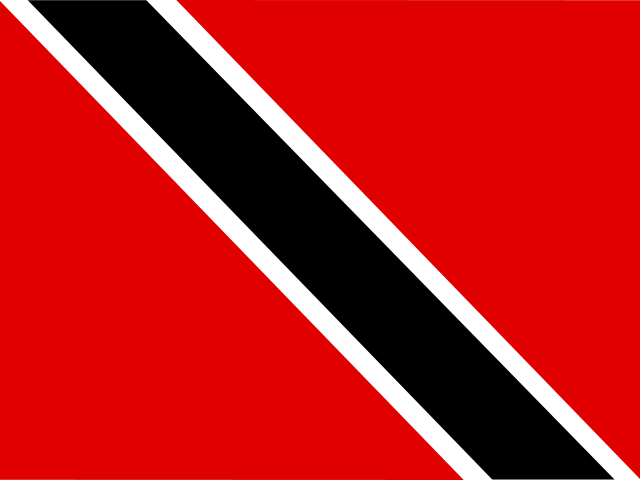
The Flag of Trinidad and Tobago
North America · Adopted 31 August 1962
Trinidad and Tobago's flag was adopted on 31 August 1962, the day the twin-island territory shed British colonial rule, replacing the old colonial ensign that had carried the Union Jack in its canton. The design was produced by a national flag committee rather than credited to a single named designer, and it was deliberately chosen before independence rather than in the immediate rush of the handover ceremony itself, part of a preparation process that also produced the country's coat of arms and national anthem ahead of the formal independence date.
The flag's defining feature is a black diagonal band, bordered in white, running from the upper hoist to the lower fly across a red field — a bold diagonal rather than the horizontal or vertical stripe arrangements most other newly independent Caribbean nations chose that same era, making Trinidad and Tobago's flag one of the more visually distinctive designs to emerge from the wave of early-1960s Anglophone Caribbean independence.
The government's official explanation ties each element to the islands' land and people rather than to any specific historical event: red represents the vitality of the land and its people, and the warmth and energy of the sun; black represents the unity, strength, and purpose of a population drawn from diverse ethnic backgrounds — including descendants of enslaved Africans, indentured laborers brought from India after the abolition of slavery, and smaller Chinese, Portuguese, and Middle Eastern communities — as well as the islands' wealth in natural resources, including its historically significant oil and asphalt deposits; and white represents the sea surrounding the two islands, the purity of the nation's aspirations, and the equality of all citizens regardless of background.
The diagonal itself has a specific compass-direction reading that the government's official material has offered: it is sometimes described as running symbolically from the northeast to the southwest, evoking the relationship between fire (the sun) and water (the sea) meeting across the land — a more poetic layer of explanation than the straightforward color meanings, and one that isn't universally repeated in every official source, reflecting the kind of interpretive variation common even in flags with a documented, deliberate committee design process.
Trinidad and Tobago's flag has not been redesigned since 1962, remaining unchanged through the country's 1976 transition from a Commonwealth realm (with the British monarch as head of state) to a republic — a significant change in constitutional structure that, notably, did not prompt any change to the flag itself, unlike some other former British colonies that adjusted their national symbols specifically at the point of becoming a republic.
Because the black-diagonal-on-red design is genuinely uncommon among world flags, Trinidad and Tobago's flag has few close look-alikes; its diagonal band bears a loose structural resemblance to a small number of other flags that use hoist-to-fly diagonals, but none shares its specific black-white-red combination, making confusion with another country's flag rare for Trinidad and Tobago compared with the more commonly mixed-up striped tricolors found elsewhere in the region.
The flag committee's work sat alongside a broader nation-building effort in 1962 that also produced the coat of arms — featuring two hummingbirds, a ship representing Christopher Columbus's 1498 arrival in Trinidad, and the islands' Amerindian-derived motto "Together we aspire, together we achieve" — material that Trinidadian civic education presents as a single coordinated set of national symbols designed to represent a genuinely multi-ethnic society rather than any one community's heritage exclusively.
Trinidad and Tobago's ethnic composition, roughly split between citizens of African and Indian descent in closely balanced proportions with smaller communities of mixed, Chinese, Syrian-Lebanese, and European heritage, is frequently cited by Trinidadian commentators as the direct real-world referent behind the flag's black band and its official "unity of a diverse people" wording — a symbolism grounded in demographic fact specific to these two islands rather than a generalized statement that could apply equally to any newly independent nation.
Trinidad's colonial history diverges sharply from most of its English-speaking Caribbean neighbors: the island remained under Spanish rule far longer than Jamaica or Barbados, only passing to Britain by capture in 1797, and much of its early sugar-plantation development was actually driven by French Catholic planters who relocated under Spain's 1783 Cedula of Population — meaning Trinidad absorbed Spanish, French, and later British colonial layers in quick succession, a compressed and unusually mixed colonial inheritance that predates and helps explain the flag committee's emphasis on unity among a genuinely multi-origin population. Tobago's own colonial history ran on an almost entirely separate track for most of this period, changing hands among Dutch, Courlander (a short-lived Baltic-German colonizing venture), French, and British claimants more than twenty times by some counts before its 1889 union with Trinidad, meaning the flag's black diagonal band, uniting fields of red on either side, quite literally mirrors a political unification of two islands with genuinely distinct, separately contested colonial pasts rather than a single shared one. The country's oil and natural gas industry, referenced obliquely in the flag's black-band symbolism of natural wealth, dates back to commercial drilling that began on Trinidad in the 1860s, among the earliest in the world, and has remained central to the economy for a century and a half, distinguishing Trinidad and Tobago's economic base sharply from the largely agricultural and tourism-dependent economies of most of its smaller Eastern Caribbean neighbors.
Which way the diagonal runs
- Flag with a marked header — The black band runs from the upper hoist down to the lower fly, and hung from the wrong edge it runs the other way, which is the one thing that can go wrong with a design this simple.
As an Amazon Associate we earn from qualifying purchases made through these links, at no extra cost to you.
Trinidad and Tobago at a glance
- Capital
- Port of Spain
- Population
- 1.5 million (2024)
- Currency
- Trinidad and Tobago Dollar (TTD)
- Language(s)
- English (official); Trinidadian and Tobagonian Creole English widely spoken
Population figure as of 2024, source: UN World Population Prospects (2024 revision). See methodology for how facts are sourced and kept current.