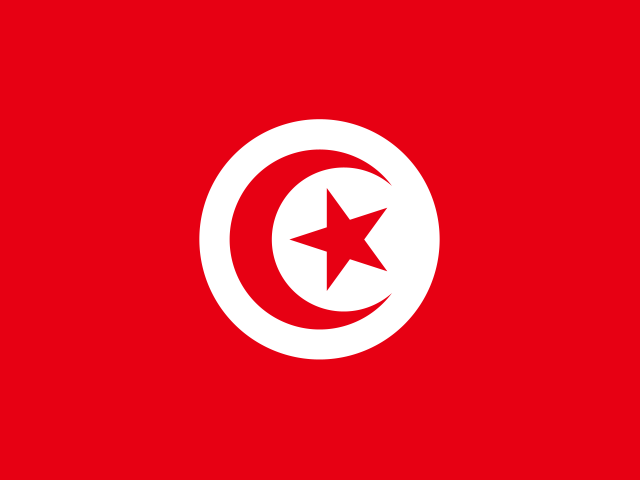
Tunis — Capital of Tunisia
Tunis is old enough to have existed alongside, and eventually outlasted, one of the ancient world's great cities: Carthage sits just a few miles northeast on the same bay, and for centuries Tunis was the lesser settlement in Carthage's shadow. That changed after the Arab conquest of North Africa in the 7th century — rather than rebuild the Roman-Byzantine city at Carthage, the Arab governor Hassan ibn al-Nu'man founded a shipyard and naval arsenal at Tunis in 698 CE, redirecting regional importance to a site the Arabs judged more defensible and better suited to their own administrative needs, and Tunis has been the region's dominant city ever since.
The Ez-Zitouna Mosque, founded in that same period around 698–703 CE, became one of the most important centers of Islamic learning in North Africa, and its attached university is among the oldest continuously operating centers of religious and legal education in the Islamic world — a status that gave Tunis intellectual as well as administrative weight for over a millennium before it became the capital of a modern nation-state.
Tunis's status as a genuine political capital solidified under the Hafsid dynasty, which ruled from the city starting in the 13th century and made it the seat of an independent Muslim kingdom for roughly three centuries, well before the Ottoman era that would later give rise to the semi-autonomous Beylik of Tunis and, eventually, the flag design of 1831.
Under the French protectorate (1881–1956), colonial administrators built a 'Ville Nouvelle' — a new town of wide boulevards and European-style buildings — alongside rather than replacing the old Medina, producing the same kind of visual split between a dense historic quarter and a colonial-era grid seen in several other North African capitals under French or other colonial rule during the same period. UNESCO added the Medina of Tunis to the World Heritage list in 1979, recognizing it as one of the best-preserved historic Arab-Islamic urban centers anywhere in the region.
Tunis is also home to the Bardo National Museum, housed in a former Hafsid and Ottoman-era palace, which holds one of the largest collections of Roman-era mosaics in the world, most excavated from sites elsewhere in Tunisia and brought to the capital — a collection that reflects Tunisia's deep Roman-era history (the province of Africa Proconsularis) as much as it does the city of Tunis specifically.
As the seat of the Beylik of Tunis from the 17th century onward, Tunis was also the city from which Hussein II Bey introduced the current national flag design in 1831, meaning the flag's origin point and Tunisia's political capital have been the same city for nearly two centuries — a continuity broken only briefly by the physical relocation of some government functions during the most disruptive periods of the 2011 revolution, when protests centered on Habib Bourguiba Avenue, the capital's main boulevard, became the visual center of the uprising broadcast internationally.
Tunis briefly served as headquarters for the Palestine Liberation Organization from 1982 to 1993, after the PLO was forced out of Beirut during the Lebanese civil war and Israeli invasion; Yasser Arafat and the organization's leadership operated from the city for over a decade, including through an October 1985 Israeli airstrike on the PLO's Tunis headquarters, a period that gave Tunis, like Algiers before it, a role hosting a prominent liberation movement in exile, though for a very different movement and set of geopolitical circumstances.
The University of Tunis, established in its modern form in 1960 shortly after independence, grew out of institutions with roots going back to the Ez-Zitouna tradition of religious and legal scholarship, and it remains one of the largest and most prestigious universities in the Maghreb, drawing students from across Tunisia and, at times, from neighboring North African countries as well.
Tunis's Lake of Tunis, a shallow lagoon separating the historic city center from its northeastern suburbs and the port of La Goulette, has been progressively reclaimed and developed since the 1980s into a modern business and residential district known as Les Berges du Lac, a striking contrast to the centuries-old Medina just a few kilometers away and a visible sign of the city's more recent economic development ambitions distinct from its historic core.
Quick facts
- Greater Tunis has a metropolitan population put at roughly 2.7 million in 2024 estimates, by far Tunisia's largest urban area.
- The Ez-Zitouna Mosque and its attached center of learning, founded around 698–703 CE, is among the oldest continuously operating institutions of Islamic scholarship in North Africa.
- Tunis's Medina, a UNESCO listing since 1979, packs roughly 700 historic monuments — mosques, mausoleums, madrasas, palaces, and fountains from the Almohad and Hafsid periods — into a compact walled quarter.
- Carthage, the ancient city Tunis eventually eclipsed, lies within Greater Tunis today as a coastal suburb and archaeological site rather than a separate city.
- Tunis served as the seat of the Hafsid dynasty from the 13th century, centuries before it became capital of the modern Tunisian state in 1956.