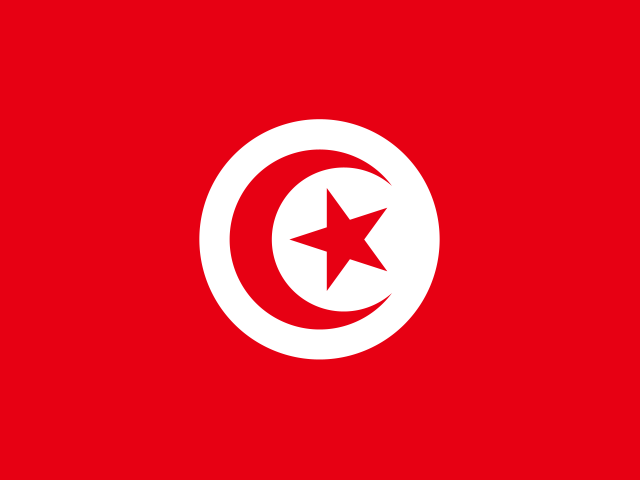
The Flag of Tunisia
Africa · Adopted 1831 (design); readopted 20 March 1956 at independence; codified by law in 1999
Tunisia's flag predates the modern Tunisian state by more than a century. It was introduced in 1831 by Hussein II Bey, the ruler of the Beylik of Tunis, an autonomous Ottoman province whose rulers had considerable freedom to govern independently while nominally acknowledging Ottoman suzerainty. Accounts differ on the exact prompt, but the design is generally understood as a deliberate response to the 1826 Ottoman naval flag reforms following the destruction of the Ottoman fleet at the Battle of Navarino — a Tunisian ruler choosing a flag both visually related to and distinct from the Ottoman standard he technically served under, a fairly bold statement of semi-autonomy for the period.
That 1831 design survived essentially unchanged through the French protectorate era (1881–1956), when Tunisia retained internal symbols like the flag even while France controlled its foreign affairs and much of its governance, and through independence in 1956, when Tunisia readopted it outright as the flag of the new sovereign state on 20 March of that year. It was not until 1999 that the government fixed the flag's exact proportions and construction geometry into law, in a measure that formalized details — the precise curve of the crescent, the star's exact placement — that had previously been left to custom and convention rather than statute.
The design itself is a plain red field with a white disc centered on it, and inside the disc a red crescent embracing a red five-pointed star. Red is understood in Tunisian tradition as recalling the blood of martyrs and carries associations with the Ottoman-era Hanafite administrative tradition under which the Beylik operated; the white disc stands for peace and purity; and the crescent and star together are widely read as Islamic symbols, though — as with most crescent-and-star flags — no single authoritative 19th-century source spells out an official meaning in the terms modern civics textbooks use.
Tunisia's crescent-and-star motif is frequently and mistakenly assumed to be a copy of Turkey's, given the superficial resemblance and the shared Ottoman historical connection, but the relationship actually runs the other way in terms of formal codification: Tunisia's flag design dates to 1831, while Turkey's own flag was not fixed into its current precise legal form until the Turkish Flag Law of 1936, more than a century later. Vexillologists also point to a genuine construction difference — Tunisia's star sits with its points touching both the inner and outer edges of the crescent's arc, a tighter, more interlocked geometry, while Turkey's star floats independently within the crescent's opening without touching it.
The flag has occasionally taken on political significance beyond its everyday use — it was carried prominently through the streets during the December 2010–January 2011 protests that toppled President Zine El Abidine Ben Ali, the opening event of what became known as the Arab Spring, with protesters treating the flag's red field and star-and-crescent as a symbol of national unity that transcended the specific political factions involved in the uprising, in a role broadly similar to how Algerians would carry their own flag through the Hirak protests several years later.
No serious redesign proposal has gained traction since 1999's codification, even through the political upheaval of the 2011 revolution and the drafting of an entirely new constitution in 2014 — unlike the flags of some other Arab Spring states, Tunisia's has remained a point of continuity across one of the most significant political transitions in the country's modern history.
Habib Bourguiba, who led Tunisia to independence in 1956 and served as its first president until 1987, is generally credited with formally readopting the 1831 Beylical design as the flag of the new republic rather than replacing it, a decision that kept Tunisia's national symbol continuous even as the country's system of government changed completely, from a monarchy under the last Bey, Muhammad VIII al-Amin, to a republic within months of independence in 1957.
Earlier Ottoman-era Tunisian vessels are recorded flying simpler, plain red flags without any crescent or star at all, a design sometimes called the beylical sanjak, before the more elaborate 1831 crescent-and-star version was introduced — evidence that the current design represents a specific, datable design decision rather than an ancient, continuously used symbol stretching back to the earliest period of Ottoman rule over Tunis, which began in 1574.
Tunisian flag protocol observed today includes flying the flag at half-mast during official periods of national mourning, a practice formalized alongside the broader 1999 legal code governing the flag's construction, and government buildings are required to display it in its exact legally specified proportions and colors rather than in informal or stylized variants, a level of formal state control over everyday display that is fairly typical of flags whose geometry and symbolism were fixed into statute relatively late, as Tunisia's was.
Under President Zine El Abidine Ben Ali, who ruled from 1987 until his ouster in the January 2011 revolution, the flag was used heavily in state propaganda and public displays as a symbol of stability and continuity — a use that made its adoption by protesters against his own government during the 2010–2011 uprising especially pointed, since demonstrators were reclaiming a symbol the regime itself had spent over two decades presenting as inseparable from its own rule.
The events that triggered the 2010–2011 uprising began not in Tunis but in Sidi Bouzid, a provincial town where the self-immolation of a young street vendor, Mohamed Bouazizi, in December 2010 set off protests that spread nationally within weeks, reaching the capital by early January 2011 — a reminder that while the flag became the visual symbol of the revolution most widely broadcast internationally from Tunis's streets, the uprising's actual origin point was a smaller interior town whose own grievances over unemployment and local corruption predated any nationwide protest movement.
The curve of the crescent
- High-resolution printed flag — The page notes the crescent's exact curve and the star's placement were only written into law in 1999, and those are precisely the details poor reproductions approximate, usually by thickening the crescent.
As an Amazon Associate we earn from qualifying purchases made through these links, at no extra cost to you.
Often confused with
- Turkey — shares the crescent-and-star-on-red arrangement, but Tunisia's design dates to 1831 and predates Turkey's own flag being fixed into its current legal form by the 1936 Turkish Flag Law, and the two differ in construction — Tunisia's star touches the crescent's arc, Turkey's floats independently within it. Compare side by side →
Tunisia at a glance
- Capital
- Tunis
- Population
- approximately 12.2 million (2024)
- Currency
- Tunisian Dinar (TND)
- Language(s)
- Arabic (official); French widely used in administration, education, and business
Population figure as of 2024, source: UN World Population Prospects (2024 revision). See methodology for how facts are sourced and kept current.