Ashgabat — Capital of Turkmenistan
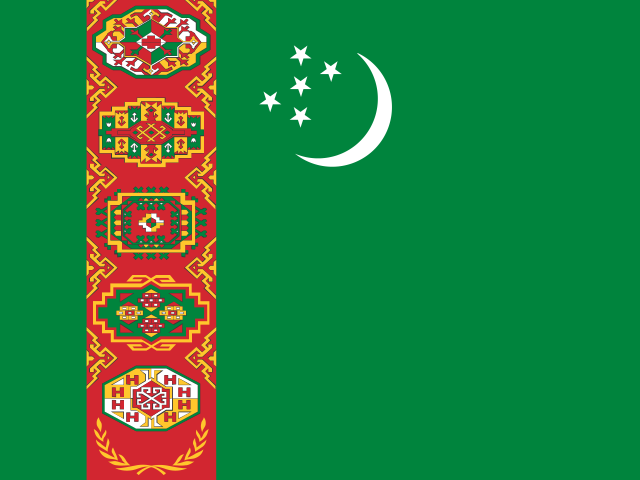
See the flag of Turkmenistan →
Ashgabat sits near the site of the ancient city of Konjikala and, more significantly, close to the ruins of Nisa, once a capital of the Parthian Empire around the 3rd century BCE, but the modern city itself is a comparatively recent creation, founded in 1881 as a Russian imperial garrison and administrative outpost along the Trans-Caspian railway line as Tsarist Russia extended its control over Central Asia.
The city's name is often explained by folk etymology as deriving from Persian words for 'city of love' or 'city of devotion,' though linguists note the more literal and better-documented derivation is closer to 'the city named after Askhabad' or a Persian-Turkmen compound tied to a personal or place name, with the romantic 'city of love' reading being a popular rather than strictly scholarly interpretation still widely repeated in tourism and civic material.
Ashgabat was almost completely destroyed by a catastrophic earthquake on 6 October 1948, one of the deadliest earthquakes of the 20th century, killing an estimated two-thirds of the city's population — Soviet authorities at the time suppressed accurate casualty figures for decades, and independent estimates now put the death toll well over 100,000, though the exact number remains disputed. The city was almost entirely rebuilt from the ground up afterward under Soviet urban planning.
After Turkmenistan's 1991 independence, President Saparmurat Niyazov and later President Gurbanguly Berdimuhamedov undertook an extraordinarily lavish reconstruction and beautification program funded by the country's natural gas wealth, giving Ashgabat one of the highest concentrations of white marble buildings of any city in the world; Ashgabat holds a Guinness World Record for the highest density of white marble-clad buildings on Earth, a distinction the government has actively promoted internationally.
The city is also known for its numerous grandiose monuments built during the Niyazov and Berdimuhamedov eras, including large fountain complexes, a monument to the country's national horse breed (the Akhal-Teke), and government buildings that project scale and prosperity in a country whose ordinary citizens have historically had limited access to independent information about how that wealth is distributed, a contrast frequently noted by outside observers and human rights organizations.
Ashgabat also hosted the 2017 Asian Indoor and Martial Arts Games, a major sporting event the government used to showcase the city's redevelopment internationally, building a large new Olympic-style sports complex for the occasion even though independent foreign press access to the country remains tightly restricted, limiting how much independent international coverage the event and the city's broader transformation actually received.
The city's Independence Monument, a large arch-topped tower completed in 1998 to mark Turkmenistan's 1991 independence, sits within a surrounding park complex and is among the tallest monuments in Central Asia, part of the same broader pattern of large-scale symbolic construction that has defined Ashgabat's post-independence urban development under successive governments.
Because so much of the city's monumental marble architecture was built within a relatively compressed period from the 1990s through the 2010s, Ashgabat presents an unusually uniform, purpose-built visual character compared with most national capitals, which typically show a much longer, more visibly layered accumulation of architectural styles built up gradually across many separate historical eras.
The Alem Cultural and Entertainment Center, a glass pyramid-shaped complex completed in 2012, houses an enclosed Ferris wheel recognized by Guinness World Records as the largest indoor Ferris wheel on Earth, one of several superlative-chasing structures the government has built in Ashgabat alongside the marble-building record. The Bagt Koshgi ('Palace of Happiness'), a large star-shaped wedding registry building completed in 2011, reflects the same monumental architectural style applied to civic rather than governmental functions, and couples across the city are required to register marriages there rather than at smaller neighborhood offices.
Car ownership in Ashgabat has historically been subject to unusual government preferences, including a period during which authorities reportedly discouraged or restricted dark-colored vehicles in favor of white cars, part of a broader pattern of tight state control over the capital's public appearance that extends well beyond architecture into everyday civic life. Despite its wide boulevards and grand public buildings, Ashgabat is frequently described by visiting journalists and diplomats as strikingly empty of pedestrians and street-level commercial life for a city its size, a contrast that has become one of the most commonly repeated observations about the capital in outside coverage.
Quick facts
- Ashgabat International Airport, opened in 2016, was built in the shape of a falcon — the bird depicted on Turkmenistan's state emblem — and ranks among the country's most expensive infrastructure projects.
- Government preferences have also shaped daily street life in Ashgabat, including a reported push toward white-painted vehicles over darker colors — one more example of how closely the capital's public image is managed.
- Ashgabat's Bagt Koshgi ('Palace of Happiness'), a star-shaped wedding registry building finished in 2011, is where all couples in the city must legally register their marriages.
- The ancient Parthian capital of Nisa, a UNESCO World Heritage Site, lies just outside modern Ashgabat.
- The city's population is estimated at roughly 1 million, though independent verification of Turkmen government population statistics is limited.