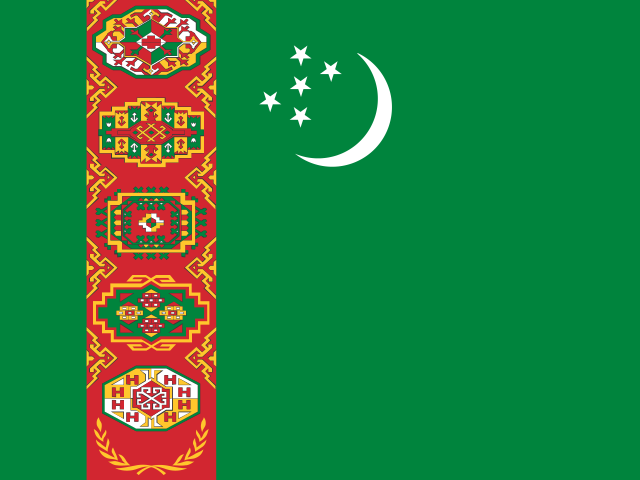
The Flag of Turkmenistan
Asia · Adopted 19 February 1992 (star and crescent added 24 January 2001)
Turkmenistan's flag is widely cited by vexillologists as the most visually complex national flag in current use, because of a single feature no other country's flag has: a vertical stripe near the hoist containing five separate carpet guls, the traditional medallion-like geometric patterns used by Turkmen tribes to identify their handwoven carpets for centuries, each rendered with enough internal detail that the stripe alone contains more distinct pattern information than most entire national flags. It replaced the Turkmen Soviet Socialist Republic's flag upon independence in 1991, formally adopted on 19 February 1992.
The five guls in the stripe — arranged in a vertical column and generally identified as the Ahal, Bukhara (Beshir/Buhara), Yomut, Arsary (Arsary/Ersary), and Saryk designs — correspond to five of the major historic Turkmen tribal confederations. Carpet-weaving is one of the oldest and most culturally significant crafts among Turkmen peoples, traditionally passed down through families and closely tied to tribal and regional identity, so encoding these specific gul patterns into the state flag was a direct claim that Turkmen national identity is fundamentally an alliance of these distinct tribal traditions united into a single modern state, made visually explicit rather than left as an abstract unity slogan.
Below the guls sit two crossed olive branches, added to the design as a symbol of peace and neutrality — a detail that connects directly to Turkmenistan's unusual official foreign policy status: the country declared permanent neutrality in 1995, a status recognized by the United Nations General Assembly, meaning Turkmenistan does not join military alliances and maintains a studied non-alignment that is almost unique among post-Soviet states, most of which joined either Western or Russian-aligned blocs.
The green field itself is traditionally read as representing both Islam, the majority religion, and, more specifically in official Turkmen government explanations, fertility and the country's agricultural traditions in a landscape that is otherwise dominated by the Karakum Desert, one of the largest deserts in Central Asia, making cultivable green land a resource-specific rather than purely decorative color choice.
The white crescent moon and five white five-pointed stars were not part of the original 1992 flag; they were added on 24 January 2001, under President Saparmurat Niyazov's government, with the crescent representing hope for the nation's future and the five stars representing the five administrative regions (welayats) of Turkmenistan — a redesign made roughly a decade into independence rather than at the moment of the flag's original adoption, reflecting the country's continued formalizing of its post-Soviet national symbolism well after 1991.
Niyazov's government (1991–2006) was known for an unusually personality-cult-driven style of governance, including renaming months of the calendar and erecting numerous monuments to himself; while the flag's carpet-gul design predates his most extreme personality-cult measures, the 2001 star-and-crescent addition happened under his rule, and Turkmenistan's flag has not been altered since his death in 2006 despite subsequent leadership changes under his successors.
Because the flag's core carpet-gul design is unlike any other national flag in the world, Turkmenistan's flag has essentially no genuine look-alikes among UN member states — its closest visual relatives are the flags of other Central Asian post-Soviet republics only in the loose sense of sharing a green field and Islamic crescent-star symbolism, not in any specific pattern or layout resemblance.
Turkmenistan's constitution and subsequent flag legislation specify the exact carpet-gul artwork, proportions, and color values in detail, and the flag is flown prominently on Flag Day, observed on 19 February, alongside Turkmenistan's Neutrality Day on 12 December, marking the 1995 UN recognition the olive branches on the flag are meant to represent.
Turkmen carpet-weaving, the craft the gul patterns on the flag directly represent, is itself recognized by UNESCO as an element of Intangible Cultural Heritage, and traditional Turkmen carpets — often called 'Bukhara carpets' internationally, after the historic Central Asian trading city through which many were sold rather than where they were made — remain a significant handicraft export and a genuine point of national pride distinct from the flag's symbolic use of the same patterns.
Because each gul historically served a practical identifying function, allowing traders and weavers to recognize which tribal group produced a given carpet at a glance, their inclusion on the flag effectively repurposes a centuries-old system of textile branding into a system of national symbolism — a genuinely unusual design logic among the world's flags, most of which draw symbolism from heraldry, religion, or political movements rather than applied craft traditions.
The flag is reportedly the most complex national flag to manufacture correctly at scale because of the fine detail required in the gul stripe, and Turkmen state media has at times highlighted the design's intricacy as a point of national distinction, framing the flag's visual complexity itself as evidence of the richness of Turkmen cultural heritage rather than treating it as a manufacturing inconvenience.
Because the guls are tied to specific tribal confederations rather than to Turkmenistan's five administrative regions represented by the added stars, the flag effectively layers two separate systems of internal division — traditional tribal lineage and modern administrative geography — onto the same small vertical stripe, a design choice that reflects how post-Soviet Turkmen national identity has had to reconcile older tribal social structures with the newer bureaucratic map inherited from Soviet-era regional planning.
The carpet band needs resolution
- Highest-resolution printed flag — The page calls this the most visually complex flag in use, and the reason is a hoist band of five woven medallions each with its own internal pattern; below a certain print resolution they are just red squares.
As an Amazon Associate we earn from qualifying purchases made through these links, at no extra cost to you.
Turkmenistan at a glance
- Capital
- Ashgabat
- Population
- 6.4 million (2024)
- Currency
- Turkmenistani Manat (TMT)
- Language(s)
- Turkmen (official); Russian widely used in business and government
Population figure as of 2024, source: UN World Population Prospects (2024 revision). See methodology for how facts are sourced and kept current.