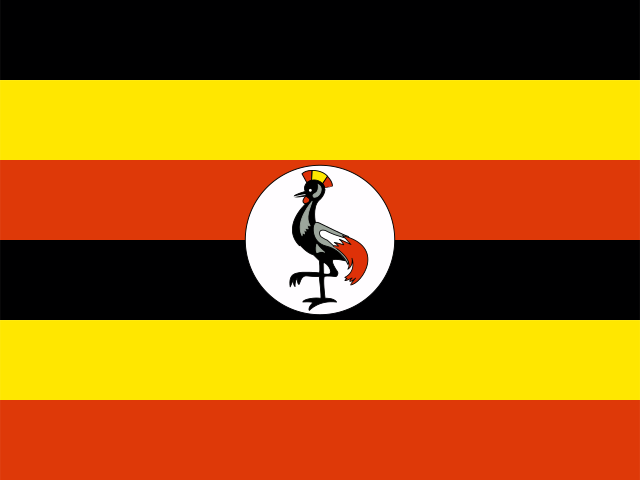
Kampala — Capital of Uganda
Kampala's name has a genuinely unusual origin story for an African capital: the site was traditionally used as royal hunting grounds by the Kabaka, the king of the Buganda Kingdom, one of Africa's oldest and most centrally organized traditional monarchies, and it was known locally as a home to impala antelope. Early British colonial officials, including the explorer and administrator Frederick Lugard, are credited with anglicizing the Luganda phrase referring to the impala's hill into 'Kampala,' a name the British then formalized as they built up an administrative presence on the site in the 1890s.
Unusually among former British colonial capitals, Kampala was not actually the seat of British colonial government in Uganda — that role belonged to Entebbe, a separate town on the shore of Lake Victoria roughly 35 kilometers away, which the British developed as their administrative headquarters and where the colonial Governor's residence was located. Kampala only became the political capital when Uganda gained independence in 1962, while Entebbe retained Uganda's main international airport and, to this day, one of the country's State House residences — a split of functions between two cities that most other former colonies never developed.
Kampala is traditionally described as a city of seven hills, each historically associated with a different institution of the Buganda Kingdom or of colonial-era religious life: Mengo Hill has long been the seat of the Kabaka's palace and government; Namirembe Hill holds the Anglican cathedral; Rubaga Hill holds the Catholic cathedral; and Old Kampala Hill is home to a major mosque — a layout that gives the city an unusually visible multi-institutional, multi-faith geography built directly into its topography, predating the city's growth well beyond those original seven hills in the decades since independence.
Idi Amin's rule from 1971 to 1979 left a heavy mark on Kampala specifically, including purges and violence carried out in the city itself and economic damage from the 1972 expulsion of Uganda's Asian community, many of whom had been central to Kampala's commercial life; the city's economy and infrastructure took years to recover even after Amin's fall, compounded by further fighting during the war that removed him and Milton Obote's contested second period in power through the mid-1980s.
Makerere University, founded in Kampala in 1922 as a technical college and later developed into a full university, became one of the most respected institutions of higher education in East Africa through the mid-20th century, drawing students from across the region during a period sometimes referred to as Makerere's 'golden age' before its reputation and resources were badly strained during the Amin years.
Kampala's status as national capital while Entebbe retained the presidential airport and a State House has occasionally mattered practically as well as symbolically — visiting heads of state and major diplomatic arrivals have historically landed at Entebbe before traveling the roughly 35 kilometers into Kampala itself, a routine that puts Uganda among a small number of countries where the everyday seat of government and the primary point of international arrival are two genuinely separate cities rather than the same metropolitan area.
Entebbe itself gained a very different kind of international attention in 1976, when a hijacked Air France flight was diverted there and Israeli commandos carried out a widely reported hostage-rescue raid on Entebbe's airport under Idi Amin's government, an episode that briefly made the airport serving Uganda's capital region one of the most closely covered news stories in the world, though the raid took place at Entebbe rather than in Kampala itself.
Kampala's Old Taxi Park and Nakasero Market areas remain, alongside the seven traditional hills, among the city's most recognizable commercial landmarks, reflecting Kampala's role as East Africa's key overland trade hub linking landlocked Uganda to the Kenyan port of Mombasa via road and, historically, rail, a role the city has held since the colonial-era Uganda Railway reached the region in the early 20th century.
The Buganda Kingdom's Lukiiko, its traditional parliament, still convenes at Mengo Hill in Kampala alongside Uganda's national institutions, a rare arrangement in which a traditional monarchy's governing body and a modern republic's national government occupy the same city without one having formally absorbed the other — a coexistence restored in 1993 when President Yoweri Museveni's government reinstated the Buganda kingship in a ceremonial capacity, decades after Obote's government had abolished it outright in the 1966 crisis.
Quick facts
- Kampala's metro area had grown to an estimated 4 million people by 2024, spilling far beyond the traditional seven-hill core that once defined the city's footprint.
- Entebbe, not Kampala, served as the seat of British colonial administration in Uganda, and still hosts the country's main international airport and a State House.
- Makerere University, founded in 1922, was for decades among the most prestigious universities in East Africa before its reputation was strained during the Amin era.
- The name Kampala derives from a Luganda reference to impala antelope once found on the hills where the Kabaka of Buganda hunted.
- Kampala's traditional seven hills each carry distinct historical associations, from the Kabaka's seat at Mengo to the Anglican and Catholic cathedrals at Namirembe and Rubaga.