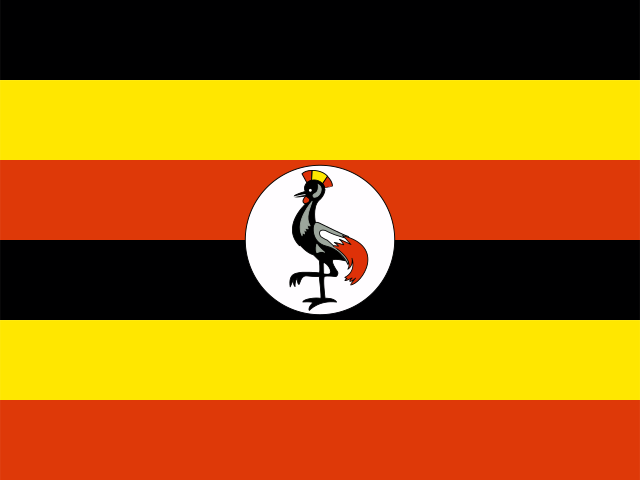
The Flag of Uganda
Africa · Adopted 9 October 1962
Uganda's flag was adopted on 9 October 1962, the day the country became independent from Britain, and its design started life as a political party's banner rather than a national one — the black-yellow-red stripe pattern was already in use by the Uganda People's Congress (UPC), the party led by Milton Obote that formed Uganda's first independent government, and the flag committee simply carried the party's colors forward into the national symbol with a bird added at the center, rather than starting from a blank design brief the way some other newly independent states did.
Six horizontal stripes, in two repeated sets of black, yellow, and red, run the length of the flag. Black represents the African people; yellow (sometimes described as gold) represents Africa's sunshine; and red represents African brotherhood, understood as a reference to the shared blood connecting Africans across ethnic and colonial-era boundaries rather than to any specific conflict, which distinguishes its meaning from the war-remembrance symbolism red carries on several neighboring countries' flags.
At the center, inside a white disc, sits a grey crowned crane (Balearica regulorum) standing on one leg — Uganda's national bird. What makes this an unusual choice among African flag emblems is that the crane was not selected fresh at independence to symbolize something new; it had already served as the official badge of the British Protectorate of Uganda under colonial rule, appearing on regimental crests and administrative insignia well before 1962. Uganda's independence government kept the same bird rather than replacing a colonial-era symbol with something invented from scratch, a genuinely unusual continuity most other newly independent African states did not choose to preserve.
The crane's raised leg is commonly explained in Ugandan civic material as symbolizing the country's forward movement into independence and progress, though — as with much flag symbolism formalized quickly around an independence date — the precise original intent behind that specific detail is not extensively documented in primary sources from 1962 itself.
The grey crowned crane's Ugandan associations run deeper than the flag alone: the bird is found across East African wetlands generally, not uniquely in Uganda, but its long-standing use in Ugandan heraldry, together with wetland habitat loss across the region in recent decades, has made it a genuine national conservation symbol as well as a political one, and it appears again on Uganda's coat of arms and various state institutions' logos.
Uganda's flag has not been redesigned since 1962 despite the country's often turbulent post-independence history, including Idi Amin's 1971 coup and brutal rule through 1979, the Uganda-Tanzania War that removed him, and Milton Obote's own return and second ousting in 1985 — governments that otherwise reshaped nearly every other state institution left the flag, including its origin as the former ruling party's own colors, untouched.
The flag is flown daily at government buildings and features in Independence Day observances each 9 October; Uganda's coat of arms, adopted separately, also depicts the crowned crane alongside a Ugandan kob antelope, but the flag itself carries no other emblem beyond the crane in its central disc.
The flag's origin in the ruling UPC party's own colors has occasionally drawn criticism from within Uganda itself, particularly from supporters of the Buganda Kingdom, whose own royal flag and institutions Obote's government moved to abolish in the 1966 Buganda crisis, when Ugandan troops stormed the Kabaka's palace at Mengo and forced the king into exile — a conflict between the young republic's national symbols, including a flag rooted in one party's identity, and Buganda's older, kingdom-specific ones, that has periodically resurfaced in Ugandan politics even after the kingdoms were constitutionally restored in 1993 in a largely ceremonial capacity.
Uganda's population has grown at one of the highest rates in the world since independence, driven by a total fertility rate that has remained among the highest globally into the 2020s, a demographic trajectory with no direct connection to the flag's own symbolism but one that has reshaped the country the 1962 flag represents far more than most of its neighbors' populations have grown over the same six decades.
Ugandan flag protocol is set out in national legislation governing its construction, proportions, and permitted uses, including restrictions on commercial use of the design — rules broadly similar in intent to those many other former British colonies adopted for their own flags around independence, reflecting a shared administrative tradition inherited from British practice even as the symbolism and colors chosen for each individual flag diverged completely from Britain's own.
The crowned crane depicted on the flag is now considered vulnerable to extinction by international conservation assessments, with wetland drainage for agriculture and urban expansion across East Africa cited as the main threat to its population — a conservation concern that has given Uganda's flag emblem a second, more urgent layer of meaning in recent decades beyond its original role as a carried-over colonial-era badge.
Milton Obote's Uganda People's Congress, whose colors the flag draws on, was itself a relatively young party at independence, formed in 1960 from a merger of smaller political groupings only two years before it led the country into independence and saw its own colors elevated to the national flag — a compressed timeline from party formation to national symbol that left the UPC's colors carrying the weight of national representation almost immediately, without the decades of broader political history some other independence-era ruling parties' symbols had already accumulated by the time their flags were adopted.
Six stripes and a central disc
- Double-sided flag — The crane in the white disc faces the hoist, so on a single-layer flag it faces the fly from behind. On a bird this recognisable that reversal is obvious, and a two-layer flag avoids it.
As an Amazon Associate we earn from qualifying purchases made through these links, at no extra cost to you.
Often confused with
- Kenya — shares a black-red palette from the same pan-African tradition, but the resemblance is loose — Kenya's flag centers a Maasai shield and spears over black-red-green horizontal bands rather than Uganda's six black-yellow-red stripes with a crane, and the two are rarely actually confused. Compare side by side →
Uganda at a glance
- Capital
- Kampala
- Population
- approximately 48.6 million (2024)
- Currency
- Ugandan Shilling (UGX)
- Language(s)
- English and Swahili (official); Luganda is the most widely spoken indigenous language, especially in and around Kampala
Population figure as of 2024, source: UN World Population Prospects (2024 revision). See methodology for how facts are sourced and kept current.