Abu Dhabi — Capital of United Arab Emirates
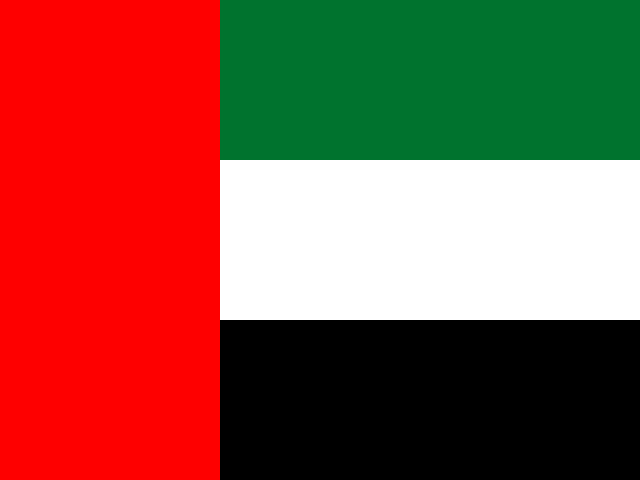
See the flag of United Arab Emirates →
Abu Dhabi's name is generally translated as 'father of the gazelle,' according to local tradition tied to the animal's historic presence on the island the city was originally founded on, and the settlement's modern origins date to 1761, when members of the Bani Yas tribal confederation, then based inland at the Liwa Oasis, discovered fresh water on the coastal island and established a permanent settlement there, founding the ruling Al Nahyan line that still governs the emirate today.
For much of the 19th and early 20th centuries, Abu Dhabi was a modest pearling and fishing town, its economy dependent on the Gulf pearl trade — a livelihood common across the Trucial States before the pearl market collapsed in the 1920s–1930s following the development of cultured pearls in Japan, a blow that hit Abu Dhabi and its neighboring emirates hard in the pre-oil decades.
Abu Dhabi's trajectory changed permanently with the discovery of commercially viable oil reserves, first exported in 1962; the resulting wealth, concentrated under Sheikh Zayed bin Sultan Al Nahyan after he became ruler in 1966, funded a rapid modernization of the city and gave Abu Dhabi the financial weight that made it the natural choice as capital when the seven emirates federated in 1971 — Sheikh Zayed went on to serve as the UAE's first president, a role held continuously by an Al Nahyan ruler since.
Abu Dhabi was chosen as the interim federal capital at the UAE's founding in 1971, with Al Ain (also within Abu Dhabi emirate) initially considered as an alternative in some early federal planning discussions, but Abu Dhabi city was confirmed and has remained the permanent seat of the federal government and the Federal Supreme Council ever since, distinguishing it from Dubai, the UAE's larger and more internationally famous commercial hub.
The city has invested heavily in cultural institutions as part of a broader diversification away from oil dependency, including the Sheikh Zayed Grand Mosque, completed in 2007 and named for the country's founding president, and the Louvre Abu Dhabi, opened in 2017 under a landmark cultural partnership agreement with France — both intended to build Abu Dhabi's profile as a global cultural destination distinct from Dubai's more commerce- and tourism-driven international image.
Abu Dhabi's sovereign wealth funds, including the Abu Dhabi Investment Authority, manage some of the largest pools of state-controlled capital in the world, built up from decades of oil revenue and now invested globally across a wide range of industries — giving the city an outsized financial influence internationally that is disproportionate to its comparatively modest population relative to major global financial centers.
Saadiyat Island, a purpose-developed cultural and residential district just off Abu Dhabi's coast, houses the Louvre Abu Dhabi and is planned to eventually include a Guggenheim museum branch and a Zayed National Museum, part of a long-term strategy to build the emirate's international cultural profile well beyond its origins as a pearling and, later, oil economy.
The Corniche, Abu Dhabi's long waterfront promenade along the Arabian Gulf, was developed extensively from the 1990s onward as part of the city's broader modernization, and the contrast between the older, more modest downtown core built up in the oil-boom decades after 1962 and the newer, larger-scale island developments like Saadiyat and Yas Island reflects the emirate's continuing expansion outward from its original coastal settlement site.
Quick facts
- Abu Dhabi hosts the headquarters of the International Renewable Energy Agency (IRENA), which relocated there in 2009 — the first major intergovernmental organization to be headquartered anywhere in the Middle East.
- Yas Island's Yas Marina Circuit has hosted the Abu Dhabi Formula One Grand Prix every year since 2009, alongside Ferrari World and Warner Bros. World theme parks built during the same tourism-development push.
- Masdar City, an experimental low-carbon development on Abu Dhabi's outskirts launched in 2006, was designed to run substantially on solar power and has served as a testbed for clean-energy technology and driverless transport pods.
- The Emirates Palace hotel, opened in 2005, was reportedly one of the most expensive hotels ever built at the time and has since doubled as a state-owned venue for hosting visiting heads of state.
- Foreign nationals make up the large majority of Abu Dhabi's resident population, a demographic pattern common across the Gulf states dating back to the labor demand the oil boom created from the 1960s onward.