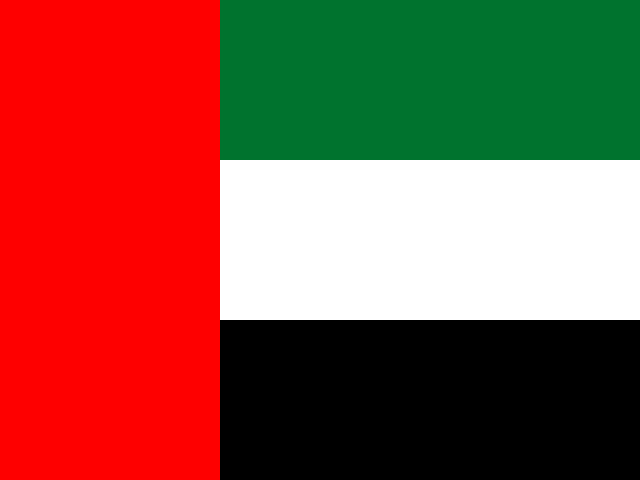
The Flag of United Arab Emirates
Asia · Adopted 2 December 1971
The UAE's flag was adopted on 2 December 1971, the exact day the federation of seven emirates — Abu Dhabi, Dubai, Sharjah, Ajman, Umm Al Quwain, Fujairah, and (joining slightly later, in early 1972) Ras Al Khaimah — formally united into a single independent state after Britain withdrew from its treaty relationships with the Gulf sheikhdoms. The design was the winning entry in a competition, submitted by Abdullah Mohammed Al Maainah, then only 19 years old, whose design was chosen specifically because it drew on the shared Pan-Arab color tradition while remaining visually distinct from other Gulf states' flags.
Those four colors — red, green, white, and black — belong to the Pan-Arab palette traced to the 1916 Arab Revolt flag against Ottoman rule, and are traditionally read as referencing successive periods of Arab history: black for the Abbasid Caliphate, white for the Umayyad Caliphate, green for the Fatimid Caliphate or for Islam broadly, and red historically tied to the Hashemite dynasty and to the bloodshed of the Arab struggle against Ottoman rule. The UAE's specific layout — a vertical red stripe at the hoist with three horizontal bands of green, white, and black filling the rest of the field — is its own arrangement of these shared colors rather than a copy of any other country's design.
This is where the UAE's story diverges sharply from several of its Pan-Arab-palette neighbors: Egypt, Syria, Yemen, and Iraq all built their modern flags around the same four colors, but each nation arranged them differently and layered on its own distinct additional symbolism — Egypt's eagle, Syria's stars, and so on — while the UAE deliberately chose a design with no additional emblem, crest, or star at all, just the four colors in their vertical-and-horizontal arrangement, making it visually one of the simplest flags among Pan-Arab-palette states even though it shares the identical color family.
Before 1971, the individual emirates that now make up the UAE flew their own separate flags, most commonly variations on plain red, a color long associated with the Trucial States (as the British called the emirates under their 19th-century treaty arrangements) — Abu Dhabi's and Dubai's pre-union flags, for instance, were essentially plain red with small distinguishing marks, and the 1971 design was a deliberate unification of these previously separate, largely red-based local traditions into one shared national symbol representing the new federal state rather than any single emirate.
Individual emirates continue to fly their own emirate-level flags (Abu Dhabi's, Dubai's, and so on) alongside the federal UAE flag for local governmental purposes, a layered flag system that reflects the UAE's federal structure — a union of seven still-distinct hereditary monarchies under one national government — differing from most unitary nation-states where only a single national flag has official governmental standing.
The UAE flag's exact proportions and color specifications are set by federal law, and 2 December is celebrated nationally as UAE National Day, with large-scale flag displays across the country's cities; National Flag Day is separately observed on 3 November, commemorating the anniversary of Sheikh Khalifa bin Zayed Al Nahyan's accession as president in 2004 and used as an occasion for mass flag-raising events distinct from the founding-day celebrations of National Day itself.
Because it belongs to the same Pan-Arab color family as several neighboring states, the UAE's flag is sometimes grouped visually with Jordan's or Palestine's, both of which also use red, white, black, and green — but Jordan's and Palestine's flags use a red triangle at the hoist with horizontal stripes trailing off it, a fundamentally different geometric structure from the UAE's vertical-stripe-plus-three-horizontal-bands layout, so the resemblance is limited to shared color palette rather than shared design.
Abdullah Mohammed Al Maainah's design was reportedly selected from among competing entries partly because of its visual simplicity and legibility at a distance, a practical consideration for a brand-new federal government that needed a flag recognizable on ships, buildings, and diplomatic missions across seven previously separate territories almost overnight, without the benefit of the years of gradual adoption and refinement many older national flags underwent.
The UAE's rapid late-20th and 21st-century development into a major global business, aviation, and tourism hub, centered particularly on Dubai and Abu Dhabi, has made its flag one of the more internationally visible Gulf flags today, frequently seen at global sporting events, on national carrier aircraft, and across the skyline of Dubai's Burj Khalifa and other landmark buildings during national celebrations, giving the design far broader everyday international exposure than its comparatively young 1971 origin might suggest.
Ras Al Khaimah's delayed accession to the union in February 1972, roughly two months after the other six emirates federated, means the UAE's flag technically predates the full seven-emirate membership it now represents by a matter of weeks — a minor but genuine historical wrinkle in an otherwise clean founding-day story, since the design itself never needed to change to accommodate the final emirate's later entry.
The red band belongs at the hoist
- Flag with a canvas header — One vertical band against the pole with three horizontals filling the rest means the design only works hung from that edge, and the header is what settles which edge that is.
As an Amazon Associate we earn from qualifying purchases made through these links, at no extra cost to you.
Often confused with
- Jordan — shares the same Pan-Arab red-white-black-green palette, but Jordan's flag uses a red triangle at the hoist with a white star, over three plain horizontal stripes — a different geometric layout from the UAE's vertical-stripe-plus-bands design. Compare side by side →
United Arab Emirates at a glance
- Capital
- Abu Dhabi
- Population
- 10.9 million (2024)
- Currency
- UAE Dirham (AED)
- Language(s)
- Arabic (official); English widely used in business and among the large expatriate population
Population figure as of 2024, source: UN World Population Prospects (2024 revision). See methodology for how facts are sourced and kept current.