London — Capital of United Kingdom
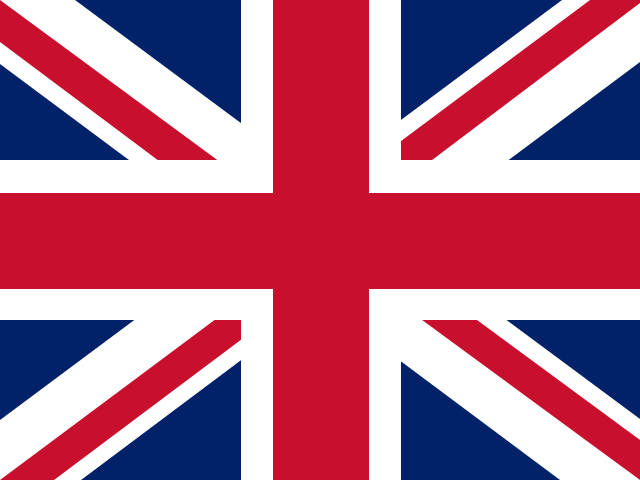
See the flag of United Kingdom →
London began as Londinium, a Roman settlement founded around 47–50 AD shortly after the Roman conquest of Britain, chosen for a location on the Thames that was both navigable from the sea and narrow enough to bridge — a combination of trade access and defensibility that has kept the same general site relevant as a center of power for nearly two thousand years since. Roman Londinium was sacked and burned by Boudica's rebellion around 60–61 AD before being rebuilt and growing into one of Roman Britain's most important cities.
The city's status as unambiguous seat of English government solidified gradually through the medieval period rather than by any single founding decree: Westminster, just upstream of the old Roman city walls, became the location of royal government and, from the 13th century, the location of Parliament, while the original walled City of London developed separately as the country's commercial and financial center — a division between 'the City' (finance) and 'Westminster' (government) that persists in London's internal geography and vocabulary to this day.
The Great Fire of London in September 1666 destroyed roughly 13,200 houses and most of the medieval city within the old Roman walls over four days, but it also cleared space for a substantial post-fire rebuilding effort led in part by architect Christopher Wren, whose St Paul's Cathedral — completed in 1710 with its distinctive dome replacing the medieval cathedral lost in the fire — remains one of London's most recognizable landmarks.
London became the capital of a united Great Britain with the 1707 Acts of Union joining England and Scotland, and then, following the 1801 Act of Union that folded in Ireland and added St Patrick's cross to the flag, the seat of an empire that at its early-20th-century peak governed roughly a quarter of the world's population and land area — a scale of administrative reach that shaped much of the city's grand Victorian and Edwardian civic architecture.
The Blitz, the sustained German bombing campaign against London and other British cities from September 1940 to May 1941, killed roughly 20,000 Londoners and destroyed or damaged large sections of the city, including the House of Commons chamber itself, which was rebuilt after the war and reopened in 1950 in a design deliberately similar to, but not identical with, the pre-war chamber.
Today London remains the seat of the UK Parliament at the Palace of Westminster, the monarchy at Buckingham Palace, and one of the world's largest financial centers through the City of London — a concentration of political, royal, and financial power in one metropolitan area that few other capitals match at a comparable scale.
London's status as capital has never been seriously contested by a rival British city the way some countries' capitals have shifted or been debated over the centuries; Edinburgh remains the capital of Scotland specifically for devolved Scottish government purposes since the Scottish Parliament's 1999 reestablishment, but London has functioned continuously as the seat of the overarching UK government since at least the medieval consolidation of royal power at Westminster.
Quick facts
- Greater London's population sits at roughly 9.0 million as of 2024 — the UK's largest city by a wide margin and among the largest in Europe.
- The 'City of London' refers specifically to the historic square-mile core within the old Roman walls, a distinct local government area with its own Lord Mayor, separate from the wider Greater London administrative region that contains most of the modern metropolis.
- Big Ben, technically the name of the bell rather than the clock tower itself (officially the Elizabeth Tower since 2012), first rang in 1859 and underwent a major multi-year restoration completed in 2022.
- London hosted the Summer Olympics three times — 1908, 1948, and 2012 — the most of any city in Olympic history.
- The London Underground, opened in 1863 as the Metropolitan Railway, is the oldest underground metro system in the world, predating comparable systems in Paris, New York, and Berlin by decades.