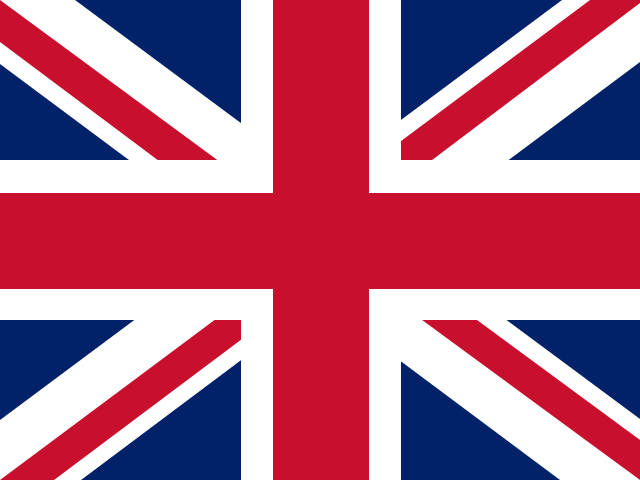
The Flag of United Kingdom
Europe · Adopted 1 January 1801
The Union Flag is a composite built from three separate national crosses layered on top of one another, and the order in which they were combined tells the story of how the United Kingdom itself was assembled. The first version dates to 1606, three years after James VI of Scotland also became James I of England in the 1603 Union of the Crowns: a royal proclamation combined England's red cross of St George on white with Scotland's white saltire of St Andrew on blue, superimposing the English cross over the Scottish saltire on a single blue field — a design used mainly at sea for the next two centuries rather than as a flag flown by the general public.
The current version was fixed on 1 January 1801, the day the Act of Union merged the Kingdom of Great Britain with the Kingdom of Ireland to form the United Kingdom of Great Britain and Ireland. That merger added the red saltire of St Patrick, representing Ireland, and required a genuinely clever piece of heraldic engineering to fit in: the St Patrick's saltire and St Andrew's saltire are both diagonal crosses that would simply overlap and disappear into each other if drawn on top of one another, so flag designers offset the two diagonals and gave each a thin white border, or fimbriation, so both remain visible in a counter-changed diagonal pattern — the asymmetric arrangement, wider on one diagonal than the other, is exactly what lets you tell the top of the flag from the bottom.
Wales has no representation on the Union Flag at all, and the reason is a matter of timing rather than oversight: Wales had already been legally annexed into the Kingdom of England by the Laws in Wales Acts of 1535 and 1542, nearly a century before the first Union Flag existed in 1606, so it was never treated as a separate constituent kingdom bringing its own cross to the design the way England, Scotland, and Ireland were. Welsh campaigners and some politicians have periodically proposed adding the Welsh dragon or the cross of St David (a gold cross on black, associated with Wales's patron saint) to a redesigned flag, but no such change has been formally adopted as of 2026.
The 1801 design has remained legally unchanged since, even though Ireland's political relationship with the rest of the United Kingdom transformed completely in the intervening period: the Irish Free State separated from the UK in 1922, and the six counties of Northern Ireland that remained part of the UK meant St Patrick's saltire stayed on the flag representing that continued constitutional link, rather than being removed when the rest of Ireland became independent.
There is a genuine, long-running dispute among vexillologists over whether 'Union Jack' is even the technically correct name for the flag when flown on land. 'Jack' traditionally refers to a small flag flown from a ship's jackstaff at the bow, and the term 'Union Jack' originated specifically for the naval version; some authorities argue 'Union Flag' is the only strictly correct name away from a ship, though the UK Parliament and Flag Institute have both stated that 'Union Jack' is now accepted as correct in either context through long-established common usage, so the dispute is more a matter of historical pedantry than a live disagreement about what to actually call it.
Because St George's cross and the wider crosses tradition run through so many national and regional flags in Europe, from Georgia's to Switzerland's, the Union Flag's specific combination of overlapping St George, St Andrew, and St Patrick crosses is a good example of how much a flag's symbolism can compress into a small visual space — for readers wanting to go deeper on what crosses and other recurring flag charges mean across different cultures, our sister site SymbolHubs covers cross symbolism specifically, tracing how the same basic cross shape carries very different meanings from one flag tradition to the next.
Britain's various overseas territories and several Commonwealth countries' historical flags incorporate the Union Flag in their own canton, a legacy of colonial-era flag design conventions rather than a feature of the UK's own flag itself; the UK's own flag has not carried any additional charge or canton of its own since the 1801 design was finalized.
Scottish independence referendums, most notably in 2014, have periodically raised the question of what would happen to the Union Flag's design if Scotland ever left the United Kingdom — since St Andrew's saltire makes up a structural part of the current flag, a 'Yes' vote would have forced a genuine redesign question rather than a purely symbolic one, and flag designers and vexillologists publicly floated several alternative arrangements at the time, none of which have been formally adopted given the 2014 referendum's 'No' result.
England's own flag, the plain red cross of St George on white, predates its inclusion in the Union design by centuries: it was associated with English identity from at least the 13th century and adopted more formally as a national symbol in the following century, drawing on the same broader medieval European tradition of crusader-era crosses that also produced Georgia's and several other countries' cross-based flags — a lineage our sister site SymbolHubs traces in more depth for readers interested in how the cross motif spread across different national traditions with different specific meanings attached in each place.
Flag flying rules in the UK are notably permissive compared to some European neighbors: under the Town and Country Planning regime, the Union Flag and other national flags can generally be flown from most buildings without requiring planning permission, a deliberate policy choice that reflects a comparatively relaxed official attitude toward everyday civilian flag display relative to countries like Spain, where regulations around the state flag and coat of arms are considerably more tightly codified.
This flag has a wrong way up
- Flag with a marked header — The two diagonals are offset rather than symmetrical, so the design is different top from bottom and can be hung inverted without looking obviously wrong. A marked header is the only reliable cue.
As an Amazon Associate we earn from qualifying purchases made through these links, at no extra cost to you.
Often confused with
- Australia — carries the Union Flag itself in its canton alongside the Southern Cross constellation and the Commonwealth Star — a colonial-legacy inclusion, not a coincidental resemblance, since Australia's flag deliberately incorporates the UK's design as its upper-left quarter. Compare side by side →
United Kingdom at a glance
- Capital
- London
- Population
- 68.3 million (2024)
- Currency
- Pound Sterling (GBP)
- Language(s)
- English (de facto official); Welsh co-official in Wales
Population figure as of 2024, source: UN World Population Prospects (2024 revision). See methodology for how facts are sourced and kept current.