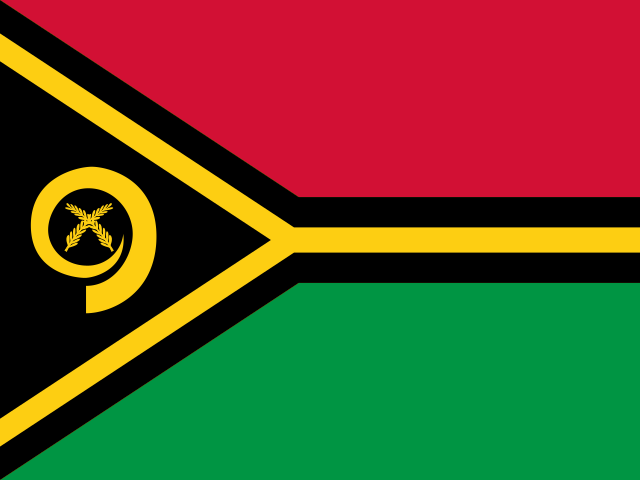
Port Vila — Capital of Vanuatu
Port Vila sits on the island of Efate and grew into Vanuatu's capital during the unusual joint-administration period when Britain and France governed the New Hebrides together as a Condominium from 1906 to 1980, an arrangement so thoroughly parallel that Port Vila itself effectively hosted two separate colonial administrations, two police forces, two currencies, and two school systems operating side by side in the same city rather than a single governing authority.
That dual-administration legacy is still visible in Port Vila's layout and civic life today: the city has historically had both English-medium and French-medium schools, and Vanuatu's post-independence constitution recognizes Bislama, English, and French as its three official languages specifically because of this shared colonial inheritance, a rarity even among former joint-administration territories worldwide.
Before European contact, the Efate area was home to established ni-Vanuatu communities long before the Condominium period, and much of Port Vila's modern urban population reflects internal migration from across Vanuatu's roughly 80 inhabited islands, drawn to the capital for work and services — a pattern that has made the city one of the more linguistically layered small capitals in the Pacific, sitting atop a country already famous for having one of the highest concentrations of distinct languages per capita anywhere in the world.
Port Vila has been repeatedly struck by major natural disasters that have shaped its modern development, most severely Cyclone Pam in March 2015, a Category 5 storm that devastated large parts of the city and much of Vanuatu, destroying homes, schools, and infrastructure and prompting a major international relief and rebuilding effort that reshaped parts of the capital's housing and public buildings in the years that followed.
Vanuatu sits directly on the Pacific Ring of Fire, and Port Vila itself lies near several active volcanoes on nearby islands, including Ambrym and Tanna, while Efate has its own history of seismic activity — a December 2024 earthquake centered near Port Vila caused significant damage to buildings in the capital, underscoring that the city faces both cyclone and earthquake risk as recurring features of life rather than rare exceptions.
During the Second World War, Efate and the wider New Hebrides became a major staging ground for Allied forces in the Pacific theater, with the United States building airstrips, a naval base, and supply depots on the island; that wartime infrastructure investment, concentrated near what is now Port Vila, left a lasting mark on the town's layout and gave it a level of built infrastructure well beyond what its small prewar population would otherwise have warranted.
Port Vila's harbor and waterfront market remain central to daily commerce, with produce brought in from across Efate and outer islands sold directly by growers rather than through large retail chains, and the town's mix of French-style bakeries and patisseries alongside traditional island food stalls is a direct, everyday legacy of the Condominium-era population of French planters and administrators who settled around the capital.
Roi Mata's Domain, a set of sites on Efate and nearby islets associated with a 17th-century paramount chief, became Vanuatu's only UNESCO World Heritage Site when it joined the list in 2008; the sites lie within reach of Port Vila and are tied to oral traditions describing Roi Mata's unification of Efate-area chiefdoms — a pre-colonial political history that predates the town itself by centuries.
Port Vila functions as the hub for Vanuatu's tourism industry, which is heavily oriented toward short-haul visitors from Australia and New Zealand arriving by air and cruise ship, and the town's economy depends substantially on that seasonal tourist traffic alongside government administration and light commerce, making cyclone and earthquake damage to the capital an economic as well as humanitarian concern each time a major event strikes.
Quick facts
- Port Vila's urban population is roughly 55,000 as of recent estimates, by far Vanuatu's largest city.
- The Vanuatu Cultural Centre and National Museum in Port Vila runs a nationwide network of volunteer fieldworkers who document island-specific oral tradition and material culture, a program launched in the 1970s and still considered a model for community-based heritage work in the Pacific.
- Relief flights after Cyclone Pam's March 2015 landfall funneled through Bauerfield International Airport at Port Vila, whose single runway became the bottleneck for the entire country's disaster response.
- Mount Yasur, an easily reached active volcano on nearby Tanna island, is a major draw for visitors passing through Port Vila, some of whom fly out for day trips to watch its near-constant eruptions.
- A magnitude earthquake struck close to Port Vila in December 2024, damaging buildings across the capital and adding to a run of seismic events the city has felt in recent years.