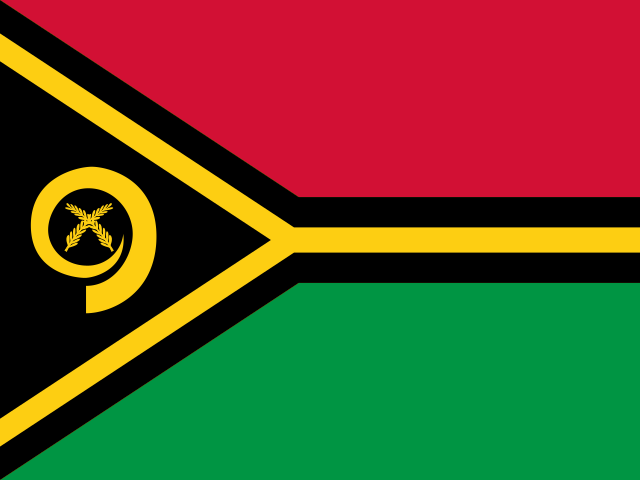
The Flag of Vanuatu
Oceania · Adopted 13 February 1980
Vanuatu's flag was adopted on 13 February 1980, a few months before independence was formally declared on 30 July 1980, ending one of the most unusual colonial arrangements in the Pacific: the New Hebrides, as the archipelago was then known, had been jointly administered since 1906 as an Anglo-French Condominium, an arrangement so thoroughly duplicated that it ran two entirely separate sets of government offices, police, courts, and currencies over the same territory rather than a single ruling power making unified decisions.
The design is built around a black horizontal 'Y' shape — sometimes described as a boomerang shape — outlined in yellow, splitting a field of red above and green below, with a black triangle at the hoist bearing a golden boar's tusk encircling two crossed leaves of the namele fern. Few other national flags anywhere build their entire composition around a shape this unconventional rather than falling back on horizontal or vertical stripes, a canton, or a simple centered emblem.
The boar's tusk is a genuine and specific reference to real ni-Vanuatu custom: curved boar tusks, cultivated over years by preventing the boar's upper teeth from wearing the lower tusk down so it grows into a full circle, are a traditional symbol of wealth, status, and prosperity across much of Vanuatu, worn as ceremonial pendants and exchanged as a form of currency and social currency in customary ceremonies that predate and continue alongside the modern cash economy.
The namele fern leaves crossed behind the tusk are used across Vanuatu in traditional ceremonial and customary law contexts, commonly placed as a marker of a peace agreement, a taboo, or a formal declaration in village custom — their inclusion ties the flag directly to Vanuatu's kastom (customary law and tradition), which the country's constitution explicitly recognizes as running alongside its introduced Western legal system rather than being replaced by it.
Red on the flag represents the blood of pigs and men shed defending the land during customary conflict and colonial resistance, black represents the ni-Vanuatu people and the volcanic soil of the islands, and green represents the richness and fertility of Vanuatu's land — a color scheme drawn from the archipelago's own environment and social history rather than from either the British or French colonial administrations that had governed it jointly for the preceding seven decades.
The Y-shaped device gives Vanuatu's flag one of the more distinctive silhouettes among the world's national flags, and it is occasionally compared to South Africa's flag, which also uses a horizontal Y as its central structural element — a genuinely unusual shared design idea between two flags from opposite sides of the world with completely unrelated colors, histories, and symbolism.
Vanuatu's path to independence involved genuine political division between Anglophone and Francophone ni-Vanuatu communities, a direct legacy of the dual-administration Condominium period: the Anglophone-led Vanua'aku Pati pushed hardest for independence through the 1970s, while some Francophone groups and the short-lived Nagriamel movement on Espiritu Santo resisted, culminating in the brief 1980 Coconut War, a small secessionist uprising on Santo that was put down with the help of Papua New Guinean troops shortly after independence was declared — one of the few instances of one newly independent Pacific nation providing direct military assistance to another in its first weeks of statehood.
The flag has not been redesigned since independence in 1980, and its boar's-tusk-and-namele emblem is still carried into modern ceremonial life well beyond the flag itself, appearing on Vanuatu's coat of arms, currency, and at customary events where chiefs from the National Council of Chiefs, the Malvatumauri, formally recognize the same symbols the flag was built around four and a half decades ago.
The Anglo-French Condominium the flag replaced was duplicated to a degree few other joint-colonial arrangements matched: residents could choose to fall under British or French law, each power maintained its own police force, prison, and currency circulating alongside the other's, and children could be schooled in an English- or French-medium system depending on which administration their family registered with — a structural doubling so complete that locals reportedly nicknamed it the 'Pandemonium' rather than the Condominium. That backdrop is part of why the 1980 flag's designers built the new national symbol entirely from ni-Vanuatu custom, deliberately choosing colors and emblems with no tie to either the Union Jack's red-white-blue or the French Tricolour's blue-white-red.
Vanuatu's flag law fixes the flag's proportions at 3:5, a wider format than the 2:3 ratio common on many other national flags, and government specification sheets set out the exact geometry of the black Y-shape's arms and the placement of the boar's-tusk-and-namele roundel within the hoist triangle, since the unconventional shape leaves considerably more room for inconsistent hand-drawn reproduction than a simple striped design would.
Vanuatu's national motto, 'Long God Yumi Stanap' ('In God We Stand', in Bislama), appears on the country's coat of arms rather than on the flag itself, and the national anthem adopted alongside independence, 'Yumi Yumi Yumi' ('We We We'), is sung in Bislama rather than English or French — a deliberate choice, since Bislama, an English-lexified Melanesian pidgin that developed during the 19th-century labor-trade era, was itself adopted as a unifying national language partly to sidestep the Anglophone-Francophone divide the Condominium period had entrenched.
Vanuatu topped the New Economics Foundation's Happy Planet Index in 2006, the index's inaugural year, based on a combination of reported life satisfaction, life expectancy, and a comparatively small ecological footprint — a ranking that briefly made the country and its flag more internationally visible than its population of a few hundred thousand would otherwise suggest. That reputation sits alongside a harder reality: Vanuatu is repeatedly ranked among the world's most disaster-exposed nations by the UN University's World Risk Index, given its exposure to cyclones, earthquakes, and active volcanism, and Cyclone Pam in March 2015 devastated much of Port Vila and outlying islands, destroying an estimated 96% of food crops on some islands even as the flag continued flying over the relief effort that followed.
A 3:5 cut around a Y
- Flag cut to 3:5 — The black Y and the emblem inside it are specified against a 3:5 field, which is wider than the common cut, so the ratio decides where the arms of the Y meet.
As an Amazon Associate we earn from qualifying purchases made through these links, at no extra cost to you.
Often confused with
- South Africa — an unrelated flag from the opposite side of the world that happens to share the same core structural idea — a horizontal Y-shape dividing the field — though South Africa's flag uses six colors in a much busier arrangement compared with Vanuatu's simpler red-green split and boar's-tusk emblem, and the two designs were developed completely independently, decades apart. Compare side by side →
Vanuatu at a glance
- Capital
- Port Vila
- Population
- 334,000 (2024)
- Currency
- Vanuatu Vatu (VUV)
- Language(s)
- Bislama, English, and French (all three official)
Population figure as of 2024, source: UN World Population Prospects (2024 revision). See methodology for how facts are sourced and kept current.