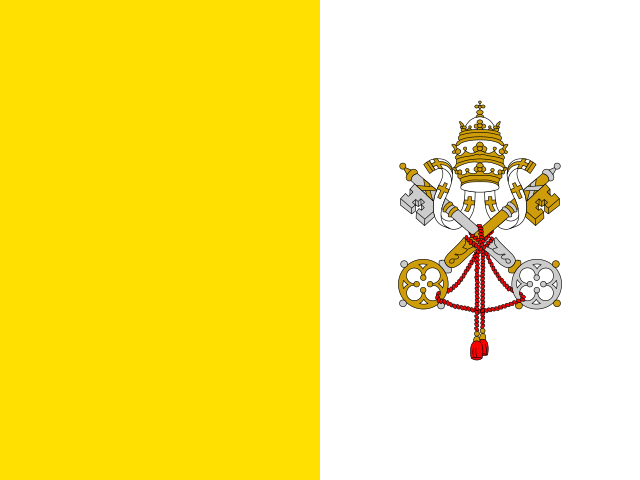
Vatican City — Capital of Vatican City
See the flag of Vatican City →
Vatican City is one of only a small handful of places in the world where the city and the country are the same entity — there is no separate 'capital of Vatican City' distinct from Vatican City itself, since the entire sovereign state occupies roughly 0.49 square kilometers on a hill west of the Tiber River in Rome, making it by a wide margin the smallest internationally recognized sovereign state in the world by both area and population.
The site's religious significance predates the modern state by centuries: St. Peter's Basilica, the massive church at the heart of Vatican City, is traditionally built over the burial site of Saint Peter, the apostle Catholic tradition regards as the first pope, who is believed to have been martyred nearby during Emperor Nero's persecution of Christians in the 60s AD; the current basilica, replacing an earlier 4th-century church commissioned under Emperor Constantine, took over a century to build, from 1506 to 1626, with contributions from a succession of Renaissance and Baroque architects including Michelangelo, who designed the basilica's dome though he died before its completion.
For over a thousand years before 1870, the pope ruled not just this small hilltop area but the much larger Papal States, a swath of central Italy governed directly by the papacy; Italian unification forces captured Rome in 1870 and absorbed the Papal States into the new Kingdom of Italy, leaving the pope in a decades-long standoff known as the 'Roman Question,' during which successive popes considered themselves prisoners in the Vatican and refused to recognize Italian sovereignty over the former papal territory.
That standoff ended with the Lateran Treaty of 11 February 1929, signed between the Holy See and Benito Mussolini's Italian government, which formally created Vatican City as a fully sovereign, independent ministate — a deliberate compromise giving the papacy unambiguous territorial sovereignty over a small area while conceding the much larger former Papal States to Italy permanently.
The Vatican Museums, housing an enormous collection of art and historical artifacts accumulated by the papacy over centuries, include the Sistine Chapel, whose ceiling Michelangelo painted between 1508 and 1512 and whose altar wall he later returned to paint The Last Judgment between 1536 and 1541 — the chapel remains in active use for its original purpose today, serving as the site where the College of Cardinals gathers to elect each new pope in a conclave.
The Pontifical Swiss Guard, protecting the territory continuously since 1506, ranks among the oldest continuously operating military units anywhere in the world; guards must be Swiss citizens and practicing Catholics, a recruitment restriction unchanged for over five centuries.
Because the state and the city are identical, Vatican City has no separate mayor or city government in the way most capitals do; day-to-day administration runs instead through the Governorate of Vatican City State, a body appointed directly by the pope, which handles everything from the postal service and museums to the small resident population's practical municipal needs — a governance structure with no real parallel among the world's other national capitals.
Quick facts
- Vatican City's resident population is estimated at roughly 880 as of 2024, the vast majority of them clergy, Swiss Guards, and Vatican officials rather than a settled civilian population in the ordinary sense.
- The state has its own postal system, radio station (Vatican Radio, broadcasting since 1931), and railway station, connected to the Italian rail network via a short spur line completed in 1934.
- St. Peter's Square, designed by Gian Lorenzo Bernini in the 1650s, is technically Italian territory under a special agreement even though it functions as the ceremonial forecourt of Vatican City, illustrating the unusually blurred practical border between the two states.
- Vatican City is not a member of the United Nations, though it holds permanent observer state status, allowing it to participate in UN proceedings without a full voting membership.
- The Vatican Apostolic Library, with roots tracing to the early Christian period and formally established in its modern form in 1475, holds one of the world's most significant collections of historical manuscripts, though public access remains restricted to qualified researchers.