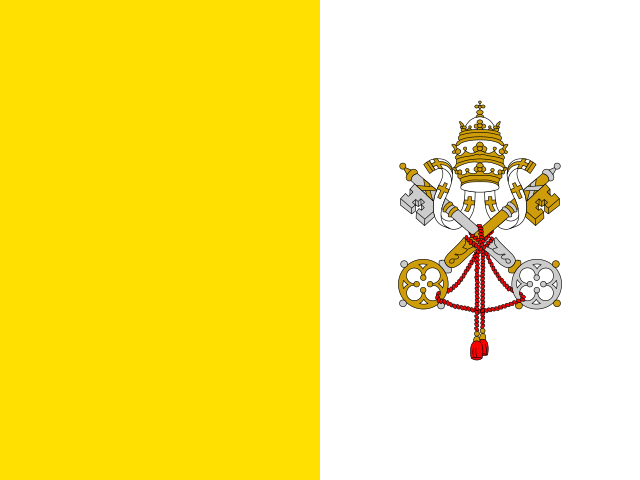
The Flag of Vatican City
Europe · Adopted 7 June 1929
Vatican City's flag is split into two vertical bands, gold at the hoist and white at the fly, with the white half bearing the crossed keys of Saint Peter beneath the papal tiara — a design formally adopted on 7 June 1929, less than four months after the Lateran Treaty of 11 February 1929 settled the decades-long 'Roman Question' by creating Vatican City as a sovereign state under the Holy See, ending a standoff that had left the papacy without recognized territorial sovereignty since Italian unification absorbed the old Papal States in 1870.
The gold and white are not a 1929 invention: they are the traditional papal colors, used on the flags and banners of the Papal States for centuries before 1929, so Vatican City's flag is better understood as a continuation of a much older heraldic tradition, formally re-anchored to a new and much smaller sovereign territory, rather than as a symbol designed from scratch for the new microstate.
The crossed keys refer directly to a passage in the Gospel of Matthew (16:19), in which Jesus tells Peter, 'I will give you the keys of the kingdom of heaven,' a verse the Catholic Church has long read as establishing Peter — and, by claimed unbroken succession, the pope — as holder of spiritual authority. One key is rendered gold and the other silver, joined by a red cord, and the two are traditionally read as representing spiritual authority (the power to bind and loose in Heaven) and temporal or earthly authority respectively, though which key stands for which has varied slightly across different heraldic renderings over the centuries.
The tiara depicted above the keys is the beehive-shaped triple crown that popes historically wore at coronation, symbolizing the papacy's threefold authority as teacher, priest, and ruler; no pope has actually worn the physical tiara at an inauguration since Paul VI set his aside in 1963 in a gesture of humility, and Vatican tradition has favored a simpler pallium-and-ring installation ceremony ever since, but the tiara has remained on the flag and papal coat of arms as a symbol of the office regardless of whether an individual pope chooses to be crowned with the physical object.
Vatican City shares one distinctive structural feature with exactly one other country in the world: its flag is square, not rectangular, making it and Switzerland's the only two square national flags in use anywhere. The Vatican's own security has been provided by the Pontifical Swiss Guard since 1506, giving the two square-flagged states a genuine institutional link — though the flags' shared square proportions themselves are generally treated by vexillologists as parallel choices made independently rather than one directly copying the other, since no surviving Vatican decree cites Switzerland's flag as the reason for the square format.
Because Vatican City is the seat of the pope and the central government of the worldwide Catholic Church rather than a nation-state in the ordinary sense, its flag functions differently from most: it is flown less as an expression of a resident population's national identity — Vatican City has fewer than a thousand residents — and more as a marker of the Holy See's diplomatic and religious authority, appearing on Vatican diplomatic missions and at Catholic institutions and events around the world far more often than it appears simply flying over everyday civic life the way most national flags do.
It is worth distinguishing the Vatican City State's flag from the personal coat of arms each individual pope adopts on election, which typically incorporates the crossed-keys-and-tiara motif alongside personal heraldic elements chosen by that pope — Pope Francis, for instance, used a shield bearing a sun, a star, and a spikenard flower reflecting his personal Jesuit and Marian devotions, layered above the same crossed keys shared with the state flag; the flag itself stays fixed regardless of who holds the papacy, while the personal arms change with every new pope.
The Lateran Treaty that created the flag's modern legal basis was itself the product of years of negotiation between the Holy See and the Italian Fascist government under Mussolini, and it remains a notably durable piece of diplomacy: the treaty's core territorial and sovereignty provisions have stayed in force essentially unchanged since 1929, even as the broader relationship between the Vatican and the Italian state has been periodically revised, most significantly through a 1984 concordat that removed Catholicism's status as Italy's official state religion without touching Vatican City's territorial sovereignty itself.
Vatican City's tiny size means its flag rarely needs the kind of look-alike-avoidance considerations that shape many national flags' design choices — no other country's flag uses a vertical gold-and-white split with crossed keys, so unlike many of Europe's tricolors and cross-based designs, confusion with another sovereign state's flag has never been a meaningful design consideration for the Holy See.
Vatican City's yellow-and-white colors also appear widely on Catholic institutional flags and banners well beyond the state's own tiny territory, since many dioceses, Catholic universities, and papal-affiliated organizations around the world incorporate the same gold-and-white palette into their own institutional branding as a visual nod to allegiance with Rome — an informal but genuinely widespread use of the state's colors that has no real parallel among other national flags, most of which stay largely confined to their own country's institutions.
Square, and split down the middle
- Square flag — The page says this is one of only two national flags that are square rather than oblong, and a version stretched to a standard length distorts the emblem on the white half along with the shape.
As an Amazon Associate we earn from qualifying purchases made through these links, at no extra cost to you.
Often confused with
- Switzerland — shares the square 1:1 proportions but nothing else — Switzerland's is a solid red field bearing a white couped cross, with no gold, no keys, and no tiara to link it visually to the Vatican's design. Compare side by side →
Vatican City at a glance
- Capital
- Vatican City
- Population
- roughly 880 (2024)
- Currency
- Euro (EUR)
- Language(s)
- Italian and Latin (official for legislative/liturgical use)
Population figure as of 2024, source: Holy See Press Office / commonly cited demographic estimates (2024). See methodology for how facts are sourced and kept current.