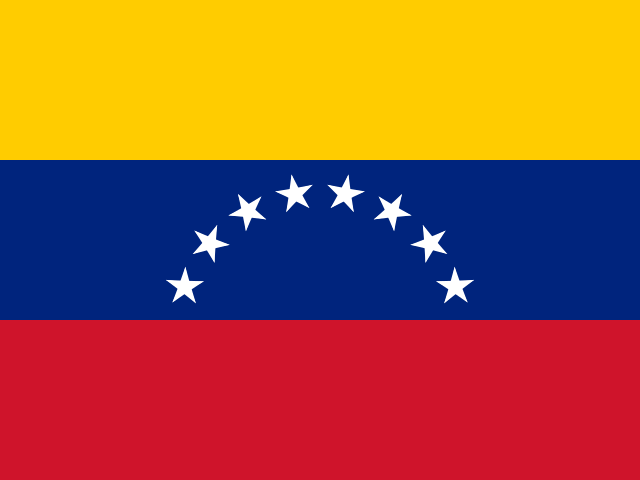
Caracas — Capital of Venezuela
Caracas was founded in 1567 by Spanish conquistador Diego de Losada under the name Santiago de León de Caracas, established in a fertile valley near Venezuela's Caribbean coast after earlier Spanish attempts to settle the area had been repeatedly resisted by the indigenous Caracas people the city takes its name from. The valley setting, roughly 900 meters above sea level and separated from the coast by a mountain range, gave the new city a notably cooler climate than the tropical coastline just a short distance away.
The mountain range separating Caracas from the sea — the Ávila, now protected as a national park bordering the city's northern edge — meant the capital never developed direct beachfront access despite its coastal proximity; the nearby port of La Guaira, reached via a winding mountain road and, later, a highway cut through the range, has served as Caracas's maritime gateway since the colonial period.
Caracas is best known internationally as the birthplace of Simón Bolívar, born in the city in 1783, whose campaigns freed not just Venezuela but Colombia, Ecuador, Peru, Panama, and Bolivia (named for him) from Spanish colonial rule — a connection the city commemorates prominently, including at the Bolívar family's colonial-era house, now a museum, and the Panteón Nacional, where Bolívar's remains are interred alongside other national heroes.
The city became capital of the independent Venezuelan state after the country's 1811 declaration, but that status wasn't uncontested through the turbulent decades of the 19th century, when Venezuela cycled through periods of federalist conflict and the seat of government occasionally shifted focus among regional caudillos before Caracas's primacy was firmly consolidated as the nation stabilized under successive 19th- and early-20th-century governments.
Caracas transformed dramatically during the mid-20th century oil boom, when Venezuela's vast petroleum reserves — among the largest proven reserves in the world — funded rapid modernization, high-rise construction, and a wave of infrastructure projects, reshaping a colonial-era city into a sprawling, high-density metropolis largely within a generation or two.
The city has also, in recent decades, become a focal point of Venezuela's severe economic and political crisis, including hyperinflation that peaked in the late 2010s and prompted a currency redenomination, alongside large-scale emigration from the capital and the country as a whole — a period whose long-term effects on the city's population and infrastructure are still unfolding and difficult to state with precision.
Caracas's Teleférico cable car system, first built in the 1950s and reaching up the Ávila mountain toward the coast, was closed for years after falling into disrepair before being reopened in 2000 following a Cuban-Venezuelan restoration partnership — a small but telling example of how the mid-century oil-boom infrastructure that shaped modern Caracas has required periodic, sometimes politically freighted, renewal in the decades since.
The University City of Caracas, home to the Universidad Central de Venezuela and designed largely by architect Carlos Raúl Villanueva in the mid-20th century, joined the UNESCO World Heritage List in 2000 for its integration of modernist architecture with large-scale public artwork by artists including Alexander Calder — a rare case of a working university campus receiving that level of international heritage recognition.
Quick facts
- Caracas's metropolitan population is estimated at roughly 2.9 million, though figures are treated as approximate given the scale of recent outward migration from Venezuela as a whole.
- The city sits in a valley about 900 meters above sea level, separated from the Caribbean coast by the Ávila mountain range, now a national park bordering the capital's northern edge.
- Simón Bolívar, the independence leader for whom Bolivia is named, was born in Caracas in 1783; his remains rest in the city's Panteón Nacional.
- La Guaira, reached from Caracas via a road and highway cut through the Ávila range, has served as the capital's principal seaport connection to the Caribbean since the colonial period.
- The Hotel Humboldt, a circular building perched atop the Ávila mountain above Caracas and completed in 1956, was reached by cable car and became an iconic, if long underused, symbol of the city's mid-century modernist ambitions before a 2010s restoration reopened parts of the complex.