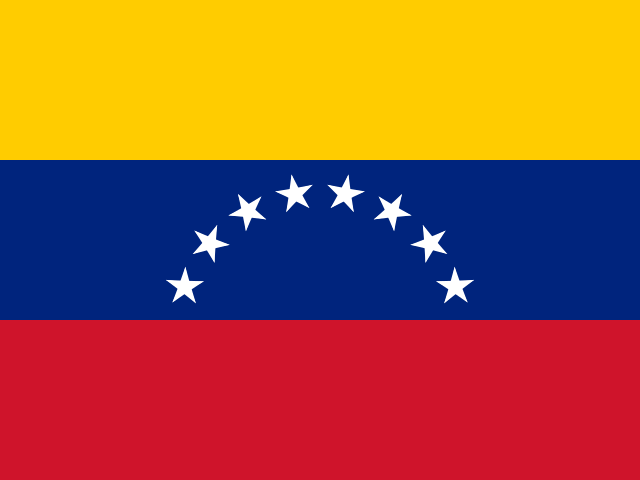
The Flag of Venezuela
South America · Adopted 3 August 2006 (present eight-star arc)
Venezuela's flag is the original source of the yellow-blue-red tricolor family that Colombia and Ecuador also carry: Francisco de Miranda, born in Caracas, designed and first raised the three-color banner in 1806 during his failed attempt to spark an independence uprising against Spain along Venezuela's coast. That first version used three equal horizontal bands and no stars at all — the stars came later, added by Simón Bolívar in 1817 to mark the seven provinces that had signed Venezuela's 1811 declaration of independence, giving the flag both a founder (Miranda) and a second author (Bolívar) in a way few national flags can claim so specifically.
For nearly two centuries afterward, Venezuela's flag carried seven stars arranged in an arc across the blue band, representing those original seven signatory provinces: Caracas, Cumaná, Barcelona, Barinas, Margarita, Mérida, and Trujillo. That seven-star version is still what most people outside Venezuela picture when they think of the flag, and it's the version that appeared on Venezuelan currency, uniforms, and official material for generations.
In 2006, under President Hugo Chávez, the government added an eighth star to the arc, citing Simón Bolívar's own stated intention — recorded in his writings — to eventually include Guayana province among the founding signatories, an inclusion Bolívar reportedly wanted but that never happened in his lifetime. The change was legally enacted by decree that August, alongside a redesign of the national coat of arms that flipped the direction a horse gallops across the shield, from facing right to facing left, a symbolic gesture toward the political left that opposition figures read as unmistakably deliberate rather than aesthetic. Critics of the Chávez government argued the eighth star was less about honoring Bolívar's wishes than about the sitting government leaving its own mark on a two-century-old national symbol, and the change remains a point of quiet political friction inside Venezuela even today — a flag detail that carries live political weight rather than settled historical consensus.
The color meanings follow the same general revolutionary vocabulary shared with Colombia and Ecuador, though Venezuelan sources tend to state them slightly differently: yellow for the nation's wealth and abundant natural resources, blue for the sea separating Venezuela from Spain (the ocean Miranda's own expedition had to cross), and red for the courage and blood of those who fought for independence. As with its neighbors, these readings were formalized in tradition rather than spelled out precisely in the original 1806 or 1811 legal texts.
Venezuela's coat of arms — which appears on the state and war flags rather than the plain civil version citizens fly day to day — is itself worth noting for its use of stars beyond the arc on the blue band: readers curious how star symbolism recurs across different flag traditions worldwide, from Islamic five-pointed stars to socialist red stars to purely numeric arrangements like Venezuela's, can find a broader treatment of the symbol on our sister site SymbolHubs' meanings dictionary.
Because Venezuela shares its color palette so directly with Colombia and Ecuador, all three flags are routinely mixed up outside the region — a mix-up Venezuelans themselves find mildly irritating given that the design originated with their own national hero rather than being borrowed from either neighbor.
The flag flies most prominently on Independence Day, 5 July, marking the 1811 declaration by the seven original provinces, and on Flag Day, 3 August, established specifically to commemorate the 2006 addition of the eighth star.
The eight-star flag has become entangled in Venezuela's deep political polarization since the mid-2010s: the government under Nicolás Maduro flies the official eight-star version at state functions, while some opposition supporters have deliberately displayed the older seven-star flag as a pointed rejection of Chávez-era symbolism, turning a detail most countries would treat as a minor heraldic footnote into an actively contested marker of political allegiance.
Venezuela's flag also flew over the country's brief formal name change in 1999, when the constitution adopted under Chávez renamed the nation the Bolivarian Republic of Venezuela — a rebranding that didn't alter the flag itself but was part of the same broader wave of symbolic reform, including the 2006 star and coat-of-arms changes, that the government pursued to visibly mark a break from the pre-1999 political order.
Venezuela's flag law specifies the exact shade of blue, yellow, and red to be used on official flags along with the precise curvature of the star arc across the blue band, a level of geometric detail that became newly relevant in 2006 when flag manufacturers nationwide had to update templates and printing plates to add the eighth star in the correct position rather than simply appending it wherever space allowed.
Francisco de Miranda himself never lived to see Venezuela's independence secured — he was captured after a military setback in 1812 and died in a Spanish prison in Cádiz in 1816, five years before Bolívar's campaigns finally freed the territory Miranda's own 1806 tricolor had first represented, which is part of why Venezuelan civic tradition treats Miranda and Bolívar as a paired founding duo rather than crediting the flag to either man alone.
Seven stars or eight
- Current-design flag — The arc gained a star in 2006, so much older stock still shows the seven-star version; counting the stars in the listing photograph settles which one is being sold.
As an Amazon Associate we earn from qualifying purchases made through these links, at no extra cost to you.
Often confused with
- Colombia — shares the same yellow-blue-red colors originated by Venezuelan-born Francisco de Miranda, but Colombia doubles the width of its yellow band and carries no stars on the blue field. Compare side by side →
- Ecuador — uses the same three colors from the same 1806 origin, but Ecuadorian law requires a coat of arms on every flag flown and Ecuador's flag carries no stars at all. Compare side by side →
Venezuela at a glance
- Capital
- Caracas
- Population
- 28.4 million (2024)
- Currency
- Venezuelan Bolívar (VES)
- Language(s)
- Spanish (official); 40+ indigenous languages hold official status for the indigenous peoples who speak them
Population figure as of 2024, source: UN World Population Prospects (2024 revision); figures are treated as approximate given the scale of outward migration in recent years, which complicates precise counts. See methodology for how facts are sourced and kept current.