Hanoi — Capital of Vietnam
Hanoi's history as a seat of power dates back over a thousand years: it was established as the capital Thang Long ('Ascending Dragon') in 1010 CE by Emperor Ly Thai To of the Ly Dynasty, according to a founding legend in which the emperor saw a golden dragon ascending from the site while sailing along the Red River and took it as a sign to build his capital there — a legend still commemorated in the city's older name and in modern Hanoi's civic imagery.
The city served, under various names, as the political and cultural center of successive independent Vietnamese dynasties for most of the following centuries, though it lost primary capital status for stretches of time to Hue, the seat of the Nguyen Dynasty from 1802 until French colonial rule reorganized administrative arrangements in the 19th and early 20th centuries, when Hanoi was designated the capital of French Indochina, a wider colonial administrative unit covering Vietnam, Laos, and Cambodia.
Ho Chi Minh proclaimed Vietnamese independence from a public square in Hanoi on 2 September 1945, and the city became the capital of the Democratic Republic of Vietnam (North Vietnam) that followed, remaining the northern capital throughout the First Indochina War against France (1946–1954) and the Vietnam War against South Vietnam and the United States, during which Hanoi endured significant American bombing campaigns, particularly the Linebacker II raids of December 1972, one of the most intensive bombing campaigns of the war.
When Vietnam was reunified in 1976 after the fall of Saigon the previous year, Hanoi was confirmed as the capital of the entire unified Socialist Republic of Vietnam rather than the former southern capital, Saigon (renamed Ho Chi Minh City in 1976 in honor of the late revolutionary leader), which instead became and remains Vietnam's largest city and primary commercial hub — a political-versus-commercial capital split broadly comparable to arrangements in several other nations.
Hanoi's Old Quarter, with narrow streets historically organized by craft guild (each street traditionally specializing in a particular trade, reflected in many streets' names today), survives as one of the best-preserved traditional urban cores in Southeast Asia, sitting alongside French colonial-era architecture from the Indochina period and, further out, the newer high-rise development that has accompanied Vietnam's rapid post-1986 Doi Moi economic reforms and growth.
The city's Temple of Literature, founded in 1070 and home to Vietnam's first national university established in 1076, is one of the oldest continuously recognized centers of Confucian scholarship in Southeast Asia, and its rows of stone stelae recording the names of successful imperial examination graduates across several centuries remain a UNESCO Memory of the World-listed historical record still standing on the original site today.
Hoan Kiem Lake, at the edge of the Old Quarter, is tied to a founding legend in which a magical sword was returned to a giant golden turtle after helping 15th-century Vietnamese hero Le Loi defeat occupying Ming Chinese forces, and the small Ngoc Son Temple on an island within the lake, connected by a red wooden bridge, remains a popular civic and spiritual landmark central to how Hanoi residents narrate their own city's identity.
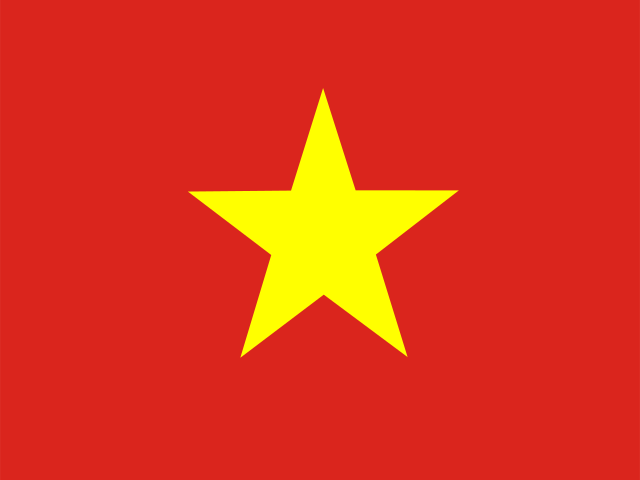
Hanoi's Ba Dinh Square, where Ho Chi Minh delivered the 1945 independence declaration and where his mausoleum now stands, continues to host major national ceremonies and remains the symbolic center of Vietnamese state political life, physically anchoring the modern capital's identity to the same 1945 founding moment that also produced the current national flag.
Quick facts
- Long Bien Bridge, built across the Red River between 1899 and 1902 by a firm associated with Gustave Eiffel, was a repeated wartime bombing target and still carries rail, motorbike, and pedestrian traffic today.
- Tran Quoc Pagoda, on a small islet in Hanoi's West Lake, is believed to date to the 6th century and is considered one of the oldest Buddhist temples in Vietnam.
- The Cat Linh-Ha Dong line, opened in 2021, gave Hanoi Vietnam's first operating urban metro line, part of a wider transit system still under construction across the capital.
- Vietnam National University, Hanoi, established in its modern form in 1993 by merging several existing colleges, is one of the country's two flagship national university systems.
- Hanoi's population is roughly 8.5-8.8 million as of recent estimates, second in Vietnam behind Ho Chi Minh City.