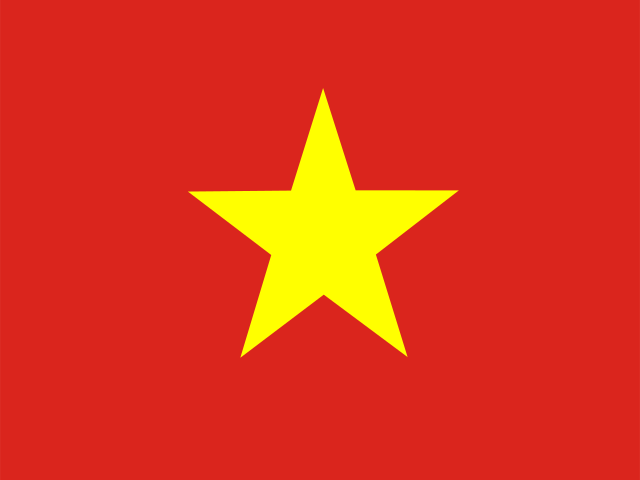
The Flag of Vietnam
Asia · Adopted 30 November 1955 (originated 1940; became flag of unified Vietnam 2 July 1976)
Vietnam's gold star on a red field originated in 1940, reportedly designed for a Viet Minh-organized uprising against French colonial rule and Japanese occupation in the country's south, before Ho Chi Minh's government formally adopted it as the flag of the Democratic Republic of Vietnam upon declaring independence from France on 2 September 1945 — a declaration France did not recognize, triggering the First Indochina War (1946–1954) that eventually forced French withdrawal after their defeat at Dien Bien Phu in 1954.
The 1954 Geneva Accords that ended that war split Vietnam at the 17th parallel into a communist-governed North, which kept the red flag with gold star, and a Western-aligned South, which flew a yellow flag with three horizontal red stripes (a design tracing to earlier Nguyen Dynasty and French-colonial-era Vietnamese flags). North Vietnam formally re-adopted a slightly modified version of the gold-star flag on 30 November 1955, adjusting the star's proportions, and this became the flag that would eventually represent the entire reunified country.
After North Vietnamese forces captured Saigon on 30 April 1975, ending the Vietnam War (known in Vietnam as the American War), the country was formally reunified as the Socialist Republic of Vietnam on 2 July 1976, and the North's red-and-gold-star flag became the flag of the entire unified nation, while South Vietnam's yellow-and-red-stripe flag was retired from official use — though that former South Vietnamese flag is still flown today by many overseas Vietnamese communities, particularly in the United States, as a symbol associated with the pre-1975 South and with opposition to the current communist government, making it one of relatively few historical national flags with an ongoing, politically charged afterlife among a diaspora population.
The single large gold star is officially explained as representing the Communist Party's leadership over the Vietnamese people, while its five points are generally read as representing the five main classes of Vietnamese society the party claimed to unite in its revolutionary program: workers, peasants, soldiers, intellectuals, and traders (sometimes rendered slightly differently in translation, but consistently five distinct social groups rather than an arbitrary number).
Red, the field color, is officially tied to revolution and to the bloodshed of Vietnam's decades-long struggle for independence and reunification, spanning French colonial rule, Japanese wartime occupation, the First Indochina War against France, and the Vietnam War against South Vietnam and the United States — a continuous, multi-decade struggle narrative that Vietnamese state education consistently ties to the flag's origin, distinct from any single battle or event.
Vietnam's flag has kept the same basic gold-star-on-red design since its 1940 origins, with only minor proportional adjustments made in 1955 and again after reunification in 1976, giving it one of the longer continuous design histories among Southeast Asian national flags despite the extraordinary political upheaval — colonial rule, foreign occupation, partition, and two major wars — the country lived through across the same period.
Because a red field with a single gold star closely resembles the flag once used by South Vietnam's Viet Cong-aligned National Liberation Front (which used a two-toned red-and-blue field with a yellow star, distinct from North Vietnam's plain red), and because several other communist states have historically used gold stars on red fields, Vietnam's flag is sometimes loosely grouped with unrelated communist-era flags in casual discussion, despite each having its own distinct design history and specific star-and-field arrangement.
The flag's exact shade of red and the star's precise proportional size relative to the overall field are specified in Vietnamese state regulations, and the flag is flown at government buildings, schools, and on major national holidays including Reunification Day (30 April) and National Day (2 September), the latter marking Ho Chi Minh's original 1945 independence declaration under this same basic design nearly eight decades ago.
Vietnam's rapid post-1986 Doi Moi economic reforms, which opened the country to foreign investment and market-oriented policy while retaining single-party communist political control, have not been accompanied by any change to the flag, illustrating how the government has kept its founding-era revolutionary symbolism constant even as the country's economic system has shifted substantially from the centrally planned model that prevailed when the flag was first adopted in the 1940s and 1950s.
The designer most commonly credited with the original 1940 flag concept, Nguyen Huu Tien, is honored in Vietnamese official history, though as with several early revolutionary-era symbols across different countries, some historical accounts note gaps and inconsistencies in the documented record from that chaotic wartime period, when the Viet Minh operated substantially underground against both French colonial authorities and Japanese occupying forces simultaneously.
Overseas Vietnamese communities, particularly the large diaspora that left after 1975 and settled in the United States, Australia, and France, remain divided in their relationship to the current flag: many diaspora organizations and local governments in areas with large Vietnamese-American populations have continued to formally recognize the former South Vietnamese flag rather than the Socialist Republic's flag, a politically sensitive distinction that periodically surfaces in diplomatic and community contexts even fifty years after reunification.
A star that must stay centred
- Geometry-accurate flag — The page notes the star's proportions were deliberately adjusted, and on a plain field with one device an off-centre or undersized star is the only thing there is to get wrong.
As an Amazon Associate we earn from qualifying purchases made through these links, at no extra cost to you.
Often confused with
- China — both use gold stars on a red field, but China's flag has one large star plus four smaller stars arranged around it in the canton, while Vietnam's has a single centered star and no additional smaller stars at all. Compare side by side →
Vietnam at a glance
- Capital
- Hanoi
- Population
- 100.2 million (2024)
- Currency
- Vietnamese Dong (VND)
- Language(s)
- Vietnamese (official)
Population figure as of 2024, source: UN World Population Prospects (2024 revision). See methodology for how facts are sourced and kept current.