Lusaka — Capital of Zambia
Lusaka began in 1905 as a small siding on the railway the British South Africa Company was extending north through the territory that would become Northern Rhodesia, named after a local Soli headman recorded as Lusaka, whose village stood near the site chosen for the rail stop. For its first three decades the town remained a minor rail settlement, well outside the colonial territory's actual center of administration.
That changed in 1935, when British colonial authorities moved Northern Rhodesia's capital from Livingstone — a town in the far south named for the explorer David Livingstone, sited near Victoria Falls and the border with Southern Rhodesia — to Lusaka, a shift driven by Lusaka's more central location within the territory and by the growing European settler population concentrated along the rail line running through it. Lusaka retained capital status when Northern Rhodesia became independent Zambia in October 1964, needing no further relocation debate at independence the way some other former colonies faced.
Under President Kenneth Kaunda, who led Zambia from independence until 1991, Lusaka became a hub for southern African liberation movements in exile, hosting representatives and, at various points, operational bases for the African National Congress, the Zimbabwe African People's Union, and the South West Africa People's Organisation among others — a role tied to Zambia's status as one of the 'Frontline States' that supported the end of white-minority rule in Rhodesia, South Africa, and South West Africa (Namibia) through the 1960s, 1970s, and 1980s, even as that support brought retaliatory cross-border raids into Zambian territory from Rhodesian and South African forces during those decades.
The city sits at the junction of two historically important routes, the Great North Road and the Great East Road, which made it a natural hub for regional trade even before independence and became strategically important afterward, when Zambia and its neighbors sought transport routes to the sea that bypassed apartheid-era South Africa and Rhodesia, including the Tanzania-Zambia Railway (TAZARA), built with Chinese assistance and completed in 1975 to link Zambia's Copperbelt to the Tanzanian port of Dar es Salaam.
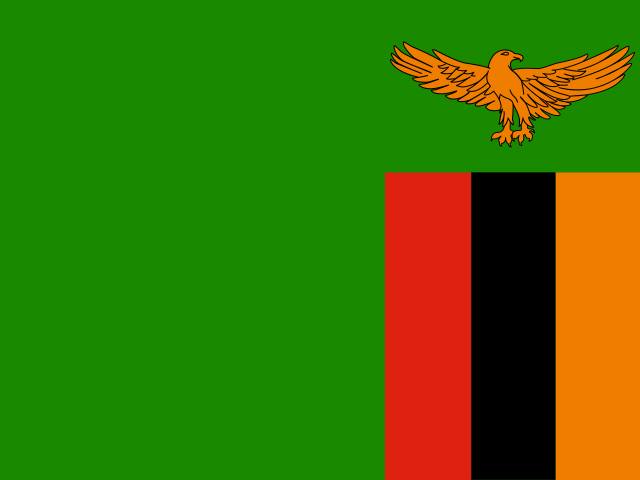
Lusaka today remains Zambia's political and commercial center, but unlike the country's flag, which draws its symbolism heavily from the Copperbelt region in the north, the capital itself sits in Zambia's more agriculturally oriented central province, a geographic separation between the country's political capital and its historic economic heartland.
The city's name itself preserves a piece of pre-colonial history that many colonial-era African capital names do not: unlike settlements renamed for British monarchs, explorers, or colonial administrators, Lusaka retained the name of the Soli headman recorded near the original 1905 rail siding, a naming choice colonial railway officials made largely for convenience at the time but one that gave the city, alone among several Central African colonial-era towns, an indigenous rather than European namesake from the outset.
The University of Zambia, established in Lusaka in 1966, two years after independence, was the country's first university and remains its largest, founded with support and funding drives that included public fundraising campaigns encouraging ordinary Zambians to contribute toward its construction — a nation-building gesture consistent with Kaunda's broader 'One Zambia, One Nation' program in the years immediately following independence.
Lusaka's downtown core still reflects its origins as a compact colonial-era rail town more than the sprawling design typical of some other African capitals built later or more deliberately planned from scratch; its street grid around Cairo Road, the city's original main commercial street named for its position on the historic 'Cape to Cairo' route once envisioned by British colonial planners, remains the commercial heart of the city today.
President Kenneth Kaunda, who governed Zambia continuously from independence in 1964 until he lost multiparty elections in 1991 — Zambia's first genuinely competitive vote after decades of one-party rule he had himself instituted in 1972 — lived out much of his post-presidency in Lusaka until his death in 2021, and his state funeral in the city drew leaders from across the region, a reflection of Lusaka's decades-long role as a hub of southern African liberation-era diplomacy under his leadership.
Quick facts
- By 2024 UN-referenced estimates, greater Lusaka held around 3.3 million residents — comfortably Zambia's largest city and several times the size of Kitwe, the Copperbelt city that ranks second.
- Lusaka's population has grown roughly a hundredfold since independence, from an estimated 25,000 residents in the early 1960s to the millions who live in the city today.
- Kenneth Kaunda International Airport, Lusaka's main airport, was renamed in 2011 in honor of the country's first president while he was still living — an unusual instance of a Zambian landmark named for someone before their death.
- The Freedom Statue, depicting a man breaking free of chains, stands near central Lusaka and was erected in 1974 to mark a decade of Zambian independence.
- A new National Assembly building funded largely through a Chinese loan has been under construction in Lusaka since the early 2020s, reportedly intended to become one of the largest legislative chambers on the continent, though its cost has drawn sustained domestic criticism.