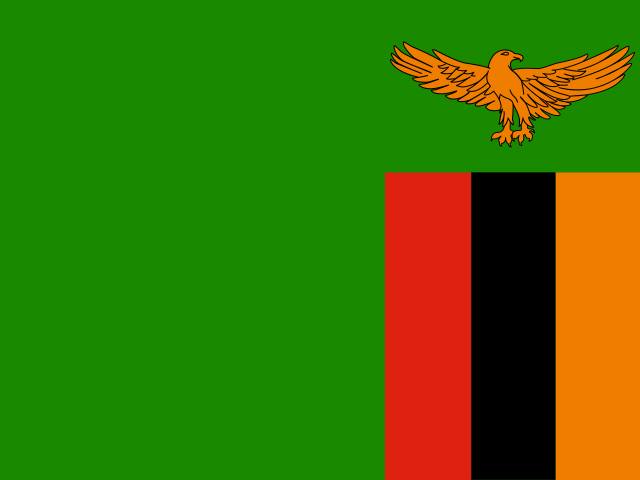
The Flag of Zambia
Africa · Adopted 24 October 1964
Zambia's flag was adopted on 24 October 1964, the day the country became independent from Britain, ending its time as the colony of Northern Rhodesia and, before that, its brief period as part of the Federation of Rhodesia and Nyasaland, a British-engineered union of three territories (1953–1963) that collapsed largely because Black African political movements in all three territories, including Kenneth Kaunda's in Northern Rhodesia, rejected the settler-dominated federation and pushed successfully for its dissolution ahead of their own separate independence.
Where many newly independent African states in this period built their flags around horizontal stripes, Zambia's design is dominated by a plain green field, an unusually large expanse of solid color for a national flag from this era, representing the country's natural resources and abundant agricultural land. In the lower fly corner, a rectangular block of three vertical stripes — red, black, and orange — sits beneath an orange fish eagle shown in flight, wings spread, positioned just above the stripe block rather than centered on the field.
Each stripe carries its own meaning: red for the political struggle that won independence, black for the Zambian people, and orange for the copper deposits of the Copperbelt region, which have anchored Zambia's economy since large-scale mining began under British colonial rule in the 1920s and remain the country's dominant export industry today. The African fish eagle (Haliaeetus vocifer), a bird found throughout much of sub-Saharan Africa's wetlands rather than uniquely in Zambia, is officially read as a symbol of the country's ability to rise above its problems, its wings spread in flight rather than perched.
Zambian government and cultural sources commonly credit the flag's design to Gabriel Ellison, a British-born artist who settled in Zambia and became closely associated with the country's state symbols, including its coat of arms and numerous postage stamp designs over subsequent decades. As with several other African flags formalized in the compressed run-up to a specific independence date, the surviving documentation attributing every detail of the final 1964 design to a single named designer is thinner than for more heavily documented cases, though Ellison's broader role in shaping Zambia's visual state symbols in the years around independence is well established.
Choosing a dominant green field rather than the horizontal tricolors many neighbors adopted gave Zambia's flag a genuinely distinctive silhouette from the outset, one that has made it less likely than many pan-African-palette flags to be confused with those of its immediate neighbors at a glance, despite sharing several of the same symbolic colors within the corner block.
The flag has not been redesigned since 1964, and it is flown daily at government institutions and prominently during Zambia's Independence Day observances each 24 October, alongside a coat of arms — also featuring an eagle, though rendered differently from the flag's — that was adopted in the same independence-era period.
President Kenneth Kaunda paired the new flag with the national motto 'One Zambia, One Nation,' a phrase meant to hold together a country of more than seventy distinct ethnic and language groups under a single post-independence identity — a nation-building effort that runs parallel to, though separate from, the flag's own black stripe representing the Zambian people as a whole rather than any one group.
The Copperbelt mining industry that the flag's orange stripe represents went through a major state takeover in 1969, five years after independence, when Kaunda's government nationalized majority stakes in the country's largest copper mining companies as part of a broader 'Zambianization' policy — a policy shift that made the mineral wealth referenced on the flag more directly tied to state control and national revenue than it had been at the moment of independence itself, before later privatization reversed much of that state ownership in the 1990s and 2000s.
Zambia's flag is also unusual in placement: rather than centering its emblem, the eagle-and-stripe block sits deliberately off to the lower fly corner, leaving the rest of the flag as an uninterrupted green field — a compositional choice that gives it one of the largest expanses of unbroken solid color of any national flag in Africa, and one reason vexillologists sometimes cite it as a useful example of restrained, asymmetric flag design compared with the more evenly divided stripe patterns common among its regional neighbors.
The orange used in Zambia's flag is officially specified as a distinct shade from the gold or yellow seen on many other African flags of the same independence era, a deliberate choice meant to evoke copper ore itself rather than the more generic 'mineral wealth' gold frequently stands for elsewhere, giving Zambia's flag one of the more specific, resource-literal color choices among its regional peers rather than a broadly interchangeable pan-African gold.
Zambia's transition to independence in 1964 was comparatively peaceful next to some of its southern African neighbors' struggles — there was no armed liberation war fought on Zambian soil comparable to the wars that produced the flags of Zimbabwe or Mozambique — and the flag's own red stripe, representing 'the struggle for freedom,' reflects a political rather than primarily military campaign led by Kaunda's United National Independence Party through the early 1960s, a distinction Zambian civic material sometimes draws explicitly when contrasting the country's path to independence with those of its neighbors.
That relatively peaceful path to independence did not, however, spare Zambia from the consequences of the region's later conflicts: Rhodesian and, later, apartheid-era South African forces carried out cross-border strikes against Zambian territory during the 1970s and 1980s in retaliation for Zambia's support of neighboring liberation movements, meaning a flag adopted without a domestic war behind it still had to be flown through years of externally imposed conflict along the country's southern border.
An emblem in the fly corner
- Double-sided flag — Everything on this flag sits in the lower fly corner, which means a single-layer version puts the eagle and the stripe block against the pole when seen from behind, where they are hidden by the folds.
As an Amazon Associate we earn from qualifying purchases made through these links, at no extra cost to you.
Zambia at a glance
- Capital
- Lusaka
- Population
- approximately 20.7 million (2024)
- Currency
- Zambian Kwacha (ZMW)
- Language(s)
- English (official); Bemba, Nyanja, Tonga, and several other Bantu languages widely spoken across different regions
Population figure as of 2024, source: UN World Population Prospects (2024 revision). See methodology for how facts are sourced and kept current.