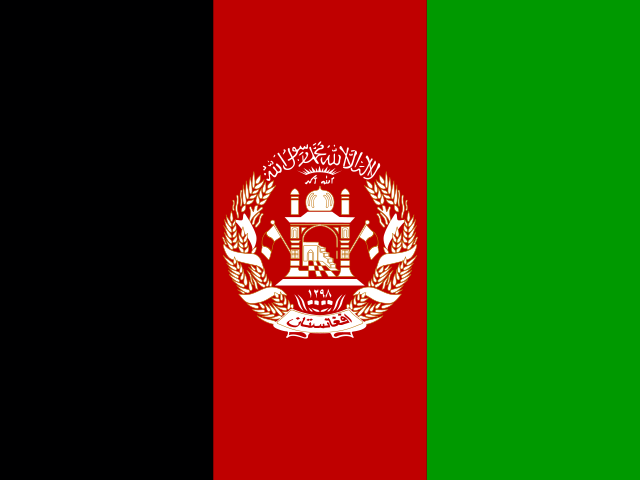
The Flag of Afghanistan
Asia · Adopted 15 August 2021 (de facto, unrecognized by the UN)
Afghanistan is currently a country with two flags in active use, and neither is the one most vexillological reference works from the 2004–2021 period still show as current. When the Taliban retook Kabul on 15 August 2021, they raised the white flag bearing the black Shahada (the Islamic declaration of faith) that the movement had used since the 1990s, and that plain white banner is now flown over government buildings inside the country. The tricolor flag adopted in 2004 — black, red, and green vertical bands with a gold emblem — is still recognized by most foreign governments and international bodies as Afghanistan's legitimate flag, since the UN has not recognized the Taliban government's change, leaving Afghanistan's own embassies abroad in some cases still flying the older design.
That 2004 tricolor itself had a genuinely turbulent design history even before 2021. Afghanistan cycled through roughly 20 different flags across the 20th and early 21st centuries as governments changed — monarchy, republic, communist-backed states, mujahideen factions, and the first Taliban government of 1996–2001 each brought their own design, making Afghanistan one of the most frequently re-flagged countries in the world during that period. The black-red-green vertical tricolor pattern used from 2004 traces its lineage back to a 1928 design under King Amanullah, and the choice to revive it after the fall of the first Taliban regime was a deliberate attempt to root the new republic's symbol in a pre-communist, pre-civil-war national identity rather than invent something new.
On the 2004 flag, black is generally explained as representing the country's turbulent past and the era before independence was secured from British influence in 1919; red is tied to the repeated armed resistance Afghans mounted against foreign intervention across three Anglo-Afghan wars and, later, the 1979–1989 Soviet occupation; and green represents hope, prosperity, and — for many Afghans — Islam. The gold emblem centered on the flag combined a mosque with a mihrab and minbar, sheaves of wheat, the Islamic declaration of faith, and the Hijri and solar calendar years, a dense and text-heavy design typical of the state emblems many mid-20th-century monarchies and republics favored.
The roughly 20 flags Afghanistan has used since the early 20th century include several that departed sharply from any color scheme still recognizable today: the communist-backed Democratic Republic of Afghanistan flew a plain red flag with a gold emblem from 1978 to 1980, closely echoing Soviet-bloc iconography, before shifting in 1980 to a black-red-green tricolor with a modified state emblem that kept the Soviet-style wreath and star even as it reintroduced the older three-color pattern. The mujahideen government that followed the 1992 fall of the communist regime restored a green-white-black tricolor with an Islamic inscription, itself replaced within a few years by the first Taliban government's plain white banner — meaning the country cycled through red, green-white-black, and white-Shahada designs across barely two decades before the 2004 republic settled on the black-red-green vertical tricolor most recently recognized internationally.
Afghan athletes have continued competing at the Olympics under the 2004 tricolor since 2021, including at the Tokyo Games held just weeks after the Taliban's return to Kabul and again at the Paris 2024 Games, since the International Olympic Committee's recognition of Afghanistan's National Olympic Committee has not shifted to the Taliban administration or its white banner — one of several international arenas, alongside a number of UN credentialing bodies, where the pre-2021 flag continues to formally represent Afghanistan despite controlling almost no territory inside the country itself.
The current Taliban flag is deliberately austere by comparison: plain white with the Shahada in black Arabic script, sometimes with the seal of the Islamic Emirate of Afghanistan added beneath it. White and the Shahada text link the design to the flag used by the Taliban during their first period of rule (1996–2001), and more broadly to a visual tradition, shared with groups like ISIS, of plain Shahada banners used by hardline Islamist movements — a resemblance that has drawn criticism and confusion internationally, even though the Taliban's own flag predates ISIS's use of the same phrase and script style.
Because recognition of the Taliban government remains contested, most international databases, sports federations, and diplomatic protocol offices have faced an unusual practical problem since 2021: which flag to display for Afghanistan. Some, including several UN bodies, have continued using the 2004 tricolor for accreditation and ceremonial purposes, a workaround that keeps a flag in official use that is no longer flown inside the country it represents.
There is no meaningful 'redesign' history to describe for the current white Shahada flag beyond its reintroduction in 2021, since it is essentially the unchanged banner the Taliban used in the 1990s; its design intentionally omits national symbols like emblems, colors, or secular iconography in favor of religious text alone, a choice consistent with the movement's stated preference for religious over nationalist symbolism.
Plain-white-with-black-script flags are rare enough globally that the current Afghan flag has few genuine look-alikes beyond the ISIS/ISIL black-flag family (which uses a white circular seal on black rather than black text on white) and Saudi Arabia's green Shahada flag, which shares the religious-text format but differs completely in color and in the addition of a sword beneath the script.
Often confused with
- Saudi Arabia — also renders the Shahada in Arabic calligraphy across the flag, but on green rather than white, with a horizontal sword beneath the text that Afghanistan's current flag omits entirely. Compare side by side →
Afghanistan at a glance
- Capital
- Kabul
- Population
- 42.6 million (2024)
- Currency
- Afghan Afghani (AFN)
- Language(s)
- Dari and Pashto (official)
Population figure as of 2024, source: UN World Population Prospects (2024 revision). See methodology for how facts are sourced and kept current.