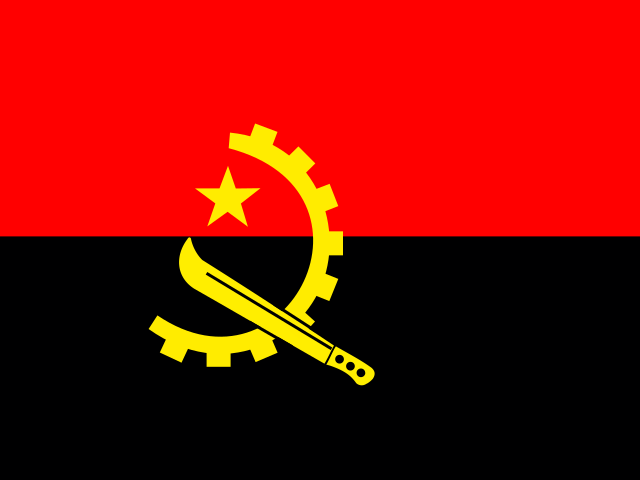
The Flag of Angola
Africa · Adopted 11 November 1975
Angola's flag was adopted on 11 November 1975, the exact day the country declared independence from Portugal after a 14-year liberation war, and it began life not as a neutral national design but as the party flag of the MPLA (Popular Movement for the Liberation of Angola), the Marxist-Leninist movement that led the new government. Because the MPLA held power at the moment of independence and the civil war against UNITA and FNLA rivals was already underway, its own banner simply became the state flag rather than being chosen through any broader national process.
The design deliberately echoes Soviet and Cuban iconography, reflecting the MPLA's ideological alignment during the Cold War: a black-and-red bicolor topped with a golden emblem combining a stylized cogwheel, a machete, and a five-pointed star, laid out in a shape that unmistakably recalls the hammer-and-sickle motif of Soviet-bloc flags, though rendered with tools specific to Angola's own economy rather than the Soviet originals.
Red is described officially as representing the blood shed by Angolans both during the independence struggle against Portugal and in the civil war that followed almost immediately afterward, one of Africa's longest and deadliest post-colonial conflicts, lasting with interruptions until 2002. Black stands for the African continent. In the emblem, the half-cogwheel represents industrial workers, the machete represents peasants and the armed struggle, and the star represents international solidarity and progress.
Since the MPLA abandoned Marxism-Leninism in the early 1990s and moved to a market economy and multiparty elections, the flag's overtly socialist imagery has become something of an anomaly — a Cold War-era party symbol still serving as the national flag of a country whose politics have otherwise moved on. A 2003 constitutional process floated redesign proposals meant to de-emphasize the party symbolism, but no replacement was ever adopted, and the original 1975 design remains in force.
The flag's persistence is itself politically significant: the MPLA has governed Angola continuously since independence, and critics have argued that retaining a party emblem as the national flag blurs the line between state and ruling party in a way few other African nations still do explicitly on their flag.
Angola's flag is flown alongside portraits of independence-era leaders at state occasions, and 11 November remains the country's most significant national holiday, commemorating both the flag's adoption and the declaration of independence in the same ceremony each year.
Angola's civil war, which ran almost without pause from 1975 until the death of UNITA leader Jonas Savimbi in 2002, meant that for the flag's first 27 years it flew over a country actively at war with itself, funded on one side by Soviet and Cuban military support and on the other by South African and American backing during the broader Cold War proxy conflict — a history that gives the flag's Soviet-style imagery a much more literal meaning than in most countries that merely borrowed the aesthetic without the direct alliance behind it.
The machete and cogwheel in Angola's emblem are drawn in gold outlined in black, sitting inside a partial gear-wheel shape crossed by the machete blade, with the five-pointed star positioned above — a layout precise enough that Angola's government has published exact geometric specifications for reproducing it on official documents and buildings.
Angola's national colors are also carried onto its coat of arms, adopted the same year as the flag, which adds a rising sun, a hoe, a cogwheel, and stalks of maize and coffee — crops central to the Angolan economy — around a book representing education, reinforcing the same industrial-and-agricultural-worker symbolism found on the flag itself.
Oil, discovered offshore in the Cabinda exclave in the 1950s and developed heavily from the 1970s onward, ended up funding both sides of Angola's long civil war at different points — government forces relied on oil revenue while UNITA drew on diamond sales from territory it controlled — meaning the same resource wealth the flag's industrial emblem gestures toward also helped prolong the conflict the flag's red stripe is meant to commemorate.
Angola's flag is one of relatively few in the world still built directly around a ruling party's original liberation-movement emblem rather than a symbol created or endorsed by cross-party consensus, a distinction Angolan opposition parties have periodically raised in calls for constitutional reform, without success so far.
Angola's own liberation struggle was itself entangled with rival movements bearing very different flags: FNLA and UNITA, the MPLA's chief rivals, each flew their own party banners during the war for independence and the civil war that followed, and had either faction won power in 1975 instead of the MPLA, Angola's national flag today would almost certainly look nothing like the one that actually flies over Luanda.
Neighboring Portuguese-speaking former colonies Mozambique, Guinea-Bissau, and Cabo Verde adopted broadly similar red-black-gold, Soviet-influenced flag designs at almost exactly the same moment in the mid-1970s, reflecting how closely coordinated the various Lusophone African liberation movements were with each other and with Soviet-bloc sponsors during that specific wave of decolonization.
Cabinda, the oil-rich Angolan exclave separated from the rest of the country by a strip of Democratic Republic of Congo territory, has its own long-running separatist movement that has periodically flown alternative flags asserting a distinct Cabindan identity, a reminder that the unity the national flag's black-and-red bicolor asserts is not universally accepted within Angola's own borders.
Keeping the cogwheel emblem legible
- Double-sided flag — The central device is a fine multi-part figure rather than a plain stripe. On single-layer cloth it shows through backwards from behind; a double-sided flag carries a correctly oriented emblem on each face.
As an Amazon Associate we earn from qualifying purchases made through these links, at no extra cost to you.
Often confused with
- Mozambique — shares Angola's red-black-gold palette and a Soviet-influenced emblem (a book, hoe, and rifle over a star) born from the same Cold War-era liberation-movement tradition, though Mozambique's stripes and layout differ. Compare side by side →
Angola at a glance
- Capital
- Luanda
- Population
- 37.9 million (2024)
- Currency
- Angolan Kwanza (AOA)
- Language(s)
- Portuguese (official); Umbundu, Kimbundu, and Kikongo widely spoken
Population figure as of 2024, source: UN World Population Prospects (2024 revision). See methodology for how facts are sourced and kept current.