The Flag of Mozambique
Africa · Adopted 1 May 1983
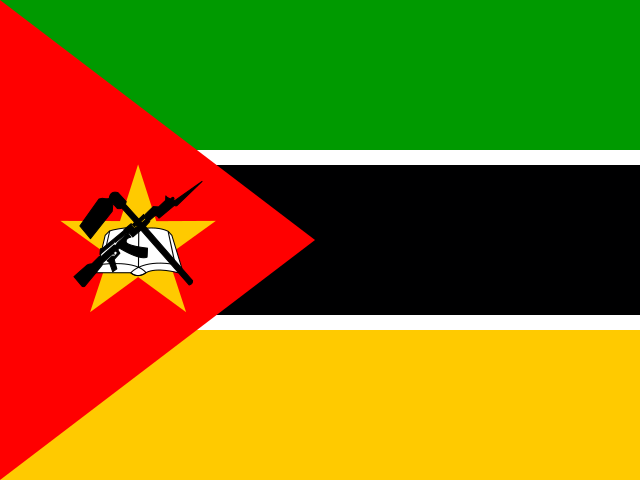
Mozambique's flag is the only national flag in the world to feature a modern firearm: a stylized silhouette of an AK-47 assault rifle, crossed with a hoe, sitting beneath a five-pointed yellow star and above an open book, all set inside a red triangle at the hoist. That combination was adopted in its current proportions on 1 May 1983, refining a design first flown at independence on 25 June 1975 that had been based directly on the banner of FRELIMO (Frente de Libertação de Moçambique), the liberation movement that fought a ten-year armed struggle against Portuguese colonial rule from 1964 and became the country's sole legal party after independence.
The rifle is a deliberate and unusually literal reference: it represents defense and vigilance, drawn specifically from the AK-47s FRELIMO fighters carried during the independence war, and its presence on the flag has made Mozambique's design a recurring talking point in vexillology precisely because most nations avoid putting contemporary weapons on their state symbols. The hoe crossed beneath it represents the country's agricultural workforce and peasantry, the book represents education, and the five-pointed star situated above both tools is drawn from the same socialist and pan-African symbolic vocabulary FRELIMO used throughout the liberation era, reflecting the Marxist-Leninist orientation the party formally adopted at independence.
The horizontal green, black, and yellow bands, separated by narrow white fimbriations, carry their own meanings distinct from the emblem: green stands for the country's natural resources and fertile land, black represents the African continent, and yellow represents the country's mineral wealth. The red triangle at the hoist, carrying the star-rifle-hoe-book emblem, stands for the struggle for independence and the blood spilled to achieve it, while the white borders around the bands are read as a wish for peace.
Because the rifle is so unusual internationally, Mozambique has periodically faced calls — including a formal 2005 national design competition — to replace or modify the emblem, with critics arguing that a weapon associated with a specific liberation-era party is an awkward permanent national symbol decades after independence and after Mozambique's own brutal 1977–1992 civil war, fought partly with the same weapon. None of the redesign proposals from that competition or since has been adopted, and the flag as fixed in 1983 remains unchanged more than four decades later, into 2026.
Mozambique's transition from a one-party Marxist-Leninist state to a multiparty constitutional system, formalized in the 1990 constitution and cemented by the 1992 peace accord ending the civil war with RENAMO, did not bring a change of flag the way some post-communist states abroad replaced their emblems — Mozambique kept the FRELIMO-derived design even as the party itself moved toward market-oriented policies and began facing genuine multiparty electoral competition.
The flag is flown on Independence Day (25 June) and Heroes' Day (3 February, commemorating FRELIMO founder Eduardo Mondlane, assassinated in 1969), both occasions when its origins in the liberation struggle are explicitly invoked in official ceremony, tying the symbol directly back to the movement whose banner it was originally drawn from rather than treating it as a neutral, post-independence-designed emblem.
The book on Mozambique's emblem is often glossed simply as 'education,' but Mozambican civic explanations tie it more specifically to the country's post-independence literacy campaigns, launched in the late 1970s to address the extremely low literacy rates left by Portuguese colonial policy, which had provided only limited formal schooling to the Black Mozambican majority; placing an open book alongside a rifle and a farming tool was meant to signal that armed struggle, agricultural labor, and mass education were treated as equally central pillars of the new state's founding project.
Mozambique's coat of arms, redesigned alongside the flag in 1990 and again in 2004, echoes the same emblem elements — the rifle, hoe, book, and star reappear there too, along with a rising sun, a map of the country, and stalks of maize and sugar cane, making the flag's central symbol part of a broader, consistent set of state imagery rather than an isolated design choice unique to the flag alone.
Mozambique's flag is sometimes brought up in international vexillology discussions specifically because of the AK-47's continued presence more than three decades after the weapon last saw active use in the country's own independence struggle; while several other post-liberation African states also referenced armed struggle on their original coats of arms or party banners, most either never carried the imagery onto their national flag itself or later dropped it, leaving Mozambique as something of an outlier in retaining a literal firearm on its flag well into the 21st century.
The FRELIMO party that designed the original 1975 flag governed Mozambique as the sole legal party until 1990, when a new constitution introduced multiparty politics under continued domestic and international pressure during the ongoing civil war; FRELIMO has won every presidential and parliamentary election since competitive politics began, meaning the flag it originally designed as a one-party liberation movement's own banner has now also served, without interruption, as the flag of a nominally multiparty democratic state for more than three decades.
White lines between the bands
- Stitched-panel flag — Narrow white separators run between the three bands and a detailed device sits on the hoist triangle, so this is a flag where stitched panels and a proper emblem print both matter.
As an Amazon Associate we earn from qualifying purchases made through these links, at no extra cost to you.
Often confused with
- Sao Tome and Principe — shares the same green-yellow-black-red palette drawn from the pan-African color set used across former Portuguese African colonies, but Sao Tome and Principe's flag has no emblem at all — just two black stars on a yellow band — making it far simpler than Mozambique's detailed hoe-rifle-book-star design. Compare side by side →
Mozambique at a glance
- Capital
- Maputo
- Population
- 34.6 million (2024)
- Currency
- Mozambican Metical (MZN)
- Language(s)
- Portuguese (official); Makhuwa, Sena, Ndau, and other Bantu languages widely spoken
Population figure as of 2024, source: UN World Population Prospects (2024 revision). See methodology for how facts are sourced and kept current.