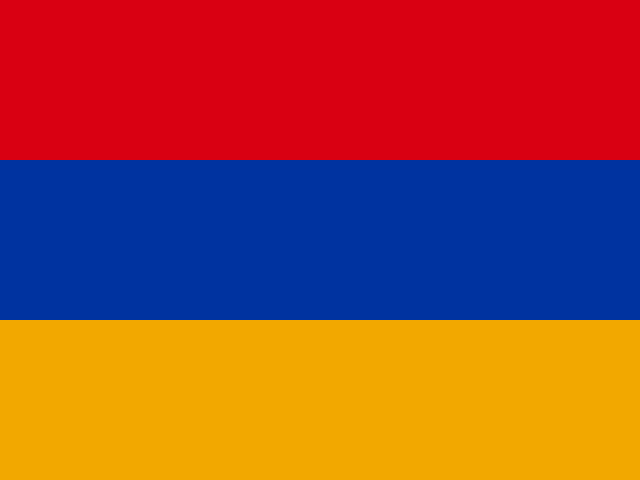
The Flag of Armenia
Asia · Adopted 24 August 1990
Armenia's tricolor of red, blue, and gold horizontal bands was adopted on 24 August 1990, while Armenia was still technically a constituent republic of the Soviet Union in the last months before independence, and it was formally reconfirmed after full independence in 1991. Its roots go back further than that vote, though: the same three colors in the same horizontal arrangement were the flag of the short-lived First Republic of Armenia, which existed from 1918 to 1920 before the Red Army's advance brought Soviet rule to the region — meaning the 1990 flag is a direct revival of a design that had been suppressed for seven decades under Soviet Armenia's hammer-and-sickle banner.
Working out exactly what the colors mean has never fully settled into one official answer, and Armenian sources themselves offer more than one interpretation, which the country's own government has acknowledged rather than papered over. The most common reading ties red to the blood shed defending the Armenian homeland, including the Armenian genocide of 1915–1923 under the Ottoman Empire, blue to the Armenian sky and to hope, and gold (sometimes described as orange) to the courage and industriousness of Armenian workers and to the country's apricot-colored landscape. An older interpretation from the 1918–1920 republic tied the colors instead to three historic Armenian kingdoms and regions.
The specific shades matter more here than in most flags: Armenia's national law is explicit that the color is a true 'apricot' or amber-orange rather than a plain yellow or gold, a detail that distinguishes it from other red-blue-gold tricolors and connects the flag visually to the apricot, a fruit closely associated with Armenian identity and sometimes claimed (disputed by botanists) as having originated in the region — the fruit's scientific name, Prunus armeniaca, reflects that long-standing association even if its actual center of domestication lay further east in Central Asia.
Between 1922 and 1990, Soviet Armenia flew a red flag bearing the hammer and sickle in gold in the canton, with the word 'Armenia' rendered in Armenian script beneath it — a design imposed as part of the standard Soviet republican flag template rather than reflecting any distinctly Armenian visual tradition, which is precisely why the 1990 return to the 1918 tricolor was treated domestically as a restoration rather than a redesign.
The horizontal red-blue-gold arrangement has stayed unchanged since 1990; Armenia's 2006 law on the state flag mainly formalized construction details — the 1:2 ratio, the exact Pantone-equivalent colors, and rules for display — rather than altering the design itself.
Because red-blue-gold horizontal tricolors are relatively uncommon worldwide, Armenia's flag has few close look-alikes, though its color palette (if not layout) is sometimes confused at a glance with Colombia's yellow-blue-red tricolor by people unfamiliar with either flag, despite Colombia's stripes being unequal in width and arranged in a completely different order.
The tricolor's own path into existence in 1918 was contested even at the time: the First Republic's National Council debated several rival proposals before settling on horizontal red-blue-gold bands, and the specific choice was influenced in part by the Armenian revolutionary movement's earlier use of a red-blue-orange tricolor flag by diaspora and resistance groups in the late 19th and early 20th centuries, meaning the 1918 state flag drew directly on activist and paramilitary banners that predated formal Armenian statehood by decades rather than being designed fresh for the new republic.
Armenia is unusual among post-Soviet states in having reused an early-20th-century pre-Soviet flag essentially unaltered rather than designing something new at independence; several other former Soviet republics — Ukraine and Georgia among them — went through more than one post-Soviet flag change or heavy modification before settling on a lasting design, while Armenia's 1990 tricolor has needed only the 2006 law's technical clarifications since its return.
The Armenian genocide's commemoration on 24 April each year, marking the start of mass deportations and killings in 1915, is one of the occasions when the tricolor is most visibly and deliberately displayed alongside the forget-me-not symbol adopted for the genocide's 2015 centenary, reflecting how directly the flag's red band is tied in public memory to that specific historical trauma rather than functioning as a more generic reference to sacrifice.
Armenia's mountainous, landlocked geography — bordered by Georgia, Azerbaijan, Iran, and Turkey, with the last two relationships shaped heavily by unresolved historical disputes — means the flag is flown not only domestically but prominently by the large Armenian diaspora, estimated to be several times larger than Armenia's resident population, in cities such as Los Angeles, Moscow, and Beirut, where community organizations use the tricolor as a unifying symbol independent of any single country's politics.
The decades-long conflict between Armenia and Azerbaijan over Nagorno-Karabakh, a mostly Armenian-populated enclave inside Azerbaijan's internationally recognized borders, ended in a decisive Azerbaijani victory in 2023 that led to the exodus of nearly the entire ethnic Armenian population from the region and the dissolution of its unrecognized breakaway government; the tricolor, which had also been flown by that breakaway administration in a locally modified form, is now flown only within Armenia's own internationally recognized territory, a significant and recent contraction of the flag's practical reach on the ground within the Caucasus.
A 1:2 cut of three equal bands
- Flag cut to 1:2 — The three horizontals are equal thirds of a field specified at 1:2, so a stock 3:5 cut both changes the outline and squashes each band by the same fraction.
As an Amazon Associate we earn from qualifying purchases made through these links, at no extra cost to you.
Often confused with
- Colombia — shares the same three colors — red, blue, and gold — but in a completely different order and with unequal stripe widths, so the resemblance is really only a coincidence of palette rather than layout. Compare side by side →
Armenia at a glance
- Capital
- Yerevan
- Population
- 2.99 million (2024)
- Currency
- Armenian Dram (AMD)
- Language(s)
- Armenian (official)
Population figure as of 2024, source: UN World Population Prospects (2024 revision). See methodology for how facts are sourced and kept current.