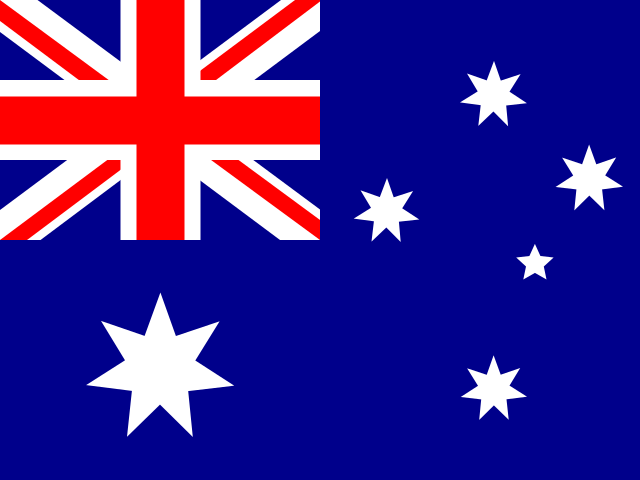
The Flag of Australia
Oceania · Adopted 3 September 1901 (design chosen); 1 March 1954 (made the statutory national flag by the Flags Act 1953)
Australia's flag began as the winning entry in a public design competition run in 1901, the year the six British colonies federated into the Commonwealth of Australia. More than 32,000 entries were submitted, and the judges could not separate five near-identical designs, so the prize money was split five ways between Ivor Evans, Leslie Hawkins, Egbert Nuttall, Annie Dorrington, and William Stevens — a schoolboy, an optician's assistant, a ship's officer, an artist, and a fisherman among them, none of them a professional designer. The winning design was flown for the first time on 3 September 1901, now marked annually as Australian National Flag Day.
For its first half-century the flag had no fixed legal status; it was used by convention and by naval regulation (it became the Royal Australian Navy's ensign in 1903) rather than by statute. That changed with the Flags Act 1953, which came into force on 1 March 1954 and made the Blue Ensign design the country's legally defined national flag for the first time, specifying its proportions and the exact placement of every star.
The canton carries the Union Jack, a direct holdover from Australia's status as a British colonial federation in 1901 and a design choice that has made the flag itself a recurring subject of political debate ever since, particularly around the 1999 republic referendum, when flag-change proposals circulated alongside the republic question without ever reaching a vote of their own.
Below the Union Jack sits the Commonwealth Star, a seven-pointed star whose points originally represented the six founding states plus one for the future territories and any states yet to join — a piece of forward-planning built into the design from 1901, before the territories it anticipated even had that status.
The five stars on the fly represent the Southern Cross, the constellation visible from everywhere in Australia and used on regional flags across the Pacific for exactly that reason of shared visibility. Four of Australia's five stars have seven points each; the fifth, smallest star has only five points, a deliberate variation that also functions as a practical way to tell Australia's flag apart from other Southern Cross flags in the region at a glance.
The Commonwealth Star itself was not always seven-pointed. When the design was first flown in 1901 it carried six points, one for each of the founding states — New South Wales, Victoria, Queensland, South Australia, Western Australia, and Tasmania. In 1908 the government added a seventh point to represent the territories collectively and to leave room symbolically for any future state, a change made while the flag was still governed by naval and administrative custom rather than statute, seven years before the outbreak of the First World War in which the flag would fly over Australian forces for the first time as a national force distinct from individual colonial contingents.
Flag protocol in Australia is set out formally by the federal government rather than left to custom: the flag must never touch the ground, must never be flown upside down except deliberately as a distress signal, and is flown at half-mast on designated days of national mourning, including the afternoon of ANZAC Day, 25 April. The Flags Act 1953 also guarantees that any Australian citizen or organization is entitled to fly the flag without needing government permission, a specific statutory protection not every country extends to its own national symbol.
A separate and increasingly prominent national symbol exists alongside the official flag: the Aboriginal Flag, designed in 1971 by Luritja artist Harold Thomas — black for Aboriginal people, red for the earth and for spiritual relationship to the land, and a yellow circle for the sun. It was given legal status as an official flag of Australia in 1995 under the Flags Act, a recognition that took nearly a quarter-century after the flag's creation, and it is now regularly flown alongside the national flag at government buildings and public events, a dual-flag arrangement without direct equivalent in most other Commonwealth countries.
Formal proposals to redesign the national flag itself — usually to remove the Union Jack — have been raised repeatedly since the 1990s, including by the Ausflag advocacy group founded in 1981, but none has gone to a binding national referendum, and polling on the question has shown persistently divided public opinion rather than a clear mandate either way.
Australia Day, 26 January, and Flag Day, 3 September, are the two occasions flag ceremonies are most visible nationally, and by convention the flag is never to be flown upside down, allowed to touch the ground, or used as a tablecloth or drapery — protocols set out in the Australian Flags booklet issued by the federal government.
Six stars, and how many points
- Detail-accurate printed flag — There are six stars in all and they do not share a point count, one of them differing from the rest, so both the number and the points are checkable before anything is bought.
As an Amazon Associate we earn from qualifying purchases made through these links, at no extra cost to you.
Often confused with
- New Zealand — the flag most often mistaken for Australia's — both are Blue Ensigns built around the Southern Cross, but New Zealand uses four plain red stars with white borders and no Commonwealth Star, while Australia uses a mix of five- and seven-pointed white stars plus the extra star beneath the Union Jack. Compare side by side →
Australia at a glance
- Capital
- Canberra
- Population
- 26.6 million (2024)
- Currency
- Australian Dollar (AUD)
- Language(s)
- English (de facto national language; Australia has no official language defined in federal law)
Population figure as of 2024, source: UN World Population Prospects (2024 revision). See methodology for how facts are sourced and kept current.