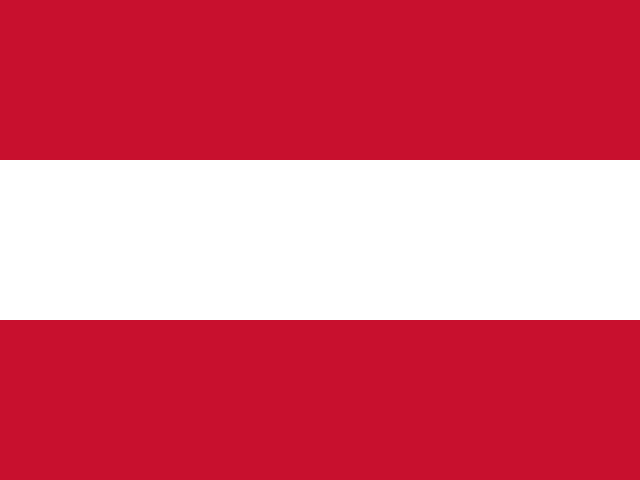
The Flag of Austria
Europe · Adopted 1 May 1945 (readopted after WWII); pattern dates to the 13th century
Austria's red-white-red horizontal tricolor is, by the country's own account, the oldest national flag design in continuous use anywhere in Europe, with a founding legend set during the Third Crusade. According to that tradition, Duke Leopold V of Austria fought so fiercely at the 1191 siege of Acre that his white surcoat was soaked in blood from head to toe except for a pale strip left dry where his sword belt had been cinched — and when he removed the belt afterward, the red-white-red pattern it revealed became his personal, and eventually his duchy's, banner. Historians treat the Acre story as unverifiable legend rather than documented fact, but seals and records confirming Austrian dukes using a red-white-red device do exist from as early as the 1230s, giving the pattern genuine medieval roots regardless of how literally the Leopold story should be taken.
That red-white-red scheme survived the centuries mostly intact through the Habsburg dynasty's long rule, though the Habsburgs' own dynastic black-and-gold flag frequently overshadowed it as the empire's primary symbol during the era of Austria-Hungary. It was the collapse of the Habsburg monarchy after the First World War that pushed red-white-red back to prominence: the newly declared Republic of German-Austria adopted it as the national flag in 1918, deliberately reaching back past the imperial black-and-gold to the older ducal colors as a symbol of a republic distinct from the fallen monarchy.
Austria's 20th century then put the flag through a genuinely turbulent stretch that few other European flags experienced in quite the same way: it was suppressed entirely after the 1938 Anschluss, when Nazi Germany annexed Austria and replaced Austrian symbols with the swastika flag for the seven years of the country's incorporation into the Third Reich. Red-white-red was formally readopted on 1 May 1945 as Austria reestablished itself as an independent state amid the collapse of Nazi Germany, making that date — rather than any point in the medieval or early-modern period — the official adoption date of the current flag even though the pattern itself long predates it.
Red is explained in modern Austrian civic material simply as the historic ducal and national color rather than carrying an official symbolic meaning tied to bloodshed the way some newer flags' red does; the flag's significance rests more on its sheer continuity and its association with Austrian identity across changes of regime than on any single interpretive reading of the colors themselves. A separate state flag, used on government buildings, adds Austria's federal eagle — holding a hammer and sickle in its talons and a broken chain around one leg, symbols added after 1945 representing labor, agriculture, and liberation from Nazi rule — centered on the white stripe, but the plain tricolor is what flies as the civil flag and is what most Austrians and visitors think of as 'the Austrian flag.'
The 1918 First Republic's choice was not uncontested at the time: German-nationalist factions within the new republic actually favored union with Germany and some briefly floated the idea of adopting German colors instead, but the red-white-red tricolor's deep association with the Babenberg and Habsburg-era Duchy of Austria specifically, rather than with the wider German-speaking world, made it the design that stuck as a marker of a distinctly Austrian rather than pan-German identity — a distinction that mattered again, far more gravely, two decades later when Nazi Germany's annexation made that same 'distinctly Austrian' identity the reason the flag was banned.
Postwar Austria's decision to readopt red-white-red so quickly, within weeks of the war's end in Europe and before the country had even fully reestablished its government structure, reflected a deliberate effort by the reconstituted political leadership to assert continuity with the pre-1938 First Republic and to visually repudiate the Nazi period as an aberration rather than a homegrown development — a framing that Austria's postwar self-image leaned on heavily for decades, even as historians later pushed back on the simplicity of treating Austria purely as Nazi Germany's 'first victim' rather than an active participant in the Anschluss.
Because a horizontal red-white-red tricolor is a genuinely simple design, Austria's flag is occasionally confused with other red-white-red flags used elsewhere, including Latvia's (which uses a distinctly darker, maroon-toned red and a different stripe proportion) and Canada's provincial and historic flags in some contexts; within Europe, the closest lookalike is the flag of Poland turned sideways in casual description, though Poland's is only two stripes, white over red, rather than three.
Austria's flag flies year-round over government buildings and is especially prominent around Austrian National Day on 26 October, which commemorates the 1955 law establishing Austria's permanent neutrality after the withdrawal of postwar Allied occupation forces — a different anniversary from the flag's own 1945 readoption but one closely tied in the public mind to Austria's assertion of full postwar sovereignty.
The claimed 13th-century seal evidence for the red-white-red pattern comes chiefly from a 1230 depiction connected to Duke Frederick II of Austria, the last Babenberg ruler, whose family's own heraldic devices are recorded using red and white well before the Habsburgs took control of the duchy later that century — meaning the flag's colors are tied to a specific ducal lineage that predates Habsburg rule by decades, a detail Austrian vexillological sources cite as the closest documentary anchor to the far more famous but historically shakier Leopold-at-Acre legend.
The plain version, not the eagle one
- Civil flag without the emblem — The page distinguishes the everyday flag from a separate version used on government buildings that adds a centred bird, so the thing to check in a listing is that the white band is empty.
As an Amazon Associate we earn from qualifying purchases made through these links, at no extra cost to you.
Often confused with
- Latvia — also a red-white-red horizontal tricolor, but Latvia's red is a distinctive dark maroon ('Latvian red') rather than Austria's brighter red, and the stripe proportions differ — Latvia's white band is notably narrower. Compare side by side →
Austria at a glance
- Capital
- Vienna
- Population
- 9.2 million (2024)
- Currency
- Euro (EUR)
- Language(s)
- German (official)
Population figure as of 2024, source: UN World Population Prospects (2024 revision). See methodology for how facts are sourced and kept current.