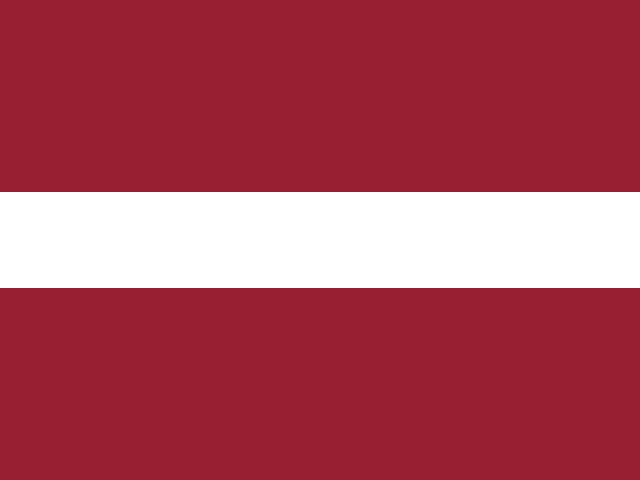
The Flag of Latvia
Europe · Adopted 27 February 1990 (readopted after Soviet occupation; original design dates to a 13th-century chronicle, first used as a modern national flag in 1917-18)
Latvia's flag carries one of the oldest documented origin claims of any national flag still in use: a dark-red-white-dark-red horizontal design is described in the Rhymed Chronicle of Livonia, a 13th-century historical account, in a passage describing a Latgalian tribal banner used in battle — centuries before any unified Latvian state existed. That chronicle reference is genuinely old and widely cited, though historians note it describes a specific local tribal banner rather than proof of a continuous, unbroken flag tradition running from the 1200s straight through to the modern Latvian state; the practical, documented revival of the design as a national symbol dates to the early 20th century rather than an unbroken medieval-to-modern lineage.
The modern flag was formally designed and popularized during the First World War, when Latvian nationalist and student groups revived the chronicle's dark-red-white color scheme as a distinctly Latvian national symbol distinct from both the Russian imperial colors Latvia had lived under and the flags of neighboring Baltic and German communities; it was flown as the flag of the short-lived independent Republic of Latvia proclaimed on 18 November 1918, and formally adopted by law in 1921 during that first period of independence.
The distinctive dark maroon-red shade — genuinely darker and more brownish than the bright reds used on most national flags — is central to Latvian national identity around the flag and is popularly explained through a folk legend describing a wounded Latvian chieftain wrapped in a white sheet, whose blood stained the cloth dark red at the edges while the center, protected by his body, stayed white; the story, whatever its historical accuracy, is widely taught and cited as the reason the flag uses this specific dark shade rather than a brighter red.
Latvia's independence, and its flag, were extinguished by force in 1940 when the Soviet Union annexed all three Baltic states under the terms of the Molotov-Ribbentrop Pact, followed by Nazi German occupation from 1941 to 1944 and then renewed Soviet control until 1991 — a fifty-year period during which flying the pre-war Latvian flag was banned and could result in serious punishment, and the Latvian Soviet Socialist Republic instead used a Soviet-style red flag with a stylized blue wave design added in 1953.
The dark-red-white-dark-red flag was legally restored even before Latvia's full formal independence was internationally recognized: it was readopted as the official state flag on 27 February 1990 by the Latvian SSR's own Supreme Council, a symbolic and legal act during the final unraveling of Soviet control that preceded Latvia's full restoration of independence, recognized internationally in September 1991 following the failed Soviet coup that August.
The proportions of the stripes were fixed precisely by a 1922 law (2:1:2 for the two dark-red bands relative to the white one) reaffirmed after 1990, a specific ratio genuinely distinctive among the world's tricolors and horizontal-banner flags, most of which use equal-width stripes; Latvia's noticeably narrower white center band is a recognizable design signature of the flag.
Because Latvia's flag uses similar dark-red-and-white coloring in a horizontal band arrangement, it is occasionally confused by casual observers with Austria's flag, though the two share no historical connection and Austria's stripes are of equal width rather than Latvia's distinctive narrow-center proportion.
Latvia's dark-red shade even has its own dedicated name in Latvian, 'Latvian red' (or informally, 'dark carmine'), and the country's design authorities have on several occasions published precise Pantone-equivalent specifications specifically to stop manufacturers producing flags in an ordinary bright red that Latvians themselves generally regard as visually wrong for their national colors — a level of public attentiveness to a single exact hue that is unusually strong compared with most other nations' flag traditions.
The flag's 1990 legal restoration during the final years of Soviet rule carried real personal risk for the officials who voted for it, since the Soviet central government had not yet recognized any Baltic republic's right to leave the union, and Latvia's move was quickly followed by heightened tension with Moscow that culminated in January 1991, when Soviet security forces killed several civilians at a television tower and other sites in Riga in an attempt to reassert central control shortly before the union's final collapse later that year.
Latvia's flag is also central to the 'Baltic Way' of 23 August 1989, when an estimated two million people joined hands in a continuous human chain stretching roughly 675 kilometers across Estonia, Latvia, and Lithuania to mark the 50th anniversary of the Molotov-Ribbentrop Pact and demand independence — a demonstration in which the flags of all three Baltic states, restored or still officially banned depending on the country at that exact moment, were carried together as a unified symbol of the shared occupation history the three nations wanted the world to recognize.
Latvian expatriate and refugee communities who fled westward during the Soviet occupation kept the pre-war dark-red-white-dark-red flag alive abroad throughout the entire fifty-year occupation, flying it at diaspora community centers, churches, and commemorative events in exile in countries such as the United States, Canada, Australia, and West Germany — a continuity of use outside Latvia's own borders that meant the flag never fully disappeared from public life even while it was banned at home.
A white band a fifth of the height
- Proportion-accurate flag — The two dark bands are twice the depth of the white one each, which makes the white a fifth of the total height: much narrower than the even thirds most tricolour stock is cut to.
As an Amazon Associate we earn from qualifying purchases made through these links, at no extra cost to you.
Often confused with
- Austria — shares the same red-white-red horizontal band arrangement and a similarly dark red tone, but Austria's three stripes are equal width while Latvia's white center band is noticeably narrower, and the two flags emerged from entirely separate historical traditions. Compare side by side →
- Bahrain — no genuine visual similarity in layout, but is sometimes grouped by casual quiz-takers among 'dark red flags' alongside Latvia's due to sharing a comparably deep red shade, despite Bahrain's serrated white-and-red vertical design being structurally unrelated. Compare side by side →
Latvia at a glance
- Capital
- Riga
- Population
- 1.9 million (2024)
- Currency
- Euro (EUR)
- Language(s)
- Latvian (official)
Population figure as of 2024, source: UN World Population Prospects (2024 revision). See methodology for how facts are sourced and kept current.