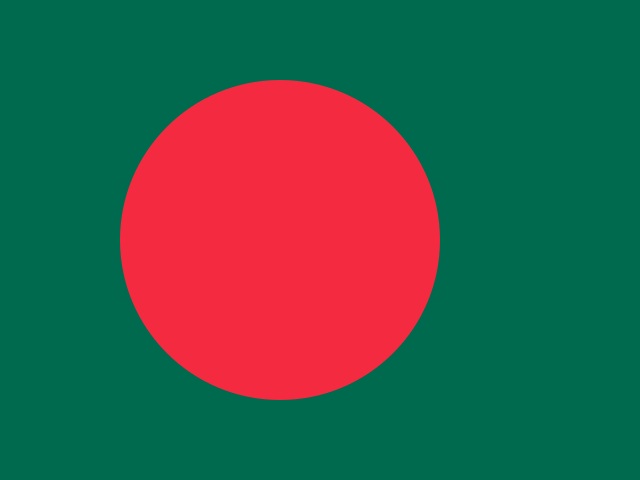
The Flag of Bangladesh
Asia · Adopted 17 January 1972 (design used unofficially from 1971)
Bangladesh's flag — a green field with a red disc set slightly toward the hoist side — was first flown, in an earlier version, on 2 March 1971 by student activists at Dhaka University, weeks before the Bangladesh Liberation War against Pakistan formally began on 26 March 1971. That original version carried a gold silhouette map of Bangladesh inside the red disc, a bold and literal symbol of the territory the independence movement was fighting to establish as its own state. After independence was won later that year with Indian military support, the map was dropped from the official flag adopted on 17 January 1972, because it proved impractical to render accurately at small sizes and looked different depending on which side of the flag was viewed, and because officials wanted a cleaner, more enduring design.
The disc is deliberately positioned off-center, shifted toward the hoist (the pole side) rather than dead-center on the field, so that when the flag flies and ripples in the wind, the visual effect makes the disc appear centered to an observer looking at the flag as it billows outward — a practical design choice specific to how flags actually behave in motion rather than how they look flat on a page or a screen.
Green is explained officially as representing the lush vegetation of the Bangladesh delta and, more broadly, the youthfulness and vitality of the nation at its founding, while the red disc represents the sun rising over Bengal and, inescapably, the blood of those killed during the 1971 Liberation War, a conflict with a death toll disputed among historians but estimated by various sources from several hundred thousand up to three million, and taught in Bangladesh as a central founding sacrifice comparable to how other post-independence states treat their own liberation-war memory.
Before 1971, the territory now called Bangladesh was East Pakistan, part of Pakistan since the 1947 partition of British India despite being geographically separated from West Pakistan by the whole breadth of India — a division that flew Pakistan's white-crescent-and-star flag until the 1971 war ended that arrangement and produced an entirely new, unrelated flag rather than a modification of Pakistan's design.
The exact shade of green specified in Bangladesh's flag regulations is a distinctive bottle or forest green rather than a brighter green, and the red is a similarly specific, slightly orange-leaning red — precise Pantone-equivalent values are set out in the government's flag rules, along with the flag's 3:5 ratio and the disc's exact size and placement, which is fixed at slightly left of the flag's geometric center along the horizontal axis.
Bangladesh's flag has not been redesigned since the map was dropped in 1972, making the 1972 adjustment the only change in the flag's history rather than one of several redesigns; the disc-on-green pattern has occasionally been compared to Japan's white field with a red disc, though the differences — background color, disc size, and disc position — are pronounced enough that the resemblance rarely causes real confusion beyond the loosest visual description of 'a red circle on a flag.'
The flag's designer, Quamrul Hasan, was a well-known Bangladeshi artist who had already built a reputation for politically charged poster art before 1971, including a widely reproduced wartime poster depicting Pakistani military ruler Yahya Khan as a fanged monster; Hasan adapted an earlier flag concept associated with student leader Shibnarayan Das and the Dhaka University activists who first raised the map-bearing version in March 1971, refining the disc's proportions and dropping the map for the version formally adopted in January 1972 once the war had ended and a permanent design was needed.
Bangladesh's Liberation War Museum in Dhaka preserves several of the earliest surviving flags flown by Mukti Bahini guerrilla fighters during the nine-month war, and some of these display noticeably cruder, hand-sewn maps and irregular disc placement compared with the standardized post-1972 version — physical evidence of how quickly and informally the symbol spread among resistance fighters well before any government existed to formalize its design.
The government's flag rules also specify a distinct, smaller version of the flag for use on vehicles belonging to the President and Prime Minister, distinguishing it from the standard civilian and government flag by a slightly different aspect ratio, and separate protocol governs the flag's display at half-mast on National Mourning Day, 15 August, commemorating the 1975 assassination of independence leader Sheikh Mujibur Rahman, a date now marked with the same gravity as Victory Day, 16 December, and Independence Day, 26 March.
Bangladesh's 1971 war for independence is estimated by various sources to have displaced roughly ten million refugees into neighboring India before it ended, one of the largest single refugee movements of the 20th century, and India's direct military intervention in December 1971 was decisive in bringing the conflict to a rapid close after Pakistani forces surrendered in Dhaka on 16 December — a date now marked annually as Victory Day, when the green-and-red flag is displayed alongside memorials to the war dead across the country in a manner distinct from the more purely celebratory tone of the March Independence Day holiday.
The flag's red disc has occasionally prompted debate within Bangladesh itself over whether its position should be adjusted slightly for flags displayed on the reverse side, since a disc fixed asymmetrically toward the hoist on the front appears mirrored — and therefore shifted toward the fly — when a viewer sees the reverse of a flag sewn from a single layer of cloth; government specifications resolve this by requiring official flags to be manufactured with the disc's correct hoist-side position sewn independently onto both faces rather than allowing a single printed or dyed layer to show through backward.
The green, and which face the disc sits on
- Dyed-through flag — The page specifies a deep bottle or forest green rather than a bright one, and that darker value is exactly what a surface print loses first in sun.
- Double-sided flag — The red disc is set slightly toward the hoist rather than centred, which the page notes means it appears shifted the other way when the cloth is seen from behind. A two-layer flag puts it toward the hoist on both faces.
As an Amazon Associate we earn from qualifying purchases made through these links, at no extra cost to you.
Often confused with
- Japan — both flags feature a red disc as the central device, but Japan's disc sits perfectly centered on a white field, while Bangladesh's is deliberately off-center on green — different colors, sizes, and placement make direct confusion uncommon. Compare side by side →
Bangladesh at a glance
- Capital
- Dhaka
- Population
- 173.6 million (2024)
- Currency
- Bangladeshi Taka (BDT)
- Language(s)
- Bengali (official)
Population figure as of 2024, source: UN World Population Prospects (2024 revision). See methodology for how facts are sourced and kept current.