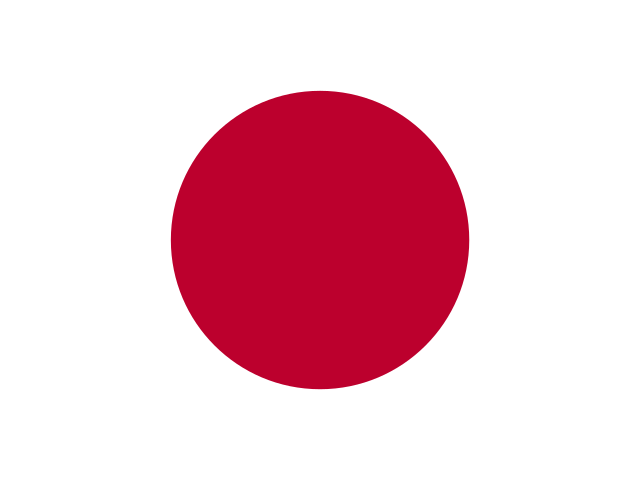
The Flag of Japan
Asia · Adopted 13 August 1999
Japan's Hinomaru — 'circle of the sun' — did not become legally official until 13 August 1999, under the Act on National Flag and Anthem, a surprisingly late formalization for a design that had already functioned as Japan's de facto national flag for well over a century and as a recognized emblem for far longer than that.
Sun imagery has been associated with Japan and its imperial line since at least the 7th century, tied to the country's self-description as the 'Land of the Rising Sun' and to Shinto mythology in which the imperial family descends from the sun goddess Amaterasu. The simple red-disc-on-white design in something close to its current form was used on military banners and by regional lords well before the modern Japanese state existed.
The Hinomaru's shift toward a genuinely national symbol began in the Meiji era: an 1870 government proclamation designated it as the ensign for merchant ships, which is generally treated as its first formal government sanction, and it was then adopted more broadly as the state's flag through the late 19th and early 20th centuries as Japan modernized its institutions along Western lines.
During Japan's 1868–1945 imperial expansion and through World War II, the Hinomaru became closely associated with Japanese militarism across the countries Japan occupied, and that association didn't disappear with Japan's surrender — the flag's display was restricted during the postwar Allied occupation and only fully unrestricted again in 1949, and even decades later its use at some public schools and events remained politically sensitive within Japan itself, tied to broader disputes over how the wartime period is taught and remembered.
The 1999 law did not change the Hinomaru's design at all; its purpose was narrower and more technical — to fix the flag's exact proportions (2:3, with the red disc's diameter set at three-fifths of the flag's height and centered), the precise shade of red, and the wording of the national anthem Kimigayo in a single piece of legislation, replacing what had previously been a mix of custom and a much older, less precise 1870 specification.
The red disc has no separate emblem, script, or additional symbol layered onto it, which makes the Hinomaru one of the visually simplest national flags in the world — a distinction that also makes it easy to reproduce accurately by hand, a practical factor in how quickly and widely it could be adopted as a genuinely national symbol once Meiji-era Japan needed one.
The Hinomaru remains a fixture of Japanese public life today, flown at government buildings, schools, and sporting events, and it appears in a modified, angular form as the naval ensign of Japan's Maritime Self-Defense Force, a version with sixteen red rays radiating from the disc that is distinct from, and legally separate from, the plain civilian national flag.
The 1999 legislation that finally codified the Hinomaru was itself politically contentious when it passed: opposition lawmakers and some educators objected specifically to provisions encouraging its display and the anthem's performance at public school ceremonies, arguing this risked reviving compulsory nationalism reminiscent of the wartime period, while supporters argued Japan needed a legally settled national flag like any other modern state rather than one resting only on custom.
Okinawa's relationship with the Hinomaru carries its own distinct history within Japan: the flag was formally banned there during the nearly three decades of U.S. administration that followed World War II until Okinawa's 1972 reversion to Japanese sovereignty, and its display in the intervening years by Okinawans was itself sometimes a pointed assertion of Japanese identity under foreign occupation rather than a straightforward patriotic gesture.
The Hinomaru is also a fixture of Japanese sporting culture well beyond formal state ceremony: it is fan-waved in enormous numbers at international competitions, appears stitched onto competitors' uniforms, and is traditionally signed by well-wishers on a hand-drawn version — known as a yosegaki hinomaru — given as a keepsake to soldiers, travelers, or athletes departing on a significant undertaking, a folk custom distinct from, and much older than, the flag's 1999 legal codification.
Because the design is so visually simple, informal or unofficial variations of a red-disc-on-white pattern occasionally appear in commercial branding or design work with only a loose connection to Japan itself, though no other country's official national flag uses the same plain centered-disc composition, which keeps the Hinomaru visually distinct even from flags that use a similar disc-on-field concept, such as Bangladesh's off-center green-and-red design.
National Foundation Day, observed on 11 February, is the closest Japan has to a flag-centered public holiday, commemorating the traditional, legendary accession date of Japan's first emperor, Jimmu, in 660 BCE; the holiday's display of the Hinomaru is noticeably more restrained than equivalent flag-heavy national holidays in many other countries, reflecting the flag's more complicated postwar political associations relative to its purely decorative use at sporting events.
Japanese municipal and prefectural governments each maintain their own separate flags and emblems flown alongside the Hinomaru at local government buildings, a two-tier flag system — national plus prefectural or municipal — common in Japan's administrative culture and distinct from countries where only a single national flag is typically displayed at government sites.
The Hinomaru's diameter-to-height ratio and its precise centering were left comparatively loose under the older 1870 specification, and part of the practical motivation for the 1999 law was to standardize mass-produced flags after decades in which manufactured Hinomaru flags had drifted into slightly inconsistent proportions depending on the maker.
Keeping the disc a true circle
- Flag cut to 2:3 — A disc is the one device that shows a wrong ratio instantly: stretch this flag to a longer stock cut and the circle becomes a visible ellipse, which no amount of print quality fixes.
As an Amazon Associate we earn from qualifying purchases made through these links, at no extra cost to you.
Often confused with
- Bangladesh — also centers a plain colored disc on a solid field, but Bangladesh's disc is set slightly off-center toward the hoist on a green field, rather than dead-center on white, and is a darker red-orange. Compare side by side →
Japan at a glance
- Capital
- Tokyo
- Population
- 123.8 million (2024)
- Currency
- Japanese Yen (JPY)
- Language(s)
- Japanese (de facto national language; no official language is designated by law)
Population figure as of 2024, source: UN World Population Prospects (2024 revision). See methodology for how facts are sourced and kept current.