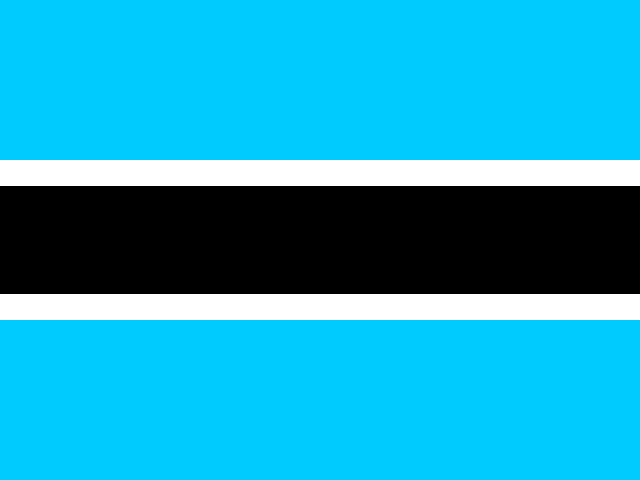
The Flag of Botswana
Africa · Adopted 30 September 1966
Botswana adopted its flag on 30 September 1966, the day the former Bechuanaland Protectorate became independent from Britain, and the design was chosen with a deliberate eye toward standing apart from its neighbors: at the time, South Africa and Rhodesia were both under white-minority rule, and Botswana's designers wanted a flag that avoided any visual association with either the apartheid-era South African flag or the pan-African red-gold-green palette used by many other newly independent African states.
The result is a light blue field — chosen to represent water, and specifically rain, in a country roughly 70% covered by the Kalahari Desert — crossed by a horizontal black stripe outlined in white. Botswana's national motto, adopted at the same time, is simply 'Pula,' the Setswana word for rain, which is also the name of the national currency; water scarcity is central enough to national identity that greeting someone with 'Pula!' functions as a kind of secular blessing.
The black-and-white stripe is officially read two ways at once: as a symbol of racial harmony between Botswana's Black and white citizens, a message that mattered enormously given what was happening across the border in Rhodesia and South Africa in 1966, and separately as a visual reference to the zebra, which was adopted as Botswana's national animal and appears on the country's coat of arms alongside the flag.
Unlike many African flags designed around the same time, Botswana's has never been altered, redesigned, or contested by a change in government — a stability that mirrors the country's unusually uninterrupted record of multiparty democracy since independence, a rarity on the continent through the late 20th century.
The choice to avoid pan-African red, gold, and green was not an accident of taste; Botswana's post-independence leadership, led by first president Seretse Khama, deliberately positioned the young country as a peaceful, resource-cautious democracy distinct from the revolutionary rhetoric of some neighboring liberation movements, and the flag's calm, geometric design reflects that same instinct toward restraint.
Seretse Khama himself had returned to Bechuanaland only a few years before independence after a long exile in Britain, forced on him by colonial and South African objections to his marriage to a white British woman, Ruth Williams; his eventual leadership of a peacefully governed, racially inclusive new nation gave the flag's black-and-white 'harmony' symbolism a resonance rooted directly in his own personal history rather than being purely abstract.
Botswana's discovery of major diamond deposits at Orapa in 1967, barely a year after independence, meant the country's leadership was able to fund infrastructure, healthcare, and education without the heavy foreign-debt burdens many newly independent African states faced, reinforcing the flag-era narrative of Botswana as a calm, well-managed exception to regional instability rather than a revolutionary state defined by struggle.
Government specification sets the flag's proportions at 2:3, with the central black stripe flanked on each side by narrow white fimbriations — a geometric arrangement Botswana has never modified since the original 1966 adoption.
Because Botswana's economy and society revolve so heavily around cattle-keeping in addition to diamonds, some commentators have offered an alternative popular reading of the flag's black-and-white stripes as evoking the hide of cattle as much as the zebra, though the zebra remains the officially designated national symbol tied to the design.
The 30 September independence anniversary is marked nationally as Botswana Day, with flag-raising ceremonies held in Gaborone's main stadium as the centerpiece of the country's official celebrations each year, alongside similar smaller ceremonies in regional centers.
Botswana's currency name, Pula, doubles as the flag's implicit motto even though the word does not appear on the flag itself; the same word is stamped on every banknote and coin, reinforcing water's symbolic centrality to national identity well beyond the flag alone.
Design historians studying African flags of the 1960s frequently cite Botswana's as one of the clearest examples of a newly independent state consciously rejecting both its colonial past and the dominant pan-African symbolic vocabulary at once, opting instead for an entirely locally grounded set of references drawn from climate and wildlife rather than politics.
The 1966 coat of arms reinforces the flag's themes directly: it depicts a pair of zebras supporting a shield, with cogwheels representing industry, a head of sorghum representing agriculture, and the same 'Pula' motto beneath — making the flag and coat of arms a genuinely coordinated symbolic pair rather than two unrelated designs adopted independently.
Public flag etiquette in Botswana is treated with particular seriousness for a country its size: schools hold regular flag-raising assemblies, and the national anthem, 'Fatshe leno la rona,' is typically sung immediately alongside the raising of the flag at official events, pairing the two national symbols in almost every formal ceremony.
Botswana's tourism industry, built heavily around the Okavango Delta and Chobe National Park, has increasingly used the flag's blue-and-black imagery in branding aimed at international visitors, leaning on the same water-and-wildlife associations the flag's designers built in from the start rather than inventing new symbolism for marketing purposes. Roughly 38% of the country's total land area is now under some form of wildlife-conservation protection, among the highest shares of any nation, reinforcing at a policy level the same environmental identity the flag gestures toward symbolically.
Why the thin white lines decide the flag
- Sewn-stripe flag — The two hairline white edges either side of the black stripe are the whole design. Stitched panels hold those narrow widths; a loose print lets them bleed into the black and the flag reads as a plain band.
As an Amazon Associate we earn from qualifying purchases made through these links, at no extra cost to you.
Often confused with
- Eswatini — sometimes confused only by unfamiliar viewers due to a shared Southern African identity, but Eswatini's flag carries a crimson band with a black-and-white shield and spears, visually nothing like Botswana's minimalist blue-and-black bands. Compare side by side →
Botswana at a glance
- Capital
- Gaborone
- Population
- 2.5 million (2024)
- Currency
- Botswana Pula (BWP)
- Language(s)
- English and Setswana (official)
Population figure as of 2024, source: UN World Population Prospects (2024 revision). See methodology for how facts are sourced and kept current.