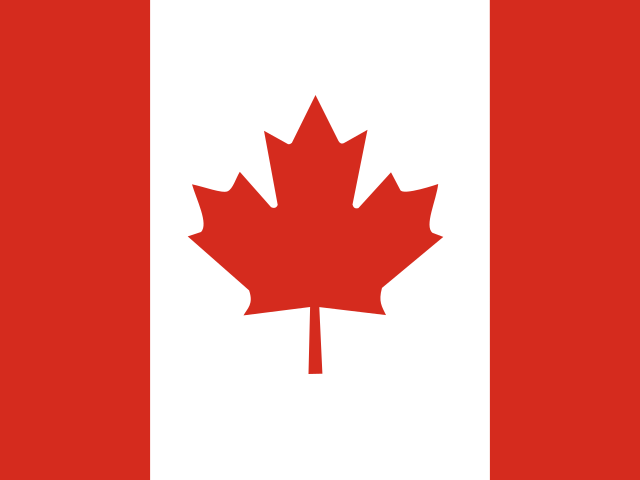
The Flag of Canada
North America · Adopted 15 February 1965
Canada's maple leaf flag was raised for the first time on 15 February 1965, a date still marked annually as National Flag of Canada Day, after one of the most contentious political debates in modern Canadian history — remembered as the 'Great Flag Debate' of 1964. Prime Minister Lester B. Pearson pushed for a distinctly Canadian flag to replace the Canadian Red Ensign, a British-derived banner combining the Union Jack with Canada's shield, which many English Canadians strongly favored keeping precisely because of its ties to Britain and to the Commonwealth, while French Canadians and many others saw it as failing to represent a country that was no longer, in practice, a colonial extension of Britain.
The debate consumed months of parliamentary time through 1964, with opposition leader John Diefenbaker fighting hardest to preserve some form of the Red Ensign or at least the Union Jack within any new design, before Pearson's government forced the issue through an all-party parliamentary committee and eventually a closure motion to end debate and bring the matter to a vote in December 1964. The result was a design substantially different from anything the Ensign had featured: a single red maple leaf on a white square field, flanked by two red vertical bars — a radical simplification compared to the heraldic Ensign it replaced, and a deliberate rejection of any British symbol in the new flag at all.
The eleven-point stylized maple leaf at the center was the product of extensive testing; designers under George Stanley, a historian whose 1964 memo first proposed the red-white-red pattern with a single central maple leaf, and graphic designer Jacques Saint-Cyr, who refined the leaf's final eleven-point shape for legibility at a distance and in wind, worked through wind-tunnel-style visibility testing to arrive at a leaf silhouette that would read clearly as a maple leaf rather than blur into an indistinct blob when the flag was flying — a practical design constraint that shaped the leaf's now-iconic angular, simplified form.
Red and white were chosen because they were already Canada's official national colors, proclaimed by King George V in 1921 for Canada's coat of arms, so the new flag's palette carried continuity even though its layout broke completely from the Red Ensign tradition. The maple leaf itself had been used as an unofficial Canadian symbol since the early 19th century, appearing on coins, regimental badges, and Canadian Expeditionary Force insignia in both World Wars, long before it became the sole central emblem of the national flag in 1965.
The maple leaf's symbolic weight in Canadian identity runs deeper than the flag alone — it appears on coinage, military insignia, and countless provincial and civic symbols, and readers curious how a single plant motif came to anchor an entire national identity can find more on the broader pattern of flags built around one dominant natural symbol at our sister site SymbolHubs, which covers the wider meanings behind national and cultural symbols in more depth than a single flag page allows.
Canada's flag has not been altered since its 1965 adoption, and unlike the decades of informal use the maple leaf enjoyed beforehand, its exact proportions, leaf geometry, and red shade (officially a specific Pantone red) are now fixed by federal law, administered under the Department of Canadian Heritage, with no subsequent design changes even as Canada's provinces and territories have each adopted their own separate flags in the decades since.
Because red-and-white with a central emblem is a globally common flag pattern, Canada's flag is occasionally confused at a glance with Peru's, though Peru's uses vertical red-white-red bands of different proportions and a national coat of arms rather than a maple leaf — the specific eleven-point leaf silhouette makes Canada's flag one of the more instantly identifiable national flags once seen up close, even if the general red-white-red structure has echoes elsewhere.
More than 2,000 designs were submitted to the parliamentary flag committee in 1964, including many that kept some version of the Union Jack in a corner canton in the style of Australia's or New Zealand's flags, and others that used a variety of Canadian symbols including beavers and fleur-de-lis; the committee's eventual unanimous recommendation for the single-leaf design surprised many observers given how divisive the broader debate in Parliament had been, and Pearson is reported to have privately favored a different three-leaf design of his own earlier in the process before the committee settled on Stanley and Saint-Cyr's simpler single-leaf version.
Reaction split sharply along regional and generational lines when the new flag was first raised on Parliament Hill in February 1965 — many veterans' groups and monarchist-leaning English Canadians criticized the loss of the Red Ensign's imperial ties, while Quebec nationalists and much of the rest of the country welcomed a flag that owed nothing to Britain, and polling in the years immediately after adoption showed the flag taking time to become the broadly unifying symbol it is regarded as today; Canadian surveys since the 1980s and 1990s have consistently found the maple leaf flag rated among the most positively regarded national symbols in the country, a reversal from the sharply divided reception it received at its 1965 debut.
The Red Ensign the maple leaf flag replaced is not entirely gone from Canadian public life: it survives informally in some veterans' and monarchist ceremonial contexts and in the design lineage of several Canadian provincial flags, including Ontario's and Manitoba's, both of which still incorporate the Union Jack in a canton in a style directly descended from the pre-1965 Red Ensign tradition Pearson's government moved the national flag away from.
The leaf has a fixed number of points
- Geometry-accurate flag — The leaf's geometry is specified rather than drawn from life, and redrawn versions add or lose points and round off the serrations, which is visible side by side with a correct flag.
As an Amazon Associate we earn from qualifying purchases made through these links, at no extra cost to you.
Often confused with
- Peru — shares the red-white-red vertical band structure at a glance, but Peru's central shield depicts a vicuña, a cinchona tree and a gold cornucopia spilling coins — heraldry with no connection to Canada's single leaf. Compare side by side →
Canada at a glance
- Capital
- Ottawa
- Population
- 40.1 million (2024)
- Currency
- Canadian Dollar (CAD)
- Language(s)
- English and French (official)
Population figure as of 2024, source: UN World Population Prospects (2024 revision). See methodology for how facts are sourced and kept current.