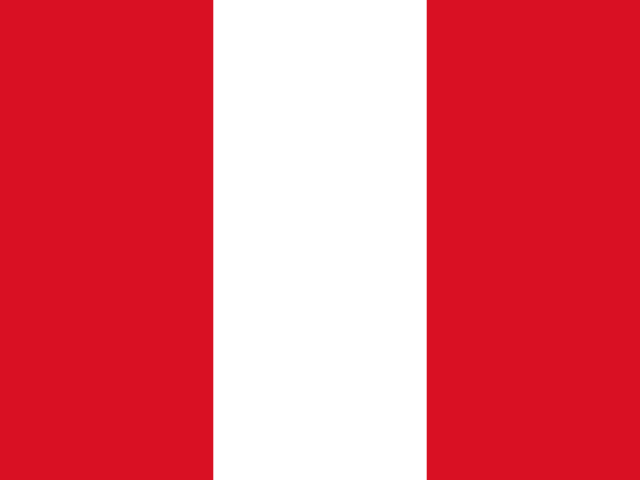
The Flag of Peru
South America · Adopted 25 February 1825 (present vertical tricolor); 31 March 1950 (present state flag with arms)
Peru's red-white-red vertical tricolor carries one of South America's more romanticized origin stories, and Peruvians themselves are generally aware it may not survive close historical scrutiny. Legend holds that General José de San Martín, the Argentine liberator campaigning along Peru's coast in 1820, was struck by a flock of red-and-white parrots — some versions of the story say flamingos — taking flight over the beach at Paracas, and chose the colors on the spot. Historians treat this as a charming but unverified tale rather than documented fact; what's certain is that San Martín did decree Peru's first flag in 1820, and it looked nothing like today's version — a diagonal red-and-white design with a rising sun, closer in spirit to some of the sun-and-sky flags used elsewhere in San Martín's home region.
The vertical red-white-red bands Peru flies today came later and went through several changes before settling. Simón Bolívar's government, which took over leadership of the independence campaign from San Martín, briefly imposed a horizontal red-yellow-blue-yellow-red design in the early 1820s modeled loosely on Gran Colombia's tricolor family further north. That design didn't stick, and Peru returned to vertical red-white-red bands, fixed by law in February 1825 — the version that has remained Peru's civil flag, essentially unaltered, for two centuries.
The state and war flags add a coat of arms centered on the white band, and the emblem is built around three specific national resources rather than abstract symbolism: a vicuña, the wild camelid native to the high Andes and Peru's national animal, prized for its fine wool; a cinchona tree, whose bark was the original source of quinine, the anti-malarial compound that made Peru's forests medically significant worldwide centuries before synthetic alternatives existed; and a cornucopia spilling gold coins, representing the mineral wealth that drew Spanish colonization to the region in the first place. Together the three sections are read as covering the animal, plant, and mineral kingdoms in a single emblem — an unusually literal piece of heraldry compared with most national coats of arms.
The current rendering of that coat of arms was fixed by law in 1950, standardizing details of the vicuña's pose and the exact composition of the shield after decades of minor variation in how different governments and printers had rendered it. Peruvian law also draws a sharp legal line between the plain civil flag (no emblem, for general public use) and the state flag carrying the coat of arms, which is reserved for government and military use — a distinction similar to the one Colombia and several other Latin American republics maintain.
Because Peru's flag has almost no ties, geographically or historically, to the Miranda-derived yellow-blue-red family used by Colombia, Ecuador, and Venezuela further north, it developed as a genuinely separate design tradition within South America, tied instead to San Martín's southern independence campaign rather than Bolívar's northern one — even though the two men's armies eventually met in Peru itself to finish the fight against Spanish colonial forces.
Peru's plain red-white-red vertical bands are visually close to a number of other flags that happen to use the same simple three-band structure and similar proportions, most notably Canada's, even though the two countries share no historical design lineage — the resemblance is a coincidence of two very different nations independently landing on a similar geometric solution.
The flag is flown most visibly on Independence Day, 28 July, marking the 1821 declaration in Lima, and on Flag Day itself, observed 7 June alongside the anniversary of the Battle of Arica, when schools across Peru hold ceremonies focused specifically on the flag's history.
That Flag Day date is itself a somber choice rather than a celebratory one: the Battle of Arica, fought 7 June 1880 during the War of the Pacific against Chile, ended in a decisive Chilean victory and the loss of Peruvian territory along the southern coast, and Peru commemorates its flag specifically on the anniversary of a defeat rather than a victory — a deliberate choice reflecting how the war, which cost Peru its nitrate-rich southern provinces permanently, remains a significant marker in national memory.
Peru's civil flag law also draws a firm line against private citizens displaying the version with the coat of arms, reserving that emblem-bearing flag for government, military, and diplomatic use — a distinction Peruvian authorities enforce more visibly than several neighboring countries with similar civil/state flag splits, including periodic public reminders around Independence Day not to fly the state version informally.
Peru's national anthem, adopted in 1821 the same year as independence, and its flag are frequently taught together in Peruvian civic education as a paired set of founding symbols from the same revolutionary moment, even though the flag's final vertical-stripe form wasn't actually settled until the 1825 law — a four-year gap between the anthem's adoption and the flag's final design that's rarely highlighted outside specialist historical accounts.
The vicuña depicted on Peru's coat of arms is more than decorative: the animal is legally protected in Peru, and its fine wool, among the most valuable natural fibers in the world, is harvested under strict government-regulated programs involving indigenous Andean communities, so the emblem's central image reflects an economic activity that is still actively practiced today rather than a purely historical or symbolic reference to the country's past.
Plain bands, and what they resemble
- Plain civil flag — The page notes how close this is to other three-band designs, and the everyday version carries no emblem at all, so what you are checking in a listing is that nothing has been added to the white band.
As an Amazon Associate we earn from qualifying purchases made through these links, at no extra cost to you.
Often confused with
- Canada — both use plain vertical red-white-red bands in similar proportions, but the resemblance is coincidental — the two flags share no historical design connection and Peru's state version adds a centered coat of arms Canada's never had. Compare side by side →
Peru at a glance
- Capital
- Lima
- Population
- 34.4 million (2024)
- Currency
- Peruvian Sol (PEN)
- Language(s)
- Spanish (official nationwide); Quechua and Aymara are official in the regions where they predominate
Population figure as of 2024, source: UN World Population Prospects (2024 revision). See methodology for how facts are sourced and kept current.