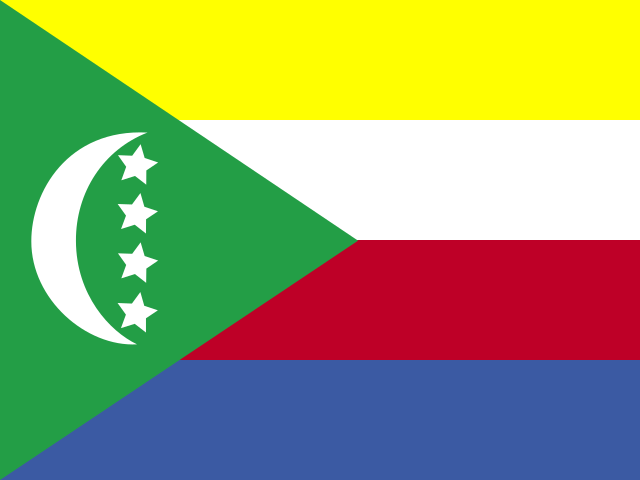
The Flag of Comoros
Africa · Adopted 7 January 2002
Comoros has burned through more national flags than almost any other country on earth, and the current design — a green field carrying a white crescent and four white stars, overlaid with four horizontal bars of yellow, white, red, and blue — dates only to a constitutional referendum on 23 December 2001, formally adopted in early January 2002. That churn is not accidental: the Comoros archipelago has spent much of its post-1975 independence lurching between coups, secession attempts, and constitutional rewrites, and each new political settlement tended to bring a new flag with it.
The four horizontal stripes and the four stars carry the same meaning, doubled: each represents one of the four main islands of the Comoros archipelago — Grande Comore (Ngazidja), Mohéli (Mwali), Anjouan (Nzwani), and Mayotte (Mahoré). That last one is the point of friction built directly into the flag. Mayotte voted to remain a French territory in referendums in 1974 and again in 2009, and is today a full French département, not part of the Comorian state in practice — yet Comoros has never dropped its claim, and the flag keeps flying a star and a stripe for a fourth island it does not actually govern, a deliberate irredentist statement stitched into the national symbol.
Green and the crescent moon are the flag's Islamic references, signaling that Comoros — whose population is overwhelmingly Sunni Muslim — is constitutionally an Islamic republic. The crescent-and-star combination is a design so widespread across the Muslim world that Comoros' particular version, with four stars rather than the more common single star, is one of the details that helps distinguish it at a glance from Ottoman-derived flags like Turkey's or Tunisia's.
Before the 2001 design, Comoros cycled through at least four distinct flags in under three decades of independence: a plain green flag with a white crescent and four stars used from 1975 to 1978, a design incorporating four colored stars representing the islands used from 1978 to 1992 with variations, and further adjustments tied to the country's shifting name (it briefly styled itself the Islamic Federal Republic of the Comoros, then later the Union of the Comoros) and its shifting relationship with the breakaway islands of Anjouan and Mohéli, both of which declared their own short-lived secessions in the 1997 crisis before rejoining under the 2001 constitutional settlement that also produced this flag.
The 2001 flag was adopted specifically as part of that reunification settlement — the new constitution created a more autonomous union structure giving Anjouan, Mohéli, and Grande Comore their own local presidents alongside a rotating union presidency, and the redesigned flag with its four equal stripes was meant to visually represent that four-way balance (including the still-claimed Mayotte) rather than favor any one island's earlier flag proposals.
Comorian law does not carry the same level of detailed technical specification for the flag's exact construction as some other nations' constitutions do; the 2001 design has nonetheless held steady through the subsequent two decades, including further political turbulence such as the 2007–2008 Anjouan crisis, without triggering another full redesign — the longest run of flag stability Comoros has had since independence.
The flag is not commonly confused with any other national flag at a glance — the specific stripe order and four-star crescent arrangement is fairly distinctive within the crescent-and-star family — though the general design language of green field, white crescent, and stars places it in the same broad Islamic-symbolism category as Mauritania's, Algeria's, and several other North and East African flags.
The Mayotte dispute embedded in the flag is not a settled historical footnote but an active diplomatic sore point: when Comoros declared independence unilaterally in 1975, France recognized the independence of only three of the four islands — Grande Comore, Anjouan, and Mohéli — while retaining Mayotte as French territory, a split the Comorian government has never accepted and continues to raise at the United Nations and African Union, where resolutions backing Comoros' claim to Mayotte have passed repeatedly without changing the practical situation on the ground.
That same island tension produced one of the odder episodes in the flag's history: during the 1997 Anjouan secession crisis, separatist leaders on Anjouan did not seek independence from Comoros at all but instead petitioned France to formally reabsorb the island as a department alongside Mayotte, and for a period local separatists flew the French tricolor over Anjouan rather than the Comorian flag — a direct inversion of the flag's own claim over Mayotte, playing out on a different island in the same archipelago.
Comoros' flag works out to a standard 2:3 proportion, but its build is structurally unusual: the four equal horizontal bands — yellow, white, red, and blue from top to bottom — sit as a discrete panel layered over the green field and crescent rather than being woven into one unified stripe pattern, a two-tier construction (field-plus-crescent underneath, four bars on top) rarely seen among flags that otherwise use a single flat pattern of stripes or quadrants.
Comorian Independence Day, 6 July, is the flag's most prominent annual public occasion, and the flag is also displayed heavily during Comoros' rotating presidency arrangement among the islands, a union structure introduced by the 2001 constitution that the flag's four-band design was created specifically to visually represent.
Comoros' population is spread unevenly across its three governed islands, with Grande Comore holding the largest share and hosting the capital, Moroni — a demographic imbalance that has periodically fed resentment on Anjouan and Mohéli toward Grande Comore's outsized political weight, one of the underlying tensions the 2001 constitution's rotating union presidency was designed to defuse, and which the flag's deliberately equal four-band structure was meant to visually deny rather than reflect.
A layered panel over a triangle
- Double-sided flag — Four bands sit over a green hoist triangle carrying a crescent and four stars, so the design has a definite front. Printed through one layer the crescent opens the wrong way from behind.
As an Amazon Associate we earn from qualifying purchases made through these links, at no extra cost to you.
Often confused with
- Mauritania — shares the green field and crescent-and-star Islamic symbolism, but Mauritania uses a single gold crescent and star rather than four white stars, and adds red border stripes rather than horizontal bars. Compare side by side →
Comoros at a glance
- Capital
- Moroni
- Population
- 852,000 (2024)
- Currency
- Comorian Franc (KMF)
- Language(s)
- Comorian, Arabic, and French (all official)
Population figure as of 2024, source: UN World Population Prospects (2024 revision). See methodology for how facts are sourced and kept current.