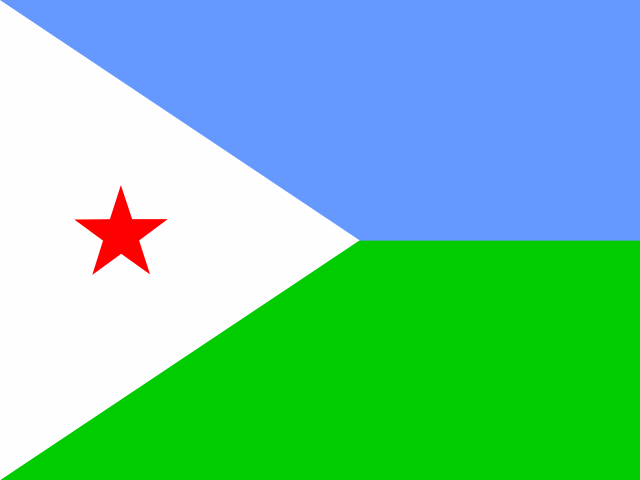
The Flag of Djibouti
Africa · Adopted 27 June 1977
Djibouti's flag became official on 27 June 1977, the exact day the tiny Horn of Africa territory gained independence from France as the French Territory of the Afars and the Issas — and the design itself is a direct visual compromise between the country's two dominant ethnic communities, the Afar and the Issa Somali, whose political rivalry shaped the territory's entire path to statehood.
The flag splits into two horizontal bands, light blue over light green, meeting a white triangle at the hoist that carries a red five-pointed star. The light blue is generally explained as representing the sky and the sea (and, by extension, the Issa Somali community, since blue is also the color of the Somali flag under which many Issa had wanted the territory to unite before independence), while the green represents the earth and, by extension, the Afar community and Islam. The white triangle stands for peace, and the red star for unity — a five-pointed star that also echoes the star on Somalia's own flag, a deliberate nod to Djibouti's large ethnic-Somali population even as the country chose full independence rather than union with Somalia.
That choice not to join Somalia was itself contested territory: in the years before 1977, factions within the territory campaigned for outright annexation by Somalia (which was pursuing a 'Greater Somalia' project uniting all Somali-inhabited territories in the Horn of Africa), while others sought continued closeness with Ethiopia or the Afar-dominated interior. The two-color, two-community flag design was a deliberate attempt to signal balance between the Issa and Afar populations rather than aligning the new state fully with either neighboring power.
Before 1977, the territory flew the French tricolor as a colony, first under the name French Somaliland from 1896 and later as the French Territory of the Afars and the Issas from 1967 onward — a renaming already meant to acknowledge the two-community reality that the eventual national flag would also encode.
The design has not been altered since independence, a stability that stands in some contrast to the territory's early political volatility; Djibouti held its first post-independence multiparty elections only in 1992, having operated under a one-party system led by Hassan Gouled Aptidon (of Issa background) through the 1980s, a period during which Afar grievances over political representation eventually spilled into a civil war from 1991 to 1994 — the flag itself remained unchanged as a shared symbol throughout that conflict rather than becoming a point of dispute between the factions.
At a passing glance Djibouti's flag can register as a cousin of Somalia's, both leaning on the same pale sky-blue and a star — but set side by side, the two designs pull apart quickly: Somalia keeps things to a single solid blue field with one oversized white star in the center, while Djibouti layers in a second field color, a white hoist triangle, and a noticeably smaller red rather than white star.
Djibouti's strategic position at the mouth of the Red Sea, controlling access to the Bab-el-Mandeb strait, has made it host to a striking number of foreign military bases for such a small country — including French, American, Japanese, and Chinese installations — but this geopolitical significance postdates the flag's design and had no bearing on its symbolism, which remains focused entirely on the internal Afar-Issa balance struck at independence.
The territory's 1967 renaming from French Somaliland to the French Territory of the Afars and the Issas followed a contested referendum that year on whether to remain French or seek independence, held amid accusations from pro-independence, largely Somali-aligned voters that France had manipulated the electorate (including by expelling Somali residents before the vote) to secure a pro-French outcome — a controversy that fed directly into the push for full independence a decade later and into the flag design's careful, deliberate balancing of the two main communities.
The 1991–1994 Afar-led civil war, fought by the Front pour la Restauration de l'Unité et la Démocratie (FRUD) against Hassan Gouled Aptidon's Issa-dominated government, ended in a peace agreement that brought Afar representatives into government and eventually into a formal power-sharing arrangement — a resolution that, notably, was negotiated and signed under the same unaltered flag both sides had flown throughout the conflict, reinforcing its role as a shared rather than factional symbol.
Djibouti's flag is legally specified with a 2:3 ratio, and government usage places the white triangle and red star consistently at the hoist regardless of context, whether on government buildings, at the port authority overseeing one of the busiest transshipment hubs on the Red Sea shipping route, or on naval vessels of Djibouti's small coast guard patrolling the Bab-el-Mandeb approaches.
President Ismail Omar Guelleh, who succeeded his uncle Hassan Gouled Aptidon in 1999 and has governed continuously since, presided over the country's long-running project to diversify its economy beyond the original French-era garrison-town model into today's multi-national logistics and basing hub — a transformation that unfolded entirely under the same unaltered 1977 flag, with no redesign proposed during any of Guelleh's successive terms in office.
Djibouti's population is overwhelmingly urban by regional standards, concentrated heavily in the capital, and the flag's Afar-Issa balance continues to shape practical politics decades after independence, including power-sharing conventions in cabinet appointments that informally track the same two-community framework the flag's blue and green fields were designed to represent in 1977.
Djibouti's semi-arid climate and limited arable land have long made the country reliant on food imports moving through the same port the flag's blue band symbolically represents, and periodic droughts across the wider Horn of Africa region have repeatedly strained food security in the interior, even as the capital's port economy has grown steadily on the back of transshipment and foreign military basing revenue.
Flying one from a boat
- Courtesy ensign — The page notes the flag is flown the same way at the port authority as on government buildings, and a vessel calling there flies a small courtesy flag at the starboard spreader, which is a separate size from a garden flag.
As an Amazon Associate we earn from qualifying purchases made through these links, at no extra cost to you.
Often confused with
- Somalia — shares the light blue coloring and a star motif, but Somalia's flag is a single solid blue field with one large white star, while Djibouti's adds a green band, a white triangle, and a smaller red star. Compare side by side →
Djibouti at a glance
- Capital
- Djibouti City
- Population
- 1.1 million (2024)
- Currency
- Djiboutian Franc (DJF)
- Language(s)
- Arabic and French (official); Somali and Afar widely spoken
Population figure as of 2024, source: UN World Population Prospects (2024 revision). See methodology for how facts are sourced and kept current.