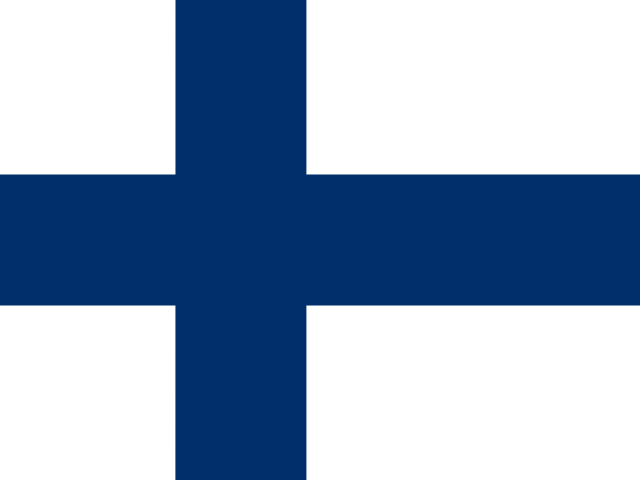
The Flag of Finland
Europe · Adopted 29 May 1918
Finland's blue-cross-on-white flag, formally adopted 29 May 1918, was created in the extraordinarily compressed and violent window immediately following Finnish independence, declared on 6 December 1917 as Russia collapsed into revolution. Within weeks of independence, Finland plunged into its own civil war between the socialist 'Reds' and the conservative, Senate-aligned 'Whites,' and the flag question became entangled with that conflict: several rival designs were debated, including one favored by some Whites featuring a lion emblem drawn from Finland's historic coat of arms, but the simple blue Nordic cross on white — based on a design popularized decades earlier by author Zacharias Topelius and artist groups in the 1860s-70s cultural nationalist movement — won out as the version enacted into law once the civil war ended in White victory in May 1918.
The blue cross follows the same off-center Nordic cross template pioneered by Denmark's Dannebrog centuries earlier, a structure Finland adopted deliberately to align itself visually and culturally with its Nordic neighbors — Sweden in particular, given Finland's centuries as an eastern part of the Swedish kingdom before Russia annexed it as an autonomous Grand Duchy in 1809 — rather than with Russia, from which Finland had just broken away, or with any specifically Finnish heraldic tradition alone.
Blue and white are explained in Finnish civic tradition as representing the country's thousands of lakes (Finland has roughly 188,000 of them) and its blue skies, paired with the snow that covers the country for much of the year — a color story tied directly to Finland's physical landscape and climate rather than to a historical event or dynastic emblem, distinguishing the reasoning behind Finland's flag colors from many other European flags whose colors commemorate specific battles, rulers, or revolutions.
A separate state flag, used by the President, government, and military, adds Finland's coat of arms — a crowned lion standing on a sword, itself dating back to 16th-century use as a symbol of the historic Grand Duchy of Finland and ultimately connected to Swedish royal heraldry — centered on the cross, but the plain blue-and-white cross flag without any emblem is the civil flag flown by ordinary citizens and is the version most closely identified internationally as 'the Finnish flag.'
Because Finland's flag follows the same Nordic cross template as Denmark, Sweden, Norway, and Iceland, it is grouped with those flags as a visually related family, but Finland's specific blue-on-white combination is not duplicated by any of them — Sweden alone comes closest with its blue field and yellow cross, an inverse color relationship to Finland's white field and blue cross that nonetheless makes the two, historically linked, flags easy to distinguish at a glance.
The 1918 civil war that provided the immediate backdrop to the flag's formal adoption was a genuinely brutal affair despite lasting only a few months, killing an estimated 36,000 people including several thousand executed after the fighting ended in prisoner camps and reprisal actions — a traumatic episode that left deep social divisions in Finnish society for decades afterward, meaning the blue-cross flag settled upon that May carried, for many Finns of that generation, an association with the White victory in a fratricidal conflict as much as with independence from Russia itself.
The design's specific artistic lineage runs through several figures beyond Topelius: an 1862 rowing club in Helsinki is credited with an early use of a blue cross on white as a club flag, and the design was subsequently refined and promoted through the following decades by figures including artist Eero Snellman and Bruno Jung as part of a broader late-19th-century cultural push to develop distinctly Finnish national symbols under the Russian Grand Duchy period, well before Finland had any prospect of actual political independence.
Finland's flag is flown on numerous officially designated flag days throughout the year, considerably more than most countries observe, including Finnish Independence Day on 6 December, and the flag's association with hard-won, comparatively recent independence — gained from Russia only in 1917, later than most Western European states — is part of why flag-flying remains an unusually widespread, actively encouraged civic practice in Finland rather than a purely ceremonial or government-only custom.
The formal flag law was updated again in 1978 to consolidate and modernize the various decrees governing use of the civil, state, and naval versions, but the essential blue-cross-on-white design and its proportions have remained unchanged since 1918 — a rare case among 20th-century European flags of essentially zero alteration to the core visual design across more than a century, despite Finland's own dramatic political transformations from Grand Duchy to independent republic to, later, wartime combatant against the Soviet Union in the Winter and Continuation Wars of 1939–44.
Finland's stubborn defense during the 1939–40 Winter War against a vastly larger Soviet invading force — inflicting disproportionate casualties on Soviet troops before eventually ceding territory in the Moscow Peace Treaty — became a formative national memory closely associated with the blue-cross flag, which Finnish troops carried through both that conflict and the subsequent 1941–44 Continuation War, cementing the flag's association with hard-fought national survival in a way that shaped Finnish patriotic identity for the rest of the 20th century.
The everyday version of three
- Plain civil flag — This page separates the ordinary flag from the versions used by the state and at sea, and the one most listings should be selling is the plain blue cross with nothing added at the centre.
As an Amazon Associate we earn from qualifying purchases made through these links, at no extra cost to you.
Often confused with
- Sweden — shares the same Nordic cross layout and blue-and-white/yellow palette, but the colors are effectively inverted — Sweden's flag is a blue field with a yellow cross, while Finland's is a white field with a blue cross. Compare side by side →
Finland at a glance
- Capital
- Helsinki
- Population
- 5.6 million (2024)
- Currency
- Euro (EUR)
- Language(s)
- Finnish and Swedish (both official)
Population figure as of 2024, source: UN World Population Prospects (2024 revision). See methodology for how facts are sourced and kept current.