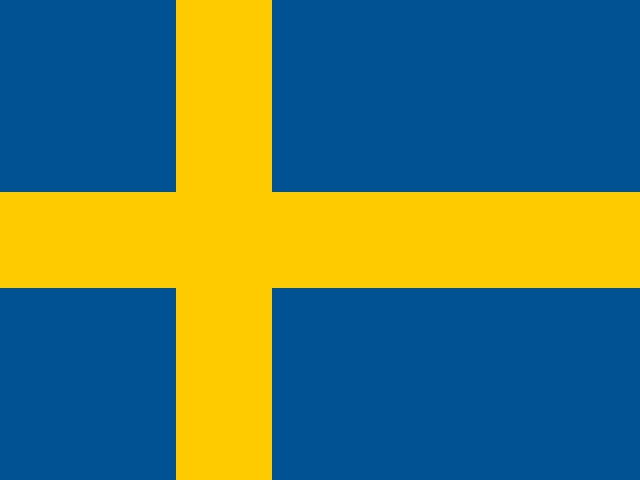
The Flag of Sweden
Europe · Adopted 22 June 1906 (proportions fixed by law); blue-and-gold cross in use since the 16th century
Sweden's flag pairs a blue field with a gold Scandinavian cross set off-center toward the hoist, and both colors come from a specific, much older source: the Three Crowns, the gold-crowns-on-blue national coat of arms that has represented the Swedish crown since at least the 14th century and appears on royal seals from the reign of Albert of Mecklenburg in the 1360s. When Sweden formally adopted a cross-shaped flag, it took the colors directly from that existing royal symbol rather than assigning new meaning to blue and gold from scratch.
The cross shape itself is a borrowing from a different neighbor: Denmark's Dannebrog, a white cross on red, is the oldest continuously used national flag in the world by tradition, with a legendary origin dated to 1219. Sweden adopted the cross format for its own flag by royal decree under King Johan III, with a Privy Council resolution in 1569 explicitly framing it as tying Sweden into the broader Nordic Christian flag tradition Denmark had established — while substituting the Swedish royal blue and gold for Denmark's red and white, so the visual family resemblance to other Nordic flags is deliberate even though the specific colors are entirely Sweden's own.
Sweden's flag went through centuries of informal variation in exact shade and proportion before the state finally legislated a precise standard: the modern law fixing the flag's dimensions, the exact ratio of the cross arms, and the specific gold and blue shades was passed on 22 June 1906, a date still marked annually as Swedish Flag Day (later folded into Sweden's National Day in 1983). Before that law, Swedish flags in everyday use varied noticeably in shade and cross width from one flagmaker to the next.
For much of its history from 1844 to 1905, Sweden's flag carried a small canton in the upper hoist corner featuring the arms of Norway, reflecting the union between the two crowns under a single Swedish king that lasted from 1814 until Norway's peaceful secession in 1905; Swedes nicknamed that combined symbol the 'sillsallad' ('herring salad') for its cluttered look, and its removal upon the dissolution of the union restored the plain, uncluttered blue-and-gold cross that Sweden flies today.
Sweden also flies a swallow-tailed version of the same blue-and-gold cross — a triple-tailed pennant shape — reserved by law for the monarchy, the armed forces, and a small number of other state institutions; the rectangular version most people recognize as 'the Swedish flag' is technically the civil and state ensign, while the swallow-tailed form carries a narrower, specifically military and royal significance that dates back to naval flag traditions.
Because the Nordic cross format is shared across Denmark, Norway, Finland, and Iceland as well as Sweden, casual observers sometimes need a second look to tell them apart at a distance; Sweden's specific blue-and-gold combination is its most reliable identifier, since none of the other Nordic states pair those exact two colors — Finland's cross is blue on white, Norway's and Iceland's are red-white-blue combinations, and Denmark's is white on red.
The Three Crowns motif behind Sweden's colors has its own contested history: medieval Sweden and Denmark both laid claim to the three-crowns symbol at different points, and a long-running (if largely symbolic, by modern standards) dispute over which kingdom had the earlier and more legitimate claim to the emblem simmered between the two crowns for centuries, occasionally surfacing as a diplomatic irritant even after both countries had settled into their modern borders and the practical stakes had long since disappeared.
Swedish Flag Day, established alongside the 1906 flag law, was originally a lower-key civic observance than the national holidays of many neighboring countries, reflecting Sweden's comparatively muted 20th-century tradition of nationalist display relative to countries that gained independence more recently; it was only in 1983 that the Swedish government redesignated 6 June as Sweden's National Day, giving the flag's anniversary a more prominent place in the annual civic calendar than it had held for its first seventy-odd years as a purely flag-specific observance.
Sweden's monarchy, one of the oldest continuous royal institutions in Europe, uses a version of the Three Crowns arms with additional heraldic detail — including the arms of the House of Bernadotte, the dynasty that has held the Swedish throne since 1818 — on the greater coat of arms used for strictly royal and some governmental purposes, distinct from the simpler blue-and-gold cross flown as the everyday national flag.
Sweden's neutrality tradition, which kept the country out of both World Wars, meant the flag never accumulated the wartime disruptions or occupation-era substitute designs that shaped the flag histories of several neighboring countries during the 20th century; the same blue-and-gold cross has flown over an uninterrupted, formally non-aligned Swedish state for the entire period since the 1905 dissolution of the Norwegian union, a rare degree of 20th-century continuity among European national flags.
That long-standing neutrality formally ended in March 2024, when Sweden joined NATO after a two-hundred-year policy of military non-alignment, a shift prompted directly by Russia's 2022 invasion of Ukraine; the blue-and-gold cross now flies alongside NATO's own flag at joint exercises and headquarters in a way it never did during the Cold War, when Sweden deliberately kept its distance from both NATO and the Warsaw Pact.
Rectangular, not swallow-tailed
- Rectangular civil flag — A swallow-tailed version of this design exists and is reserved for narrower uses, so the everyday flag is the plain rectangle and a forked fly in a listing means the wrong one.
As an Amazon Associate we earn from qualifying purchases made through these links, at no extra cost to you.
Often confused with
- Finland — uses the same Scandinavian cross layout, but Finland's colors are blue on a white field rather than Sweden's gold cross on blue — a color swap that keeps the two easy to distinguish once you know which country uses which combination. Compare side by side →
Sweden at a glance
- Capital
- Stockholm
- Population
- 10.6 million (2024)
- Currency
- Swedish Krona (SEK)
- Language(s)
- Swedish (official)
Population figure as of 2024, source: UN World Population Prospects (2024 revision). See methodology for how facts are sourced and kept current.