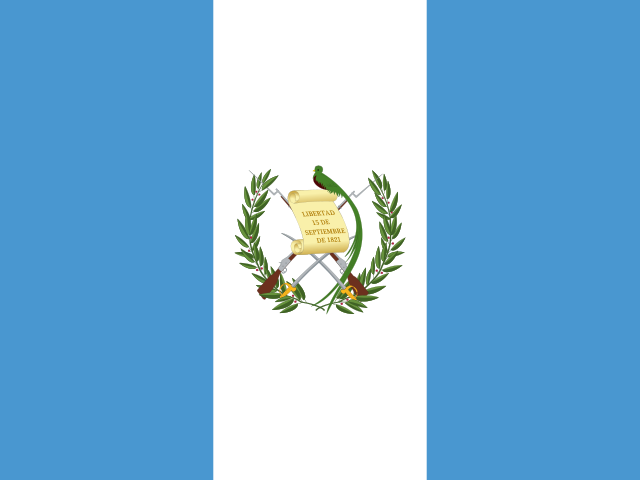
The Flag of Guatemala
North America · Adopted 17 August 1871 (current coat of arms details fixed 1968)
Guatemala's current flag dates to 17 August 1871, adopted after the Liberal Revolution led by Justo Rufino Barrios and Miguel García Granados overthrew the preceding conservative government, which had flown a red-yellow-blue tricolor modeled loosely on Central American federal-era designs of its own era. The new Liberal government deliberately broke from that predecessor by returning to a version of the original blue-white-blue banner of the 1823 United Provinces of Central America — the federation that briefly joined Guatemala with Honduras, El Salvador, Nicaragua, and Costa Rica after independence from Spain — but arranged the stripes vertically rather than horizontally, a layout choice that visually distinguishes Guatemala's flag from its federation-descended neighbors at a glance.
The vertical arrangement itself carries no single official symbolic explanation beyond distinguishing the new Liberal-era flag from the ousted conservative government's tricolor, but the blue is read as representing the sky and the two oceans bordering Guatemala — the Pacific and the Caribbean — while the white center stripe stands for peace and purity, continuing the same basic color logic inherited from the old federal flag even as the orientation changed.
At the center of the white stripe sits Guatemala's coat of arms, added in its now-familiar form in the late 19th century and refined by law in 1968: crossed rifles and swords behind a scroll reading 'Libertad 15 de Setiembre de 1821' (marking the shared Central American independence date), framed by a laurel wreath, with a resplendent quetzal perched on top. The quetzal is Guatemala's national bird, a strikingly colored, long-tailed bird native to Central American cloud forests that has been sacred to Maya and other Mesoamerican cultures for centuries and is also the name of Guatemala's currency — making it one of relatively few countries whose national bird, flag emblem, and unit of currency are all the same specific animal.
The rifles and swords crossed on the coat of arms are a specifically Liberal-era addition, intended to commemorate the armed struggle of the 1871 revolution itself rather than the earlier 1821 independence from Spain that the scroll date actually references — a slight tension in the emblem's messaging that reflects how the 1871 government layered its own revolutionary narrative onto the older, shared Central American independence story.
Guatemala's flag belongs to the same federal-era family as El Salvador, Honduras, and Nicaragua's flags, all descended from the original 1823 blue-white-blue federation banner, but Guatemala diverged furthest from that shared ancestor by switching to a vertical layout in 1871, while its neighbors largely kept the horizontal arrangement — a genuine design break within the family that makes Guatemala's flag the easiest of the four to distinguish from the others at a glance.
The flag has not been redesigned since 1871 beyond the 1968 legal standardization of the coat of arms artwork, and Guatemalan law specifies both a plain civil flag (blue-white-blue without the emblem) and a state flag bearing the coat of arms, a two-tier system consistent with the broader Central American pattern but which, as in several neighboring countries, is not always strictly observed in everyday civilian use.
Guatemala marks Independence Day on 15 September, the date inscribed on the coat of arms scroll and shared with El Salvador, Honduras, Nicaragua, and Costa Rica as the common 1821 declaration from Spain, and the flag and the quetzal emblem together are treated as core symbols of Guatemalan national identity in school curricula and public ceremony.
Justo Rufino Barrios, the Liberal general most associated with the 1871 flag's adoption, went on to rule Guatemala as president from 1873 until his death in battle in 1885, pursuing an aggressive modernization agenda alongside a short-lived and unsuccessful attempt to forcibly reunify the old Central American federation by military conquest in 1885 — an ambition the flag's vertical blue-white-blue design, chosen at the start of his rise to power, long outlasted even though the reunification project itself collapsed with his death.
The resplendent quetzal's inclusion on the coat of arms reflects a symbolic role that predates the Spanish conquest by many centuries: the bird's iridescent green tail feathers were prized by the Maya and later the Aztec as royal and priestly ornamentation, considered more valuable than gold in some Mesoamerican trade contexts, and the bird is sometimes said locally to be unable to survive in captivity, dying if caged — a claim of disputed biological accuracy but one repeated often in Guatemalan civic storytelling as a symbol of the bird's, and by extension the nation's, association with liberty.
Guatemala's currency, the quetzal, was introduced in 1925, decades after the bird had already become the flag's central emblem, extending the same national symbol from the flag onto everyday currency in a way that reinforces the quetzal's status as arguably the single most concentrated national symbol in Guatemalan public life, appearing simultaneously on money, the coat of arms, and by extension the flag itself.
Miguel García Granados, who co-led the 1871 Liberal Revolution alongside Barrios and briefly served as provisional president before Barrios succeeded him, is a comparatively less-remembered figure in Guatemalan flag history than Barrios himself, though contemporary accounts credit the two men jointly with the decision to break from the ousted conservative government's earlier tricolor and revive the federation-era blue-and-white palette in the vertical arrangement Guatemala still uses today.
A quetzal and a scroll at flag scale
- High-resolution printed flag — The emblem's details were pinned down in 1968 and include a bird, a scroll of small lettering and crossed items behind it, all rendered inside a wreath: fine work for a printed flag.
As an Amazon Associate we earn from qualifying purchases made through these links, at no extra cost to you.
Often confused with
- El Salvador — shares the same 1820s federation-era blue-white color scheme, but El Salvador kept the horizontal stripe orientation while Guatemala switched to vertical stripes in 1871, and the two countries' coats of arms are entirely different in imagery. Compare side by side →
Guatemala at a glance
- Capital
- Guatemala City
- Population
- 18.1 million (2024)
- Currency
- Guatemalan Quetzal (GTQ)
- Language(s)
- Spanish (official); 20+ Mayan languages recognized
Population figure as of 2024, source: UN World Population Prospects (2024 revision). See methodology for how facts are sourced and kept current.