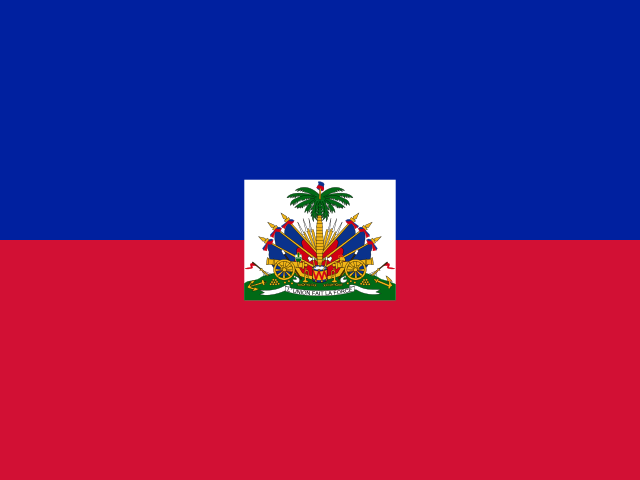
The Flag of Haiti
North America · Adopted 25 February 1986 (design dates to 18 May 1803)
Haiti's flag is usually dated to 18 May 1803, when General Jean-Jacques Dessalines is said to have taken the French Tricolore — blue, white, and red — and torn the white panel out, then had the remaining blue and red bands sewn back together into a single bicolor. The story, told at a congress of revolutionary generals at Arcahaie during the final stages of the Haitian Revolution, is treated as founding national mythology rather than settled documentary fact; the seamstress credited with the actual sewing, Catherine Flon, is honored on Haitian Flag Day, 18 May, every year, but no contemporary 1803 document records the moment in the detail the legend now carries. What is documented is the underlying political logic: white had represented the French colonial regime and, by extension, the white planter class Haiti's revolution had just overthrown, and removing it from the flag was removing that regime from the national symbol.
The revolution that produced this flag was the only successful large-scale slave revolt in modern history to end in an independent state, and it makes Haiti's 1804 founding distinct from every other flag on this list of former colonies: the flag change wasn't a transfer of sovereignty from one government to another, it was the erasure of a slaveholding colonial power by the people it had enslaved. Blue is generally read as representing the Black and mixed-race population united after the revolution, and red the same population's willingness to shed blood for freedom, though Haitian sources vary on whether blue specifically meant the Black population and red the mixed-race gens de couleur, or whether the two colors were understood together as one people rather than two groups.
The horizontal-versus-vertical arrangement of the two bands has changed with the country's politics more than once. Dessalines's original 1803 flag is usually described as a horizontal bicolor, but under some 19th-century governments — including periods under Emperor Faustin Soulouque in the 1850s and later regimes — the stripes were rearranged vertically, closer to the French original's structure just with red replacing white. The horizontal blue-over-red arrangement most associated with the modern flag became fixed relatively late, and the coat of arms at the center — a palm tree topped by a Cap of Liberty, flanked by flags, cannons, and drums, with the motto "L'Union Fait La Force" (Union Makes Strength) beneath — has itself been redrawn multiple times since the 19th century as governments updated its details.
The flag law currently in force dates to 25 February 1986, adopted shortly after the fall of the Duvalier dictatorship, which had briefly imposed a black-and-red flag (1964–1986) that broke from the traditional blue-and-red pattern entirely as a personal political statement by the regime. The 1986 return to blue-and-red was explicitly a restoration of the pre-Duvalier national symbol, and the current constitution enshrines the coat-of-arms version for official/government use and a plain bicolor (no coat of arms) as the civil flag flown by ordinary citizens — a two-tier system, common internationally, that distinguishes state authority from general civic use.
Haiti's blue-and-red bicolor happens to closely resemble Liechtenstein's flag as it existed before 1937 — both were blue over red, no coat of arms, in roughly the same proportions — an overlap that reportedly became visible to Liechtenstein's own government at the 1936 Berlin Olympics, where the two countries' delegations were startled to see each other carrying what looked like the same flag. Liechtenstein added a gold crown to its blue band the following year specifically to end the resemblance, making this one of the few documented cases where one country changed its flag because of confusion with another's, rather than the more common scenario of coincidental resemblance nobody ever formally addressed.
The coat of arms carries weight well beyond decoration in Haitian civic life: the Cap of Liberty atop the palm tree is a direct reference to the revolutionary abolition of slavery, and the arrangement of weapons and flags around the tree is read as a permanent visual reminder that Haitian independence was won by armed uprising rather than negotiated transfer, a framing textbooks and national ceremonies still lean on heavily on both Independence Day, 1 January, and Flag Day, 18 May.
Haitian law requires the coat-of-arms version on all government buildings, military uses, and diplomatic missions, while the plain bicolor is what's generally seen at civilian celebrations, in the diaspora, and on informal displays — a distinction most casual observers outside Haiti are unaware of, leading many international media images of "the Haitian flag" to actually show the civil version rather than the state version.
The flag's role in the Haitian diaspora carries a weight distinct from most other national flags of similarly sized countries: with several million Haitians living abroad, concentrated heavily in the United States, Canada, and the Dominican Republic, the blue-and-red bicolor functions as a visible marker of identity in diaspora communities that often maintain closer emotional ties to national symbols than to any specific current Haitian government, a dynamic shaped by decades of political instability, dictatorship, and, more recently, the collapse of state authority across large parts of the country.
With the arms, or the plain bicolour
- Flag with the arms — The page separates an official version carrying the arms on a white panel from a plain two- band civil flag, and without the panel this design is also the pre-1937 Liechtenstein flag.
As an Amazon Associate we earn from qualifying purchases made through these links, at no extra cost to you.
Often confused with
- Liechtenstein — was blue-over-red with no crown until 1937, nearly identical to Haiti's civil flag until the two countries' delegations noticed the overlap at the 1936 Berlin Olympics and Liechtenstein added a gold crown to distinguish itself. Compare side by side →
Haiti at a glance
- Capital
- Port-au-Prince
- Population
- 11.6 million (2024)
- Currency
- Haitian Gourde (HTG)
- Language(s)
- French and Haitian Creole (both official)
Population figure as of 2024, source: UN World Population Prospects (2024 revision). See methodology for how facts are sourced and kept current.