The Flag of India
Asia · Adopted 22 July 1947
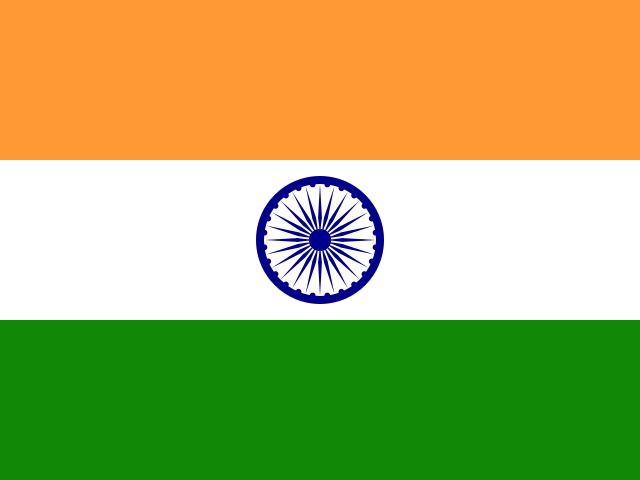
India's flag — saffron, white, and green horizontal bands with a navy-blue 24-spoke wheel centered on the white band — was adopted by the Constituent Assembly on 22 July 1947, just over three weeks before independence from Britain on 15 August 1947. The design descended directly from the flag of the Indian independence movement itself, particularly a 1931 tricolor associated with the Indian National Congress, but the 1947 version made one deliberate and politically significant substitution: it replaced the charkha, the spinning wheel that Mahatma Gandhi had championed since the 1920s as a symbol of Indian self-sufficiency and the boycott of British textiles, with the Ashoka Chakra, a 24-spoke wheel taken from the Lion Capital of Ashoka, a 3rd-century-BCE sculpture erected by the Mauryan emperor Ashoka at Sarnath, near where the Buddha is traditionally said to have given his first sermon.
That substitution was debated and not universally welcomed at the time — Gandhi himself had wanted the spinning wheel retained, since it carried his own philosophy of self-reliance and nonviolent economic resistance, and some independence-movement figures saw the change to a more ancient, dynastic-era symbol as a step away from Gandhi's specific vision. The Constituent Assembly ultimately chose the Ashoka Chakra partly because it linked the new state to Ashoka's historical reputation as a ruler who embraced Buddhist principles of dharma (moral law/duty) after a famously violent early conquest, giving independent India a symbol rooted in an indigenous ancient tradition of governance by moral law rather than a specifically Gandhian, 20th-century economic-protest symbol.
The three colors were given an explicitly secular, non-religious explanation by the Constituent Assembly specifically to avoid the flag being read as favoring any one of India's religious communities: saffron represents courage, sacrifice, and renunciation; white represents truth, peace, and light; and green represents faith, fertility, and the land's prosperity — a formulation adopted precisely because saffron and green also happen to be colors associated in popular imagination with Hinduism and Islam respectively, a coincidence the framers wanted to explicitly not endorse given the flag's role as a shared symbol for a newly independent, religiously diverse nation formed in the same year as the traumatic Partition of British India into India and Pakistan.
The 24 spokes of the Ashoka Chakra are sometimes popularly explained as representing the 24 hours of the day, a symbol of continuous, ceaseless progress ('the wheel of the law in motion'), though this specific interpretation is a later popular gloss rather than an explanation the original Constituent Assembly formally codified — the Assembly's own resolution described the wheel simply as the emblem of the historic Ashoka Chakra without spelling out numerological meaning for the spoke count.
Flag protocol in India was notably restrictive for decades after independence: ordinary citizens were legally barred from flying the national flag on private buildings outside a few designated national days until a 2002 Supreme Court ruling, following a case brought by industrialist Naveen Jindal, struck down those restrictions and established a citizen's right to fly the flag with dignity year-round, a significant liberalization of what had been one of the world's more tightly regulated national flag-display regimes.
The tricolor's basic saffron-white-green horizontal design with a central navy emblem has not changed since 1947, though the flag's exact construction and display rules were consolidated into the Flag Code of India, most recently and significantly revised in 2002 (the same year as the Supreme Court ruling) and again in 2021 to permit polyester as well as hand-spun khadi cloth, a change that drew some public debate given khadi cloth's own symbolic tie to Gandhi's self-sufficiency movement.
For most of independent India's history, only one organization was legally permitted to manufacture the flag at all: the Khadi Development and Village Industries Commission (KVIC) held an exclusive government license for producing the hand-spun, hand-woven khadi bunting version, with fabric typically sourced from a small cluster of certified khadi units concentrated around Hubli-Dharwad in Karnataka. Bureau of Indian Standards specification IS1:1968 (revised over the decades) fixes the flag's ratio at exactly 2:3, sets the Ashoka Chakra's 24 spokes to equal spacing and identical rendering on both faces of the cloth, and specifies the number of threads per square inch the khadi bunting must contain — a manufacturing standard precise enough that officials have periodically seized and destroyed flags found to violate it, including machine-woven or synthetic versions sold during the decades before the 2021 Flag Code amendment opened production to private polyester mills.
The 2021 change coincided with the government's Har Ghar Tiranga ('flag in every home') campaign, launched in 2022 around the 75th anniversary of independence, which encouraged and in some states subsidized households to fly the tricolor from their own rooftops during Independence Day week — a direct continuation of the citizen's-right-to-fly-the-flag principle the 2002 Supreme Court ruling had established two decades earlier, now actively promoted by the state rather than merely permitted by it. The Flag Foundation of India, founded by Naveen Jindal after his own case established that right, has separately run flag-literacy and correct-display-etiquette campaigns nationwide, since the Flag Code specifies detailed rules for the flag's position relative to other flags, the hours it may be flown, and the manner of its disposal (privately, respectfully, and typically by burning or burial rather than discarding it as ordinary waste).
The wheel on both faces, and the cloth it is on
- Double-sided flag — The page notes the wheel is specified to render identically on both faces of the cloth, which is a manufacturing requirement rather than an aesthetic one and rules out a single- layer print.
- Cotton bunting flag — The national standard goes as far as specifying the thread count of the woven cloth, so the fabric itself is part of the specification here in a way it is not on most flags.
As an Amazon Associate we earn from qualifying purchases made through these links, at no extra cost to you.
Often confused with
- Niger — shares a similar three-band layout with a circular emblem centered on the middle band, but Niger's flag uses orange rather than saffron, a plain orange disc rather than a navy wheel, and its stripes are white-orange-green rather than India's saffron-white-green. Compare side by side →
India at a glance
- Capital
- New Delhi
- Population
- 1.45 billion (2024)
- Currency
- Indian Rupee (INR)
- Language(s)
- Hindi and English (official at the union level); 22 languages recognized in the Constitution's Eighth Schedule
Population figure as of 2024, source: UN World Population Prospects (2024 revision). See methodology for how facts are sourced and kept current.