The Flag of Niger
Africa · Adopted 23 November 1959
Niger adopted its flag on 23 November 1959, roughly a year before formal independence from France arrived on 3 August 1960, as part of the broader wave of national symbol design that swept French West Africa in the run-up to decolonization. Unlike some neighboring former French colonies, Niger did not go through an earlier interim flag or a shared federation banner before settling on its own design — the 1959 tricolor has remained the country's flag continuously since, through military coups, changes of republic, and, most recently, the political upheaval following the July 2023 coup that removed President Mohamed Bazoum.
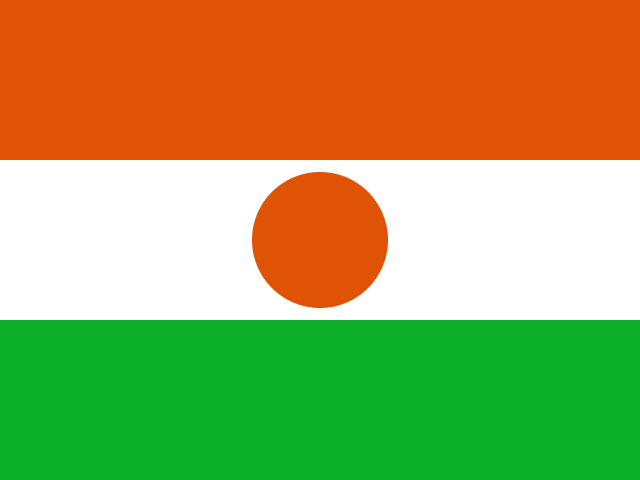
The flag is a horizontal tricolor of orange, white, and green, with a solid orange disc centered on the white band. Orange represents the Sahara Desert that covers the northern two-thirds of the country, and by extension the hardships of that arid landscape and the effort required to overcome them; green represents the fertile, more densely populated south along the Niger River valley, along with hope and agriculture; and white, in the middle, is read as a symbol of purity and, more specifically, of the Niger River itself, the lifeline separating and connecting the desert north from the greener south.
The orange disc at the center of the white band is generally described as representing the sun, an especially direct symbol for a country where the Sahara dominates the northern landscape and daily life for a large share of the population, though it is also sometimes read more broadly as a symbol of independence and national sovereignty, arriving on the flag the same year Niger secured self-governing status within the French Community, a year ahead of full independence.
Niger's flag uses the same three colors — orange (sometimes rendered closer to a rust or 'Niger orange'), white, and green — found in several other former French West African states' flags from the same independence-era design period, but with a distinctive horizontal band layout rather than the vertical tricolor used by neighbors like Mali or Ivory Coast, making the central orange disc the flag's most immediately distinguishing feature.
Niger's flag comes out unusually close to square: its dimensions run roughly 6:7, compared with most national flags' 2:3 or 3:5 proportions, a specification set out in the country's original 1959–1960 constitutional documents and retained through Niger's subsequent constitutions, including the Fifth Republic constitution adopted in 2010 after a period of military rule.
Since the July 2023 military takeover, Niger has been governed by a transitional military authority that withdrew the country from ECOWAS obligations and, alongside Mali and Burkina Faso, formed the Alliance of Sahel States; by 2026 the 1959 flag was still being flown as the country's official national flag, even as the transitional government pursued other symbolic and institutional changes.
The flag is flown on Independence Day, 3 August, and on Republic Day, 18 December, marking the 1958 vote that established Niger as an autonomous republic within the French Community ahead of full independence two years later — the same period during which the flag itself was designed and formally adopted.
Niger's coat of arms, distinct from the flag but adopted in the same independence-era period, carries related imagery — a rising sun, crossed spears and a shield, millet stalks, and zebu cattle heads — reinforcing the same north-south, desert-to-farmland duality that the flag's orange, white, and green bands represent, with agricultural and pastoral symbols standing in for the same fertile-south, arid-north divide expressed more abstractly on the flag itself.
The orange used on Niger's flag is specified in national symbol regulations as a particular shade sometimes referred to informally as 'Niger orange,' distinguishing it from the brighter orange used on some other national flags and helping the disc-and-band design remain visually distinct from similarly colored flags used by other former French West African territories in the same independence period.
Niger held a constitutional referendum in November 2010 following a 2010 military coup that removed President Mamadou Tandja, restoring civilian rule under the country's Seventh Republic constitution; that document, like the earlier ones before it, left the 1959 flag entirely untouched, treating national symbols as a settled matter even as the country's broader constitutional and political structures were repeatedly rewritten across five decades of intermittent military intervention.
Niger's population is among the youngest and fastest-growing in the world, with a very high average birth rate that United Nations demographers have repeatedly flagged as one of the highest of any country, a demographic reality that shapes national planning far more directly than most of the flag's historical symbolism, even as the orange-white-green tricolor continues to represent a population whose composition looks very different today than it did at the flag's 1959 adoption.
Niger shares its orange-white-green palette and general design logic — a plain tricolor with a single central emblem representing sun or unity — with a handful of other former French colonies that gained independence in 1960, part of a broader pattern in which newly independent Francophone African states often chose visually restrained designs distinct from the more heavily symbol-laden flags adopted by several former British colonies in the same period.
Nearly square at 6:7
- Flag cut close to square — At roughly 6:7 this is one of the squarest national flags there is, and a stock 3:5 cut stretches the three bands and flattens the orange disc into an ellipse.
As an Amazon Associate we earn from qualifying purchases made through these links, at no extra cost to you.
Often confused with
- Ivory Coast — shares the exact same orange, white, and green palette from the same French West African independence era, but Ivory Coast's flag is a vertical tricolor with no central emblem, while Niger's is horizontal with a solid orange sun disc on the white band. Compare side by side →
Niger at a glance
- Capital
- Niamey
- Population
- 26.3 million (2024)
- Currency
- West African CFA Franc (XOF)
- Language(s)
- French (official); Hausa, Zarma, and other national languages widely spoken
Population figure as of 2024, source: UN World Population Prospects (2024 revision). See methodology for how facts are sourced and kept current.