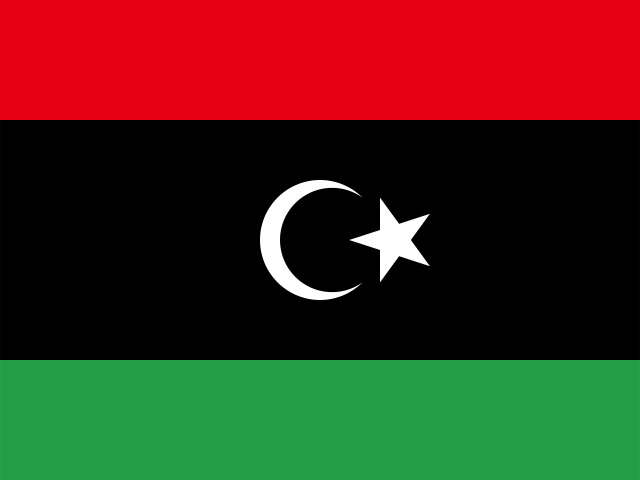
The Flag of Libya
Africa · Adopted 3 August 2011 (readopted, originally 24 December 1951)
Libya's current flag has an unusual history: it is not a new design but the restoration of the country's original 1951 independence flag, brought back into official use on 3 August 2011 by the National Transitional Council during the uprising that ended Muammar Gaddafi's 42-year rule. Gaddafi had discarded this flag in 1969, immediately after seizing power in a coup, and its return in 2011 was a deliberate rejection of everything Gaddafi's government had stood for, expressed through the reinstatement of a pre-Gaddafi symbol rather than the creation of an entirely new one.
The original flag was designed for the Kingdom of Libya's independence in 1951 under King Idris, and its central black stripe bearing a white crescent and star is drawn from the flag of Cyrenaica, the eastern Libyan region and historical power base of King Idris's Senussi movement, while the red and green stripes were added to represent Libya's other two historic regions, Fezzan (red) and Tripolitania (green), making the tricolor a deliberate stitching-together of the three regions that were unified into a single kingdom in 1951 — a genuinely federal design rather than an abstract color choice.
The crescent and star at the center are Islamic symbols common across the region, but their specific pairing with a black field in this design ties them directly to the Senussi order, the Islamic religious and political movement that led Libyan resistance to Italian colonization in the early 20th century and provided the monarchy's ruling family — giving Libya's crescent a more specific regional and dynastic origin than the more generically Ottoman-derived crescents used on flags like Turkey's.
When Gaddafi seized power in 1969, he replaced this flag first with a red-white-black tricolor closely resembling Egypt's, and then in 1972, as part of a short-lived federation with Egypt and Syria, adopted the Arab Liberation flag design shared by all three states. In 1977, after Libya broke from that federation and Gaddafi's politics grew more idiosyncratic, he replaced it again with a plain field of solid green, the only national flag in modern history to consist of a single color with no design, emblem, or pattern of any kind — a choice tied to Gaddafi's 'Green Book' political ideology.
The all-green flag flew for 34 years, through the entirety of Gaddafi's later rule, and became so closely identified with his regime that its abandonment during the 2011 uprising, in favor of the tricolor from the monarchy period, was itself one of the clearest visual signals of the revolution's aims — protesters carried the old tricolor from the flag's earliest reappearance in Benghazi in February 2011, months before the National Transitional Council made it official.
The restored flag was formally retained by Libya's subsequent governments after Gaddafi's fall and death in October 2011, and it has remained the national flag through the years of political fragmentation and rival governments that followed, even as competing factions have disputed nearly everything else about how the country should be governed.
King Idris, whose Senussi-linked 1951 flag was restored in 2011, ruled Libya as its only monarch from independence until Gaddafi's coup deposed him in 1969 while he was abroad for medical treatment; Idris never returned to Libya and died in exile in Cairo in 1983, meaning the flag's 2011 revival brought back a design tied to a monarchy that, by then, had been out of power for over four decades and whose last king had already died in exile years before the flag itself was restored.
The years since 2011 have been marked by deep territorial and political division, including a period when Libya effectively had two rival governments — one internationally recognized and based in Tripoli, another based in the east around Tobruk and Benghazi and backed by military commander Khalifa Haftar — with both sides nonetheless continuing to fly the same restored tricolor, a rare instance of bitterly opposed factions retaining an identical national flag throughout their conflict rather than each adopting a rival symbol.
Libya's oil wealth, among the largest proven reserves in Africa, has been both a stabilizing and destabilizing force throughout this fractured period: oil revenue has periodically been split or contested between rival governments and armed factions, and blockades of key oil facilities by groups seeking leverage in political negotiations have repeatedly interrupted the production that remains the country's single most important economic asset, an asset with no direct symbolic reference on a flag whose colors instead speak to region, resistance, and Islamic identity rather than to the resource now central to Libya's economy and its ongoing political disputes.
The restored tricolor's continuity was tested most starkly between 2015 and December 2016, when fighters affiliated with the Islamic State seized the coastal city of Sirte, Gaddafi's birthplace, and flew their own black jihadist banner over the city in place of any Libyan national flag until local forces, backed by U.S. airstrikes, drove them out — a rare stretch in which a stretch of Libyan territory flew neither the internationally recognized tricolor nor any rival Libyan faction's flag, but an entirely non-state one instead.
Libya's flag law sets the proportions at 1:2, a notably more elongated shape than the 2:3 ratio common elsewhere, and specifies the five-pointed star as sitting centered within the black stripe with a single point directed straight upward. Because Libya's two rival post-2014 governments in Tripoli and the east both continued flying the identical restored tricolor, military and political factions in the conflict have instead distinguished themselves through separate unit insignia, vehicle markings, and shoulder patches rather than through any variation of the national flag itself, which neither side has ever proposed changing.
A long 1:2 field
- Flag cut to 1:2 — At 1:2 the middle black band runs much further than a 2:3 cut would, and the star and crescent are placed against that longer band, so the proportion is what keeps the emblem where the page puts it.
As an Amazon Associate we earn from qualifying purchases made through these links, at no extra cost to you.
Often confused with
- Mauritania (pre-2017) — Libya's black-red-green horizontal tricolor bears no strong resemblance to most other flags, though its crescent-and-star motif places it in the same broad Islamic-symbol family as many North African and Middle Eastern flags. Compare side by side →
Libya at a glance
- Capital
- Tripoli
- Population
- 7.4 million (2024)
- Currency
- Libyan Dinar (LYD)
- Language(s)
- Arabic (official); Tamazight (Berber) spoken by minority communities
Population figure as of 2024, source: UN World Population Prospects (2024 revision). See methodology for how facts are sourced and kept current.