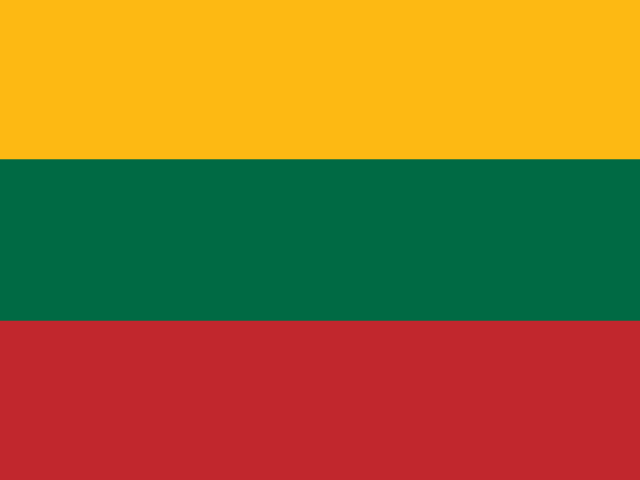
The Flag of Lithuania
Europe · Adopted 20 March 1989 (reinstated); originally adopted 25 April 1918
Lithuania's yellow-green-red horizontal tricolor was adopted on 25 April 1918, just months after the Council of Lithuania declared independence from the collapsing Russian Empire and German wartime occupation on 16 February 1918. Unlike neighboring Latvia's flag, which drew on a chronicle-documented medieval banner, Lithuania's modern tricolor had no direct medieval antecedent — the medieval Grand Duchy of Lithuania, one of the largest states in Europe at its height in the 14th and 15th centuries, had instead used the Vytis, a mounted knight emblem, as its primary heraldic symbol rather than a plain tricolor, and that emblem survives today as Lithuania's coat of arms rather than as the flag itself.
The 1918 tricolor's three colors carry meanings that were articulated fairly explicitly at the time of adoption and have remained stable in Lithuanian civic memory since: yellow for the sun, prosperity, and light; green for the country's forests, fields, and hope; and red for the courage and blood of those who died defending Lithuania, particularly during the difficult fight to establish and defend the newly declared state against Soviet, Polish, and Bermontian (pro-German) forces in 1918-20.
Lithuanian independence and its flag were extinguished in 1940 when the Soviet Union annexed the country under the terms of the Molotov-Ribbentrop Pact, the same fate that befell Estonia and Latvia simultaneously; Nazi German occupation followed from 1941 to 1944, after which Soviet control was reimposed and lasted until 1990, with the flag banned throughout and the Lithuanian Soviet Socialist Republic instead flying a red flag bearing a hammer and sickle and a narrow horizontal wave-pattern stripe near the bottom.
Lithuania was the first of the three Baltic states to move decisively against Soviet rule in the late 1980s: its parliament (the Supreme Council) reinstated the pre-war yellow-green-red flag as the official state flag on 20 March 1989, well before the formal Act of the Re-Establishment of the State of Lithuania on 11 March 1990 — making Lithuania the first Soviet republic to declare its intention to restore full independence, a claim the Soviet Union initially refused to recognize, leading to a tense standoff that included a deadly Soviet military crackdown in Vilnius in January 1991 before independence was fully secured later that year.
A second, historically distinct flag plays an important supplementary role in Lithuanian national symbolism: the Vytis banner, a red flag bearing the white mounted-knight emblem from the medieval coat of arms, was Lithuania's historical state flag for much of its earlier existence and remains in use today as a ceremonial and presidential-standard-type flag alongside the plain tricolor, a two-flag arrangement (a plain civil tricolor plus a historical heraldic banner for state ceremony) shared conceptually, though not visually, with a few other European nations.
The exact shade of yellow was slightly adjusted by a 2004 law, moving from a paler yellow to a more saturated, golden-yellow tone intended to make the flag read more crisply and consistently when reproduced digitally and in mass manufacture — a minor technical update rather than a substantive redesign of the tricolor's underlying 1918 structure.
Lithuania's flag has occasionally been confused by casual observers with several other yellow-green-red or green-yellow-red tricolors used elsewhere in the world, including some African nations' flags that independently adopted a similar three-color palette for entirely unrelated Pan-African symbolic reasons, a coincidence of color choice rather than any shared design history.
The January 1991 crackdown, in which Soviet special forces attacked the Vilnius television tower and killed fourteen civilians who had gathered to defend it, is remembered in Lithuania specifically as a moment when ordinary citizens physically shielded the broadcasting facility — and, by extension, the ability to keep broadcasting news of the restored flag and independence movement — with their own bodies against Soviet armored vehicles, an episode that remains central to how Lithuanians narrate their own path back to statehood.
Lithuania's National Flag Day, established after independence, is marked annually on 1 January, commemorating the date in 1919 when the tricolor was first raised over Gediminas Tower in Vilnius — distinct from the 25 April 1918 legal adoption date, reflecting how the flag's early history involves several genuinely separate milestones (adoption, first prominent hoisting, wartime suppression, and 1989-90 restoration) rather than a single clean origin point.
The Vytis emblem that appears on Lithuania's ceremonial red banner has its own long and genuinely contested modern political history: it was used by various anti-Soviet partisan and émigré groups throughout the occupation period as an underground symbol of continuity with pre-war statehood, and its post-1990 restoration to official use was treated by many Lithuanians as at least as symbolically significant as the return of the plain yellow-green-red tricolor itself, given the emblem's much older direct medieval lineage compared to the flag's early-20th-century origin.
Lithuania observes its restoration of independence with two separate national holidays rather than one — 16 February for the original 1918 declaration and 11 March for the 1990 re-establishment act — and the tricolor is flown at full ceremonial prominence on both dates, a dual-holiday structure that directly reflects the flag's own two distinct 20th-century origin moments rather than treating 1918 and 1990 as a single continuous story.
Holding the yellow band
- Dyed-through flag — Yellow is the top band and the one that greys out first on printed stock, which on a three- band flag leaves the whole design looking dusty rather than merely faded in one place.
As an Amazon Associate we earn from qualifying purchases made through these links, at no extra cost to you.
Often confused with
- Bolivia — shares a similar yellow-with-green-and-red palette, though Bolivia's flag uses red-yellow-green from top to bottom (the reverse general order) plus a central coat of arms — the resemblance is a coincidental overlap of three popular flag colors rather than any historical link. Compare side by side →
- Estonia — no colors in common, but as Lithuania's fellow Baltic state with a broadly parallel 1918-1940-1991 independence, occupation, and restoration history, the two flags are frequently discussed together even though their designs (blue-black-white for Estonia) look nothing alike. Compare side by side →
Lithuania at a glance
- Capital
- Vilnius
- Population
- 2.9 million (2024)
- Currency
- Euro (EUR)
- Language(s)
- Lithuanian (official)
Population figure as of 2024, source: UN World Population Prospects (2024 revision). See methodology for how facts are sourced and kept current.