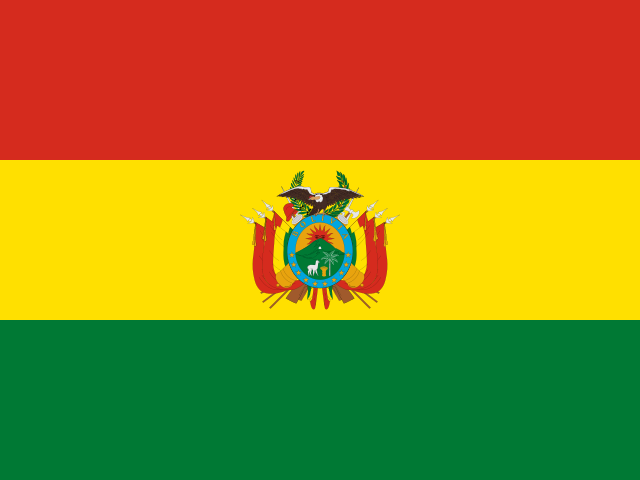
The Flag of Bolivia
South America · Adopted 5 November 1851 (tricolor); 7 February 2009 (Wiphala made co-official)
Bolivia has flown a red-yellow-green tricolor in some form since shortly after independence from Spain in 1825, but the specific arrangement now in use — red on top, yellow in the middle, green on the bottom, with the national coat of arms centered on the state version — dates to a decree signed by President Manuel Isidoro Belzu on 5 November 1851. It replaced an earlier 1826 flag designed under Simón Bolívar's ally Antonio José de Sucre that had used the same three colors but in a different order and proportion, and the country tweaked the arrangement again in 1888, when the coat of arms was standardized to the version still used on the state flag today.
The colors are read nationally as red for the blood and courage of the soldiers who fought for independence, yellow (sometimes described as gold) for the country's mineral wealth — a pointed reference given Bolivia's centuries-long history as a major silver, and later tin, producer centered on the mines of Potosí — and green for the country's fertility and its lowland forests. Those readings are the ones taught in Bolivian schools, though as with many 19th-century tricolors adopted before any official decree spelled out symbolic meaning, the interpretations were largely supplied by later generations rather than written into the original 1851 or 1888 legislation.
What makes Bolivia's flag arrangement unusual among nations is that it is not the country's only official flag. Since 2009, under a new constitution promoted by President Evo Morales, Bolivia's first president to identify as Indigenous, the Wiphala — a square banner made of a checkerboard of 49 small squares in seven colors representing a rainbow spectrum, long used by Andean Indigenous communities, particularly Aymara and Quechua groups, as a symbol of ethnic and cultural identity — was elevated to co-official status alongside the red-yellow-green tricolor, rather than replacing it.
The Wiphala predates the modern Bolivian state by an uncertain margin; some scholars and Indigenous advocates trace versions of the checkerboard pattern back to pre-Columbian Andean textile and ceremonial traditions, while others regard the specific seven-color, 49-square design in wide use today as a 20th-century standardization of older, more varied local patterns rather than a single unbroken ancient design — a genuinely disputed point rather than settled history, and one that surfaces regularly in Bolivian political debate over how far back the symbol's authenticity actually extends.
The Wiphala's seven colors — commonly listed as red, orange, yellow, white, green, blue, and violet, arranged diagonally across the 49-square grid so each hue appears seven times — are popularly described as a rainbow spectrum, but Aymara and Quechua cultural organizations do not agree on a single fixed meaning for each individual color the way Bolivian schools teach a settled reading of the tricolor's red, yellow, and green. Some interpretations tie the colors to the four cardinal directions of Andean cosmology plus additional social and political principles such as reciprocity and communal labor; others treat the grid pattern itself, rather than any one color, as the primary carrier of meaning, representing the diversity of Andean peoples and territories united within a single banner. There are also several regional variants of the Wiphala historically used by different Aymara communities, and the specific seven-by-seven design elevated to co-official status in 2009 is one standardized version among a handful that had circulated in the 20th century.
Article 6 of Bolivia's 2009 constitution names both the tricolor and the Wiphala as national symbols, and by law both are meant to be flown together at government buildings and official events — a co-official arrangement that remains genuinely contested within Bolivia. Supporters frame it as overdue recognition that Bolivia's population is majority Indigenous and that the flag adopted in 1851 represented only the country's Spanish-descended and mestizo elite; opponents, including some on the political right and portions of the urban lowland population, have at times treated the Wiphala's elevated status as a symbol of Morales-era politics specifically rather than settled national consensus, and its display has been a flashpoint during periods of political unrest, including the disputed 2019 election crisis.
The Bolivian tricolor's civil and state versions differ the way several Latin American flags do: the plain red-yellow-green stripe used by the public carries no emblem, while the state version adds the coat of arms — a shield showing Cerro Rico, the silver-bearing mountain above Potosí, along with a llama, sheaves of wheat, and a rising sun, ringed by ten small national flags representing the nine departments plus, in some renderings, a tenth reserved for the coastal department lost to Chile in the War of the Pacific (1879–1884), a territorial loss still commemorated annually on Bolivia's Día del Mar and a live point of diplomatic tension between the two countries.
Bolivia's Día de la Bandera (Flag Day) falls on 17 August, a date tied to Sucre's original 1826 decree rather than to Belzu's 1851 redesign that actually produced the flag Bolivians fly today, and the discrepancy is rarely commented on outside specialist histories of the flag. Military garrisons across the country hold formal flag ceremonies that day, while the tricolor's more visible annual moment is Independence Day on 6 August, when private homes and municipal buildings nationwide are hung with the flag a day ahead of the flag-specific holiday, producing a rare two-day stretch each August when Bolivian civic symbolism is on especially heavy public display.
Because Bolivia is landlocked — a direct consequence of that 19th-century war — its flag carries none of the maritime symbolism common on the flags of its Pacific-coast neighbors, and the loss of coastal access remains one of the most persistent themes in Bolivian civic and political life, referenced in school curricula, military ceremony, and recurring but so far unsuccessful diplomatic and legal efforts, including a case brought before the International Court of Justice that Bolivia lost in 2018, to regain some form of sovereign access to the sea.
Which of the two banners you mean
- Three-band tricolour flag — The page describes two co-official banners, one a three-band tricolour and the other a square multicoloured checkerboard, so a listing has to be read carefully to know which is being sold.
As an Amazon Associate we earn from qualifying purchases made through these links, at no extra cost to you.
Often confused with
- Ghana — uses the same red-yellow-green palette, but arranged as horizontal stripes with a black star centered on the yellow band, and the two flags' color symbolism developed independently on opposite sides of the Atlantic. Compare side by side →
- Lithuania — uses the identical three colors as horizontal stripes, but in reverse order — yellow on top, green in the middle, red on the bottom — a genuine, if coincidental, mirror-image resemblance between two flags with no historical connection to one another. Compare side by side →
Bolivia at a glance
- Capital
- Sucre
- Population
- 12.4 million (2024)
- Currency
- Boliviano (BOB)
- Language(s)
- Spanish and 36 Indigenous languages including Quechua, Aymara, and Guaraní (all official)
Population figure as of 2024, source: UN World Population Prospects (2024 revision). See methodology for how facts are sourced and kept current.