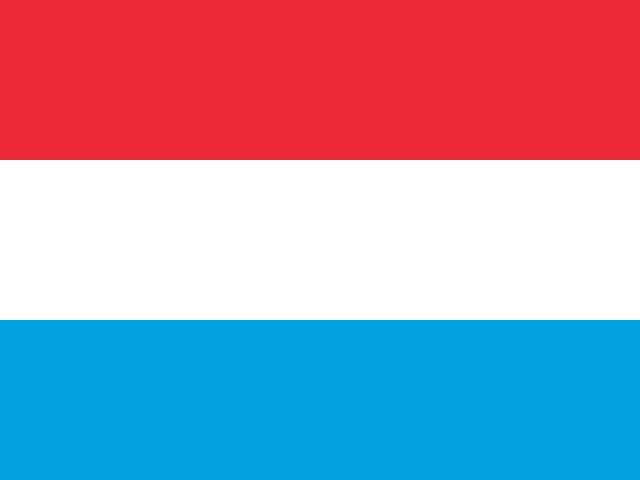
The Flag of Luxembourg
Europe · Adopted 23 June 1972 (legally fixed proportions and colors; the design itself in informal use since the mid-19th century)
Luxembourg's red-white-blue horizontal tricolor derives from the coat of arms of the House of Nassau, the ruling dynasty that had governed the territory (in various forms and unions) since the Middle Ages, and its colors were first combined into a plain tricolor flag and displayed publicly during the 1830-31 Belgian Revolution, when Luxembourg — then still administratively entangled with the Netherlands under a personal union of crowns — saw local sentiment split between those favoring union with the new Belgian state and those wishing to remain tied to the Dutch king, and the red-white-blue banner served early on as a marker of loyalty to the Nassau dynasty rather than as a fully settled national flag.
The flag's use grew steadily through the 19th century as Luxembourg's own distinct national identity solidified, especially after the 1839 Treaty of London formally partitioned the historic Duchy, giving the larger, mostly French-speaking western portion to Belgium (as the Belgian province of Luxembourg) while confirming the smaller remainder as an independent Grand Duchy — the borders, roughly, of the Luxembourg that exists today — still nominally in personal union with the Netherlands until that link was finally severed in 1890, when Nassau succession rules diverged and Luxembourg passed to a different branch of the family than the Dutch throne.
Because Luxembourg's tricolor uses precisely the same three colors as the Netherlands' own flag — red, white, and blue, in the same top-to-bottom order — the resemblance between the two has been a genuine, recurring point of discussion in Luxembourg for well over a century, sharpened by the fact that the two countries shared the same royal house for decades in the 19th century. The most commonly cited distinguishing details are that Luxembourg's blue stripe is a noticeably lighter, brighter 'sky blue' or 'azure' compared to the Netherlands' darker, more cobalt-toned blue, and that Luxembourg's flag is conventionally displayed in a taller, less elongated ratio (roughly 1:2 or 3:5 depending on context) than the Netherlands' typically wider 2:3 proportions.
That closeness sparked a genuine and long-running domestic debate in Luxembourg over whether to adopt a visually more distinctive flag — most prominently, the Roude Léiw ('Red Lion'), a red-clawed, blue-and-white striped heraldic lion on a gold field drawn from Luxembourg's own historical coat of arms, which nationalist and some political voices have periodically argued should replace or supplement the plain tricolor precisely because it cannot be mistaken for any other country's flag. The debate has recurred in Luxembourg's parliament and press across multiple decades without the tricolor ever actually being replaced; the Roude Léiw instead survives today as Luxembourg's official civil ensign for ships and its state/presidential-type banner, used alongside, not instead of, the plain tricolor.
The plain tricolor's legal status was fixed relatively late and specifically as a defensive measure: a 1972 law formally set the exact colors and 1:2 proportions of the state flag by statute for the first time, a step taken partly in response to the recurring Dutch-resemblance debate, giving Luxembourg's flag legally documented, distinct specifications rather than leaving the exact shade of blue to informal custom and manufacturer variation as it effectively had been for over a century beforehand.
Luxembourg's flag is flown daily at government buildings and is displayed with particular prominence around National Day, 23 June, which — despite the name — is not the birthday of the current reigning Grand Duke but a fixed date established in 1961, celebrated with official ceremony in the capital regardless of the actual monarch's real birthdate.
The ongoing closeness to the Dutch flag remains the single most cited fact about Luxembourg's flag internationally, more often discussed than the flag's Nassau-dynasty origins or the Roude Léiw alternative — a reminder that a flag's popular reputation and its actual documented history do not always align.
The Roude Léiw itself has a documented medieval pedigree distinct from the plain tricolor's 19th-century emergence: the striped blue-and-white lion device is drawn from the arms attributed to the medieval Counts, later Dukes, of Luxembourg going back to the 13th century, giving Luxembourg — somewhat like Latvia and its 13th-century chronicle reference — two coexisting national symbols with genuinely different depths of historical pedigree, one medieval and heraldic, one 19th-century and civic.
Luxembourg's monarchy, the Grand Duchy, is itself unique among European states as the world's only remaining sovereign grand duchy, and the flag's Nassau-derived colors are frequently paired publicly with the Roude Léiw banner at events involving the Grand Ducal family specifically, reinforcing the flag's underlying dynastic origin even as the plain tricolor functions as the everyday civil national flag for ordinary purposes.
The 1867 Second Treaty of London, which guaranteed Luxembourg's permanent neutrality and forced the demolition of its fortress, also indirectly cemented the tricolor's status as a purely civil national symbol rather than a military one, since Luxembourg subsequently maintained only a small ceremonial guard rather than a standing army for most of the following century — a demilitarized status that lasted until Luxembourg joined NATO as a founding member in 1949, after Nazi Germany's occupation during the Second World War had exposed the limits of the country's earlier guaranteed neutrality.
Two different flags to choose between
- Boat ensign — The page explains a separate lion design is the official flag for shipping rather than the plain tricolour, so anyone flying one on a vessel wants the lion version and not the stripes.
As an Amazon Associate we earn from qualifying purchases made through these links, at no extra cost to you.
Often confused with
- Netherlands — uses the identical red-white-blue horizontal color order Luxembourg's flag does, a resemblance rooted in the two countries' shared 19th-century royal House of Orange-Nassau connection — Luxembourg's blue is conventionally lighter and its flag is displayed in a taller ratio, but the two are still the most frequently mixed-up pair of European tricolors. Compare side by side →
Luxembourg at a glance
- Capital
- Luxembourg City
- Population
- 660,000 (2024)
- Currency
- Euro (EUR)
- Language(s)
- Luxembourgish, French, and German (all three official)
Population figure as of 2024, source: STATEC (Luxembourg national statistics institute) / UN estimates (2024). See methodology for how facts are sourced and kept current.