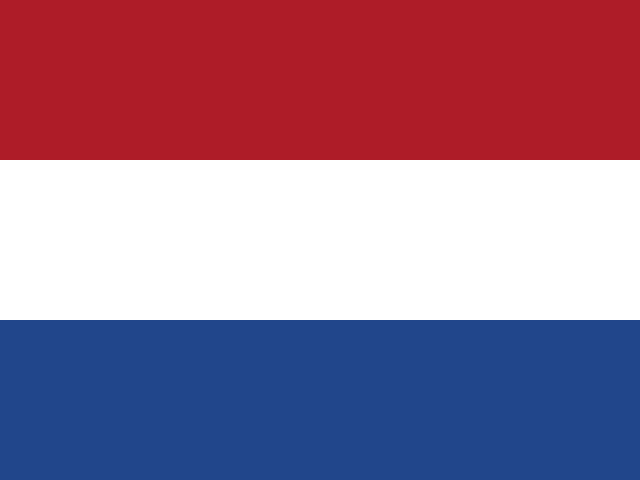
The Flag of Netherlands
Europe · Adopted 19 February 1937
The Dutch tricolor's red-white-blue horizontal bands were only legally fixed by royal decree on 19 February 1937, a surprisingly late official date for one of Europe's oldest continuously used flag traditions — the confusion in the centuries before that decree is itself the real story of this flag.
It began as orange, not red. During the Dutch Revolt against Spanish rule (1568–1648), rebels rallied under the Prinsenvlag, the 'Prince's Flag,' orange-white-blue, taking its orange from William of Orange, leader of the revolt and founder of the House of Orange-Nassau that still occupies the Dutch throne today. Orange dye in the 16th and 17th centuries was notoriously unstable, however, made from substances that faded toward red with sun exposure and repeated washing — a practical, unglamorous chemistry problem that gradually turned orange flags into red-looking ones simply through wear.
By around the 1630s, a distinct red-white-blue version, known as the Statenvlag or 'States Flag,' had emerged in parallel use, particularly favored by the Dutch navy and the States-General, the governing body of the Dutch Republic. For roughly two centuries afterward, both the orange and red versions were flown more or less interchangeably depending on region, occasion, and simple availability of dye, with no single legally fixed 'correct' version — a genuinely unusual state of affairs for a national flag by modern standards, where ambiguity of this kind is rare.
The 1937 decree existed specifically to end that ambiguity, and the political context mattered: in the 1930s the Dutch National Socialist Movement (NSB), a fascist party sympathetic to Nazi Germany, had taken to displaying the orange-white-blue Prinsenvlag alongside an orange lion emblem as one of its own political symbols. The Dutch government's decision to legally confirm red — not orange — as the correct flag color was made partly to draw a clear, unambiguous line between the constitutionally recognized state flag and the version being used by a fascist political movement, even though the orange version had a much longer documented pedigree.
Orange never disappeared from Dutch national identity, though; it simply moved off the flag and onto everything else. It remains the color of the royal House of Orange-Nassau, the near-universal color of Dutch national sports supporters, and the centerpiece of King's Day (Koningsdag) celebrations each April, when Dutch cities turn orange for a national holiday that has nothing to do with the flag's actual colors — a genuine split between the country's constitutional flag and its emotionally dominant national color that few other countries have quite so pronounced.
The Dutch tricolor is also historically significant well beyond its own borders: Tsar Peter the Great of Russia studied shipbuilding in the Netherlands in the late 17th century and, admiring the Dutch flag, based Russia's own red-white-blue tricolor on it, simply rearranging the color order — a direct, acknowledged design lineage that makes the Dutch flag a genuine ancestor of the Russian one, not merely a coincidental color match.
No further redesign has occurred since 1937. The Netherlands remains a constitutional monarchy, and the flag has stayed constant through the loss of most of its overseas colonial territories in the 20th century, including Indonesian independence in 1945–1949 and the independence of Suriname in 1975, changes that reshaped the kingdom's territory without prompting any change to the flag flown over the remaining Netherlands and its Caribbean constituent countries.
The Prinsenvlag's orange-white-blue design did not disappear entirely when the Dutch state settled on red — it traveled instead into other flags shaped by Dutch colonial and cultural influence. The flag of New York City is a direct descendant, its vertical orange-white-blue bands derived from the flag flown over the Dutch colonial settlement of New Amsterdam before the English renamed it New York in 1664. South Africa's national flag between 1928 and 1994 was likewise built on the orange-white-blue Prinsenvlag pattern, reflecting the historical influence of Dutch (Boer) settlement, and was retired specifically because of those associations when South Africa adopted its current post-apartheid flag.
Within the Netherlands itself, orange has never needed the flag to remain the country's dominant unofficial identity marker — Dutch sports fans, royal celebrations, and the national football team all lean on orange far more heavily in practice than the constitutionally correct red-white-blue tricolor, a split between the legal flag and the emotionally central color that the 1937 decree never fully resolved and, by most accounts, was never really trying to.
A small orange pennant is still occasionally flown above the tricolor on private homes on specific royal-family occasions, such as a birthday or graduation within the House of Orange-Nassau — an informal but genuinely widespread custom that keeps the historical Prinsenvlag color present in everyday Dutch flag etiquette even though it has no standing under the 1937 law defining the state flag itself.
Red on top, not orange
- Current-design flag — An orange-white-blue version of this flag exists and is a different historical banner, so the check on a listing is simply whether the top band is red.
As an Amazon Associate we earn from qualifying purchases made through these links, at no extra cost to you.
Often confused with
- Russia — uses the same red-white-blue palette by direct, documented influence — Peter the Great modeled Russia's tricolor on the Dutch flag he studied while learning shipbuilding — but reorders the stripes into a different sequence. Compare side by side →
- Luxembourg — uses a near-identical red-white-blue horizontal tricolor, distinguished mainly by a lighter shade of blue and a slightly different overall proportion rather than color order. Compare side by side →
Netherlands at a glance
- Capital
- Amsterdam
- Population
- 18.0 million (2024)
- Currency
- Euro (EUR)
- Language(s)
- Dutch (official); Frisian co-official in the province of Friesland
Population figure as of 2024, source: UN World Population Prospects (2024 revision). See methodology for how facts are sourced and kept current.