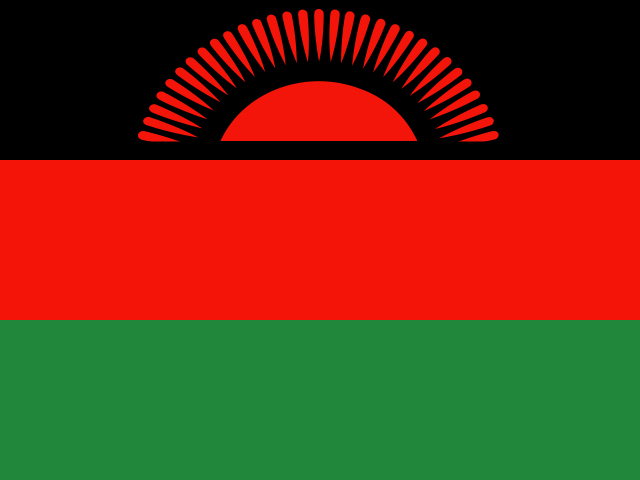
The Flag of Malawi
Africa · Adopted 6 July 1964 (rising sun redesigned 2010, reverted 2012)
Malawi's flag was adopted on 6 July 1964, the day the country — then still generally known by its colonial name, Nyasaland — became independent from Britain and renamed itself Malawi under its first president, Hastings Banda. The black-red-green horizontal tricolor with a rising red sun on the black band was designed for the Malawi Congress Party, the independence movement Banda led, and adopted wholesale as the new national flag, echoing the pattern seen elsewhere in Africa where an independence party's own banner became the state's.
The rising sun is the flag's most distinctive feature and represents the dawn of freedom for Malawi and for Africa more broadly — a deliberately continental as well as national symbol, tied to the wave of African independence movements sweeping the continent through the late 1950s and early 1960s of which Malawi's was part. It is depicted with 31 visible rays, rising from the horizon along the top edge of the black band.
The three colors follow black-red-green pan-African convention with country-specific meaning attached: the black band stands for the African people of Malawi; the middle red band commemorates those who died in the fight for freedom, a color choice Banda's government tied to the broader regional tradition of liberation symbolism even though Malawi's own transition to independence was comparatively peaceful next to some of its neighbors' armed struggles; and the bottom green band stands for the country's evergreen vegetation and fertile land, particularly relevant in a country whose economy has long depended heavily on agriculture, especially tobacco.
In 2010, President Bingu wa Mutharika's government controversially redesigned the flag, changing the rising red sun to a full white sun centered in the flag and moving it to the green band, arguing that Malawi's independence-era 'dawn' had already arrived and that a full sun better represented an economically developed, mature nation. The change was deeply unpopular, seen by critics as an unnecessary break with a nearly 50-year-old national symbol imposed without broad public consultation, and it became entangled with wider public discontent over Mutharika's increasingly authoritarian governance in his second term, which also saw a major diplomatic falling-out with Western donor governments and a severe fuel and foreign-currency shortage in the country.
Following Mutharika's sudden death in office in April 2012, his successor Joyce Banda — Malawi's first female president — moved quickly to restore the original 1964 flag, reverting the change within months of taking office, a rare example on the continent of a national flag being changed and then reverted within a two-year span, and one directly tied to a specific unpopular presidency rather than a broader shift in national symbolism.
Since 2012, Malawi's flag has remained the original 1964 black-red-green design with the rising red sun, and the brief 2010-2012 white-sun variant is now treated mainly as a footnote in the country's flag history rather than a lasting design change.
Malawi's economy remains among the most agriculture-dependent in southern Africa, with tobacco alone historically accounting for well over half of the country's export earnings in some years — a dependence that gives the flag's green band an unusually direct, ongoing economic weight rather than only a founding-era symbolic one, though government diversification efforts in the 2010s and 2020s have pushed to reduce reliance on the crop.
Hastings Banda, whose Malawi Congress Party banner became the 1964 flag, went on to rule as president for life from 1971 until multiparty elections finally ended his 30-year hold on power in 1994, a rule marked by a pervasive personality cult, strict censorship, and the suppression of political dissent through much of the Cold War era — a legacy that makes the flag's survival unchanged across both his authoritarian decades and the country's subsequent democratic transition a genuinely notable thread of continuity.
Malawi remains one of the poorest countries in the world by per-capita income, a fact that sits alongside the flag's yellow rising sun and its 1964 promise of a hopeful new dawn with an obvious tension that Malawian commentators and politicians have referenced in public debate for decades; the country has nonetheless maintained a comparatively strong record of peaceful multiparty transfers of power since 1994, including a landmark 2020 rerun election — ordered by Malawi's own courts after finding irregularities in the original 2019 vote, one of very few times an African court has annulled a sitting president's re-election — that removed incumbent Peter Mutharika from office.
The 2010 swap to a white sun was not a cosmetic tweak logged only in government gazettes — it forced a costly re-issue of flags on public buildings, police and military uniforms, government vehicles, and diplomatic missions abroad at a time when Malawi was already short on foreign currency, and opposition members of parliament boycotted debate on the enabling bill rather than accept it without amendment, arguing the government had bypassed the kind of broad public consultation a nearly half-century-old national symbol deserved. Reverting it in 2012 carried its own logistical cost, since every one of those white-sun flags and repainted emblems then had to be replaced a second time within two years.
Malawi's flag law fixes the ratio at 2:3 and specifies the sun's 31 rays individually rather than leaving the count to an artist's discretion, along with the exact black, red, and green shades used on government-issued flags — a level of legal precision that meant Mutharika's 2010 government had to amend the underlying flag statute itself, not just issue a new design, in order to make the white-sun version official, which is part of why its reversal in 2012 could also be accomplished through a comparatively quick legislative fix rather than a prolonged redesign process.
Counting the rising sun's rays
- High-resolution printed flag — The ray count is fixed rather than left to the artist, which makes it a check you can run on any flag you are sent: count the rays in the red band before you fly it.
As an Amazon Associate we earn from qualifying purchases made through these links, at no extra cost to you.
Often confused with
- Kenya — shares the black-red-green pan-African palette in horizontal bands, though Kenya's flag centers a Maasai shield and spears rather than Malawi's rising sun, making the two easy to place in the same color family but not to mistake for each other up close. Compare side by side →
Malawi at a glance
- Capital
- Lilongwe
- Population
- 21.7 million (2024)
- Currency
- Malawian Kwacha (MWK)
- Language(s)
- English and Chichewa (both official)
Population figure as of 2024, source: UN World Population Prospects (2024 revision). See methodology for how facts are sourced and kept current.